



الصفحة 1
الصفحة 1

Non-Covalent Multi-Porphyrin Assemblies : Synthesis and Properties
This book presents an overview of the synthesis, structure, and properties of molecules obtained by connecting several porphyrins or metalloporphyrins through a variety of chemical linkages. This handsomely produced book gives the reader a broad introduction to this popular and important field. Much of the work encompassed in this area is inspired by the desire to obtain photochemically responsive molecules capable of mimicking various aspects of photosynthesis… As with many edited volumes of this type, there is a certain amount of duplicate coverage of some topics. Also the focus is largely on the methods used to generate the multiporphyrin arrays, and in some cases less attention is given to the properties, other than the structural properties of these arrays.

Neodymium Based Ziegler Catalysts - Fundamental Chemistry
In this volume we try to review the available literature by two independentapproaches to Nd and Ln-catalyzed diene polymerizations. In the first part ofthe volume, which is entitled “Neodymium-Based Ziegler/Natta Catalysts andtheir Application in Diene Polymerization”, a polymer chemist’s view is givenwith strong emphasis on Nd-based catalyst systems. Also technological andindustrial aspects of Nd-catalyzed diene polymerizations are addressed. In thesecond part of the volume, which is entitled “Rare-Earth Metals and AluminumGetting Close in Ziegler-type Organometallics”, a more organometallic per-spective is given and Ln-based catalyst systems are addressed. By the synopsisof these different perspectives, the reader will comprehend the complexity ofLn-based Ziegler catalyst systems and their application to the polymerizationof dienes.
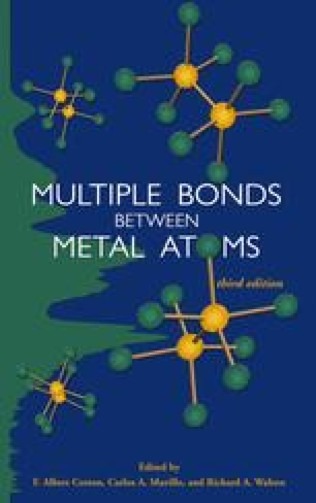
Multiple Bonds between Metal Atoms
The 3rd edition of the Multiple Bonds between Metal Atoms deals with one of the most active fields of inorganic chemistry … . It presents an extensive, critical review and discussion of preparations, reactions, bonding, and physical properties of more than 4000 compounds … heartily recommend it to inorganic and materials chemists, and to all scientists concerned with the synthesis, spectroscopy, and structures of transition-metal compounds. It also belongs in academic, industrial, and government research libraries.

Molecular Wires : From Design to Properties
In the emerging field of nanoscience the desire to construct objects which in the molecular scale can resemble and act as macroscopic devices is a constant trend. Amongst the simplest but also most attractive functional component molecular wires are surely the most investigated. The reason for such interest is quite obvious since wires, in today world, are used all around us and are the most indispensable unit to assemble any type of electronic devices.In this issue the synthesis and characterization of molecular wires based on organic or metal complexes components, their properties and some theoretical background will be illustrated.

Molecular microbiology of heavy metals
Molecular Microbiology of Heavy Metals includes chapters on allocation of metals in cells, metal transporter, storage and metalloregulatory proteins, cellular responses to metal ion stress, transcription of genes involved in metal ion homeostasis, uptake of essential metals, metal efflux and other detoxification mechanisms. Also discussed are metal bioreporters for the nanomolar range of concentration and tools to address the metallome. Chapters in the second part cover specific metals such as Fe, Mn, Cu, Ni, Co, Zn and Mo as key nutrient elements and Ag, As, Cd, Hg and Cr as toxic elements.

Molecular Biology of Metal Homeostasis and Detoxification : From Microbes to Man
One of the challenges faced by every cell as well as by whole organisms is to maintain appropriate concentrations of essential nutrient metals while excluding nonessential toxic metals. Toward that end, all organisms have developed mechanisms for metal homeostasis and detoxification to maintain metal levels within physiological limits. This book brings together current knowledge of the molecular basis of metal homeostasis and detoxification in various eukaryotic model systems, including yeasts, plants, and mammals. It focuses on the cellular systems controlling metal transport, intracellular distribution, and immobilization as well as on systems regulating metal-dependent transcription. In addition to environmental aspects (including phytoremediation), the book treats the pathophysiology of metal deficiency and overload in relation to disease.
Modern Aspects of Electrochemistry ; Vol. 42
MODERN ASPECTS OF ELECTROCHEMISTRY No. 42 Edited by Constantinos Vayenas University of Patras, Greece Topics in Number 42 include: The electrochemistry and electrocatalysis of Ruthenium in regards to the development of electrodes for Polymer Electrolyte Membrane (PEM) fuel cells Breakthroughs in Solid Oxide Fuel Cell (SOFC) anodes and cathodes leading to improved electrocatalysis Electrocatalysis of the electrochemical reduction of CO2 on numerous metals The interfacial phenomena of electrodeposition and codeposition, and the need for new theoretical analyses of the electrode-electrolyte interface Advantages of scanning tunneling microscopy (STM) in understanding the basics of catalysis, electrocatalysis and electrodeposition The role of electrochemistry in emerging technologies including electrodeposition and electroforming at the micro and nano levels, semiconductor and information storage, including magnetic storage devices.

Modern Aspects of Electrochemistry ; Vol. 38
Solid State Electrochemistry encompassing modern equilibria concepts, thermodymanics and kinetics of charge carriers in solids.,Electron transfer processes, with special sections devoted to hydration of the proton and its heterogeneous transfer.Electrosorption at electrodes and its relevance to electrocatalysis and electrodeposition of metals,The behavior of Pt and other alloy electrocatalyst crystallites used as the electrode materials for phosphoric acid electrolyte fuel-cells.Applications of reflexology and electron microscopy to the materials science aspect of metal electrodes.Electroplating of metal matrix composites by codeposition of suspended particles, a process that has improved physical and electrochemical properties.

Microstructuring of Glasses
As microstructured glass becomes increasingly important for microsystems technology, the main application fields include micro-fluidic systems, micro-analysis systems, sensors, micro-actuators and implants. And, because glass has quite distinct properties from silicon, PMMA and metals, applications exist where only glass devices meet the requirements. The main advantages of glass derive from its amorphous nature, the precondition for its - theoretically - direction-independent geometric structurability. Microstructuring of Glasses deals with the amorphous state, various glass compositions and their properties, the interactions between glasses and the electromagnetic waves used to modify it.

Microorganisms in the deterioration and preservation of cultural heritage
This book offers a comprehensive overview of the role and potential of microorganisms in the degradation and preservation of cultural materials (e.g. stone, metals, graphic documents, textiles, paintings, glass, etc.).

Micromechanics and Nanosimulation of Metals and Composites : Advanced Methods and Theoretical Concepts
This book provides insight into advanced numerical and experimental investigations of the microstructural aspects of strength and damage of metals and metal-based composites. In particular, atomistic and dislocation models, micromechanical simulations and homogenization techniques, as well as experimental observations in combination with computer simulations, are described. These methods are successfully applied to analyze the mechanical behavior of metals and metal-matrix composites.

Microbial Processing of Metal Sulfides
The application of microbiological methods to the extraction of metals from minerals has definitely gained a prominent role and is supported by the several bioleaching and biooxidation processes operating in different sites over the world. In recent years new techniques and new results about proteomic and bioinformatics are bringing a new perspective on the microbial processes.This book focuses on the basic aspects of the process with special emphasis on recent contributions regarding the chemical and microbial aspects of the bioleaching process and the use of microorganisms in the treatment of complex ores and concentrates.

Micro- and Macro-Properties of Solids : Thermal, Mechanical and Dielectric Properties
Each of the eight chapters treats an important aspect of solid state physics, comprising a complete review of the particular field. Typically, a chapter starts with basic information about a property of a solid and the related experimental techniques. This is followed by a global overview which brings together all important contributions by different research workers in the field. This overview is comprehensive and covers essential literature over the past 60 years. Each chapter concludes with a detailed discussion of the contributions made by the chapter authors and their associates, in some cases spanning the last 45 years. In addition, Micro- and Macro-Properties of Solids provides data on new materials such as rare-earth metals, semiconductors, ferroelectrics, mixed-valence compounds, superionic conductors, optical and optoelectronic materials and biomaterials.

Metals in Society and in the Environment : A Critical Review of Current Knowledge on Fluxes, Speciation, Bioavailability and Risk for Adverse Effects of Copper, Chromium, Nickel and Zinc
In 2002, the Swedish Metal Information Task Force (MITF) engaged the Environmental Research Group (MFG) to update previous monographs on copper, zinc and major alloying metals (such as chromium, nickel and molybdenum) in society and in the environment. This book presents new results on metal fluxes from society to the environment, on metal speciation in water, soil and sediment, and its interpretation in terms of mobility, biological uptake and toxicity. The scientific fundamentals of new approaches, like the Acid Volatile Sulphide (AVS) concept to predict metal bioavailability in sediments, and the Biotic Ligand Model (BLM) to calculate the toxicity of metals to aquatic organisms, are critically evaluated, with a focus on copper, nickel, zinc, and, in part, chromium.

Metal-containing molecules and nanomaterials : from diagnosis to therapy
Since the discovery and successful deployment of salvarsan to treat syphilis, as well as cisplatin as a cancer drug, the field of metallodrugs has been flourishing. In addition to therapeutic applications, metals and metal-containing molecules have properties, such as an electrochemical or an optical signal, used to diagnose biologically relevant molecules or unravel cellular metabolism. Metals are part of the essential elements for life, and of increased attention in nutraceuticals. Most of the current diagnosis processes, therapeutics and nutraceuticals are based on organic molecules. MILS-26 reviews the most recent metal-containing molecules and nanomaterials for diagnosis and therapy

Metal-Catalysed Reactions of Hydrocarbons
This unique book, drawing on the author’s lifetime experience, critically evaluates the extensive literature on the field of Metal-Catalysed Reactions of Hydrocarbons. Emphasis is placed on reaction mechanisms involving hydrogenation, hydrogenolysis, skeletal and positional isomerisation, and exchange reactions. The motivation for fundamental research in heterogeneous catalysis is to identify the physicochemical characteristics of active centres for the reaction being studied, to learn how these may be modified or manipulated to improve the desired behavior of the catalyst, and to recognize and control those aspects of the catalyst's structure that limit its overall performance. By restricting the subject of the book to hydrocarbons, Bond has progressively developed the subject matter to include areas of importance both to researchers and to those working in the industry.

Metal Catalyzed Reductive C-C Bond Formation : A Departure from Preformed Organometallic Reagents
The prototypical catalytic reductive C–C bond formations, the Fischer-Tropsch reaction [1] and alkene hydroformylation [2], were discovered in 1922 and 1938, respectively [3,4]. These processes, which involve reductive coupling to carbon monoxide, have long been applied to the industrial manufacture of commodity chemicals [5]. Notably, alkene hydroformylation, also known as the oxo-synthesis, has emerged as the largest volume application of homogeneous metal catalysis, accounting for the production of over 7 million metrictons of aldehyde annually. Despite the impact of these prototypical reductive C–C bond formations, this field of research lay fallow for several decades.

Metal Catalyzed Cascade Reactions
Transition metal-catalyzed cascade reactions are an elegant approach to complex molecular scaffolds. Besides their esthetics and increase in structural complexity, they have also become mechanistic challenges for the combination of organometallic elementary steps. As a consequence, cascade reactions have revolutionized synthetic strategies and conceptual thinking. The authors highlight cyclization via carbopalladation and acylpalladation and Heck-pericyclic sequences. They discuss p-allyl palladium-based cascade reactions, Michael-type additions as an entry to transition-metal-promoted cyclizative transformations, and sequential or consecutive palladium-catalyzed processes, and show Pauson-Khand cascades, metal-catalyzed cyclizations of acyclic precursors, as well as cascade and sequential ruthenium-catalyzed transformations. Therefore, the reader finds overview of an exciting and highly dynamic field of a new and innovative methodological concept

Mechanochemistry in Nanoscience and Minerals Engineering
Mechanochemistry as a branch of solid state chemistry enquires into processes which proceed in solids due to the application of mechanical energy. This provides a thorough, up to date overview of mechanochemistry of solids and minerals. Applications of mechanochemistry in nanoscience with special impact on nanogeoscience are described. Selected advanced identification methods, most frequently applied in nanoscience, are described as well as the advantage of mechanochemical approach in minerals engineering. Examples of industrial applications are given. Mechanochemical technology is being applied in many industrial fields: powder metallurgy (synthesis of nanometals, alloys and nanocompounds), building industry (activation of cements), chemical industry (solid waste treatment, catalyst synthesis, coal ashes utilization), minerals engineering (ore enrichment, enhancement of processes of extractive metallurgy), agriculture industry (solubility increase of fertilizers), and pharmaceutical industry (improvement of solubility and bioavailability of drugs).

Mechanical Behaviour of Engineering Materials : Metals, Ceramics, Polymers, and Composites
How do engineering materials deform when bearing mechanical loads? To answer this crucial question, the book bridges the gap between continuum mechanics and materials science. The different kinds of material deformation (elasticity, plasticity, fracture, creep, fatigue) are explained in detail. The book also discusses the physical processes occurring during the deformation of all classes of engineering materials (metals, ceramics, polymers, and composites) and shows how these materials can be strengthened to meet the design requirements. It provides the knowledge needed in selecting the appropriate engineering material for a certain design problem. The reader will thus learn how to critically employ design rules and thus to avoid failure of mechanical components.
