



الصفحة 1
الصفحة 1
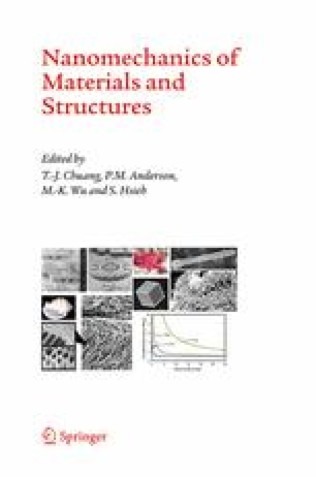
Nanomechanics of Materials and Structures
This book is derived from the proceedings of the International Workshop on Nanomechanics held at Asilomar Conference Grounds in Pacific Grove, California on July 14-17, 2004. The main objective was to convene leading researchers in the nanotechnology community to assess the current state-of-the-art and disseminate recent progress, critical issues, barriers to applications, and directions for future research in nanomechanics.

Micromechanics and Nanosimulation of Metals and Composites : Advanced Methods and Theoretical Concepts
This book provides insight into advanced numerical and experimental investigations of the microstructural aspects of strength and damage of metals and metal-based composites. In particular, atomistic and dislocation models, micromechanical simulations and homogenization techniques, as well as experimental observations in combination with computer simulations, are described. These methods are successfully applied to analyze the mechanical behavior of metals and metal-matrix composites.

Mechanics of Materials
Provides a precise presentation of subjects illustrated with numerous engineering examples that students both understand and relate to theory and application. The tried and true methodology for presenting material gives students the best opportunity to succeed in this course. From the detailed examples, to the homework problems, instructors and students can be confident the material is clearly explained and accurately represented.
Mechanics of Materials
Provides a review of statics, covering the topics needed to begin the study of mechanics of materials including free-body diagrams, equilibrium, trusses, frames, centroids, and distributed loads. It presents the foundations and applications of mechanics of materials with emphasis on visual analysis, using sequences of figures to explain concepts and giving detailed explanations of the proper use of free-body diagrams. The Cauchy tetrahedron argument is included, which allows determination of the normal and shear stresses on an arbitrary plane for a general state of stress. An optional chapter discusses failure and modern fracture theory, including stress intensity factors and crack growth.

Mechanics and Strength of Materials
This treatise contains topics on Solid Mechanics, the Theory of Slender Members and an Introduction to the Theory of Structures, usually taught in the disciplines of Strength of Materials of most Engineering courses, such as Civil, Mechanical and Aeronautical Engineering.

Engineering mechanics 2 : Strength of materials : An introduction with many examples
Provides students with a clear introduction and to enable them to formulate and solve engineering problems in this field. For this purpose, the book provides a number of examples. The Contents : Introduction to linear elasticity – Plane stress state – Bars – Beams – Beam deflections – Shear stresses in beams – Torsion – Energy methods – Buckling of bars
Continuum Mechanics
This book presents an introduction into the entire science of Continuum Mechanics in three parts. PART I: Continuum Mechanics introduces into the Foundations using tensors in Cartesian coordinate systems, classical theory of elasticity, and fluid mechanics. PART II: Mechanics of Materials has chapters on viscoelasticity, plasticity, principles of constitutive modelling, and thermodynamics. PART III presents Tensor Analysis and fundamental equations of Continuum Mechanics in curvilinear coordinates.
Advances in Mechanics of Materials for Environmental and Civil Engineering
Deals with both mathematical modeling and experimental studies related to systems relevant for various civil engineering fields. The book addresses several key topics, including artificial intelligence applied to the control and monitoring of construction site personnel, finite element models for endplate beam-to-column connections under various load conditions, random functionally graded micropolar beams, and many others. The book explores the design and study of microstructures aimed at increasing the toughness and durability of novel materials in building and construction, based also on the re-utilization of residues and wastes of metallurgical industry produces.
