



الصفحة 1
الصفحة 1
Open Quantum Systems II : The Markovian Approach
These books present in a self-contained way the mathematical theories involved in the modeling of such phenomena. They describe physically relevant models, develop their mathematical analysis and derive their physical implications. Volume II is dedicated to the Markovian formalism of classical and quantum open systems. A complete exposition of noise theory, Markov processes and stochastic differential equations, both in the classical and the quantum context, is provided. These mathematical tools are put into perspective with physical motivations and applications.
Open Quantum Systems I : The Hamiltonian Approach
These books present in a self-contained way the mathematical theories involved in the modeling of such phenomena. They describe physically relevant models, develop their mathematical analysis and derive their physical implications. This Volume, I the Hamiltonian description of quantum open systems is discussed. This includes an introduction to quantum statistical mechanics and its operator algebraic formulation, modular theory, spectral analysis and their applications to quantum dynamical systems.

Online Storage Systems and Transportation Problems with Applications : Optimization Models and Mathematical Solutions
This books covers the analysis and development of online algorithms involving exact optimization and heuristic techniques, and their application to solve two real life problems. The first problem is concerned with a complex technical system: a special carousel based high-speed storage system - Rotastore. It is shown that this logistic problem leads to an NP-hard Batch PreSorting problem which is not easy to solve optimally in offline situations. The second problem originates in the health sector and leads to a vehicle routing problem. Reasonable solutions for the offline case covering a whole day with a few hundred orders are constructed with a heuristic approach, as well as by simulated annealing. Optimal solutions for typical online instances are computed by an efficient column enumeration approach leading to a set partitioning problem and a set of routing-scheduling subproblems. The latter are solved exactly with a branch-and-bound method which prunes nodes if they are value-dominated by previous found solutions or if they are infeasible with respect to the capacity or temporal constraints.
On the Topology of Isolated Singularities in Analytic Spaces
The aim of this book is to give an overview of selected topics on the topology of real and complex isolated singularities, with emphasis on its relations to other branches of geometry and topology. The first chapters are mostly devoted to complex singularities and a myriad of results spread in a vast literature, which are presented here in a unified way, accessible to non-specialists. Among the topics are the fibration theorems of Milnor; the relation with 3-dimensional Lie groups; exotic spheres; spin structures and 3-manifold invariants; the geometry of quadrics and Arnold's theorem which states that the complex projective plane modulo conjugation is the 4-sphere. The second part of the book studies pioneer work about real analytic singularities which arise from the topological and geometric study of holomorphic vector fields and foliations. In the low dimensional case these turn out to be related to fibred links in the 3-sphere defined by meromorphic functions. This provides new methods for constructing manifolds equipped with a rich geometry.

Official Statistics 4.0 : Verified Facts for People in the 21st Century
Explores official statistics and their social function in modern societies. Digitisation and globalisation are creating completely new opportunities and risks, a context in which facts (can) play an enormously important part if they are produced with a quality that makes them credible and purpose-specific. In order for this to actually happen, official statistics must continue to actively pursue the modernisation of their working methods.

Numerical Treatment of Partial Differential Equations
In 1988 we started work on the frst German edition of our book, which appeared in 1992. Our aim was to give students a textbook that contained the basic concepts and ideas behind most numerical methods for partial di?er- tial equations. The success of this frst edition and the second edition in 1994 encouraged us, ten years later, to write an almost completely new version, taking into account comments from colleagues and students and drawing on the enormous progress made in the numerical analysis of partial di?erential equations in recent times. The present English version slightly improves the third German edition of 2005: we have corrected some minor errors and added additional material and references.

Numerical Techniques for Chemical and Biological Engineers Using MATLAB® : A Simple Bifurcation Approach
This book addresses the bifurcation characteristics of chemical and biological processes as the general case and treats systems with a unique steady state as special cases. It uses a system approach which is the most efficient for knowledge organization and transfer. The book develops mathematical models for many commercial processes utilizing the mass-, momentum-, and heat-balance equations coupled to the rates of the processes that take place within the boundaries of the system. The models are solved numerically through MATLAB codes with emphasis on the design and optimization of the chemical and biological industrial equipment and plants.

Numerical solution of Variational Inequalities by Adaptive Finite Elements
Franz-Theo Suttmeier describes a general approach to a posteriori error estimation and adaptive mesh design for finite element models where the solution is subjected to inequality constraints. This is an extension to variational inequalities of the so-called Dual-Weighted-Residual method (DWR method) which is based on a variational formulation of the problem and uses global duality arguments for deriving weighted a posteriori error estimates with respect to arbitrary functionals of the error. In these estimates local residuals of the computed solution are multiplied by sensitivity factors which are obtained from a numerically computed dual solution. The resulting local error indicators are used in a feed-back process for generating economical meshes which are tailored according to the particular goal of the computation.
Numerical Solution of Partial Differential Equations on Parallel Computers
The scientific fields of Ma- ematics and Physics provide a powerful vehicle for such descriptions in terms of Partial Differential Equations (PDEs). Formulated as such equations, physical laws can become subject to computational and analytical studies. In the computational setting, the equations can be discreti ed for ef?cient solution on a computer, leading to valuable tools for simulation of natural and man-made processes. Numerical so- tion of PDE-based mathematical models has been an important research topic over centuries, and will remain so for centuries to come. In the context of computer-based simulations, the quality of the computed results is directly connected to the model’s complexity and the number of data points used for the computations. Therefore, computational scientists tend to ?ll even the largest and most powerful computers they can get access to, either by increasing the si e of the data sets, or by introducing new model terms that make the simulations more realistic, or a combination of both. Today, many important simulation problems can not be solved by one single computer, but calls for parallel computing.
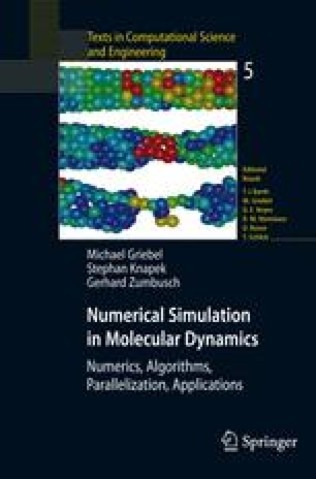
Numerical Simulation in Molecular Dynamics : Numerics, Algorithms, Parallelization, Applications
Particle models play an important role in many applications in physics, chemistry and biology. They can be studied on the computer with the help of molecular dynamics simulations. This book presents in detail both the necessary numerical methods and techniques (linked-cell method, SPME-method, tree codes, multipole technique) and the theoretical background and foundations. It illustrates the aspects modelling, discretization, algorithms and their parallel implementation with MPI on computer systems with distributed memory. Furthermore, detailed explanations are given to the different steps of numerical simulation, and code examples are provided.

Numerical Optimization : Theoretical and Practical Aspects
This book starts with illustrations of the ubiquitous character of optimization, and describes numerical algorithms in a tutorial way. It covers fundamental algorithms as well as more specialized and advanced topics for unconstrained and constrained problems. Most of the algorithms are explained in a detailed manner, allowing straightforward implementation. Theoretical aspects of the approaches chosen are also addressed with care, often using minimal assumptions. It's contains computational exercises in the form of case studies which help understanding optimization methods beyond their theoretical, description, when coming to actual implementation. Besides, the nonsmooth optimization part has been substantially reorganized and expanded.

Numerical Optimization
Numerical Optimization presents a comprehensive and up-to-date description of the most effective methods in continuous optimization. It responds to the growing interest in optimization in engineering, science, and business by focusing on the methods that are best suited to practical problems.The book has been thoroughly updated throughout. There are new chapters on nonlinear interior methods and derivative-free methods for optimization, both of which are used widely in practice and the focus of much current research. Because of the emphasis on practical methods, as well as the extensive illustrations and exercises.
Numerical Methods for Laplace Transform Inversion
Operational methods have been used for over a century to solve many problems—for example, ordinary and partial differential equations. In many problems it is fairly easy to obtain the Laplace transform, but it can be very demanding to determine the inverse Laplace transform that is the solution of the given problem. Sometimes, after some difficult contour integration, we find that a series solution results, but even this may be quite difficult to evaluate in order to get an answer at a particular time value.

Numerical Methods for General and Structured Eigenvalue Problems
The purpose of this book is to describe recent developments in solving eig- value problems, in particular with respect to the QR and QZ algorithms as well as structured matrices. Outline Mathematically speaking, the eigenvalues of a square matrix A are the roots of its characteristic polynomial det(A??I). An invariant subspace is a linear subspace that stays invariant under the action of A. In realistic applications, it usually takes a long process of simpli?cations, linearizations and discreti- tions before one comes up with the problem of computing the eigenvalues of a matrix. In some cases, the eigenvalues have an intrinsic meaning, e.g., for the expected long-time behavior of a dynamical system; in others they are just meaningless intermediate values of a computational method. The same applies to invariant subspaces, which for example can describe sets of initial states for which a dynamical system produces exponentially decaying states. Computing eigenvalues has a long history, dating back to at least 1846 when Jacobi [172] wrote his famous paper on solving symmetric eigenvalue problems. Detailed historical accounts of this subject can be found in two papers by Golub and van der Vorst [140, 327].
Numerical Methods for Controlled Stochastic Delay Systems
The Markov chain approximation methods are widely used for the numerical solution of nonlinear stochastic control problems in continuous time. This book extends the methods to stochastic systems with delays. Because such problems are infinite-dimensional, many new issues arise in getting good numerical approximations and in the convergence proofs. Useful forms of numerical algorithms and system approximations are developed in this work, and the convergence proofs are given. All of the usual cost functions are treated as well as singular and impulsive controls. A major concern is on representations and approximations that use minimal memory.

Numerical Mathematics and Advanced Applications ENUMATH 2019 ; European Conference, Egmond aan Zee, The Netherlands, September 30 - October 4
It contians basic aspects and new trends in numerical mathematics and scientific and industrial applications, all examined at the highest level of international expertise.
Numerical Mathematics and Advanced Applications ; Proceedings of ENUMATH 2007, the 7th European Conference on Numerical Mathematics and Advanced Applications, Graz, Austria, September 2007
The European Conference on Numerical Mathematics and Advanced Applications (ENUMATH) is a series of meetings held every two years to provide a forum for discussion on recent aspects of numerical mathematics and their applications. These proceedings contain a selection of invited plenary lectures, papers presented in minisymposia and contributed papers. Topics include theoretical aspects of new numerical techniques and algorithms as well as of applications in engineering and science. The book will be useful for a wide range of readers, giving them an excellent overview of the most modern methods, techniques, algorithms and results in numerical mathematics, scientific computing and their applications.

Numerical Mathematics and Advanced Applications ; Proceedings of ENUMATH 2005 the 6th European Conference on Numerical Mathematics and Advanced Applications, Santiago de Compostela, Spain, July 2005
This book include applications such as atmosphere and ocean, water pollution, electromagnetism, interface problems, waves, finance, heat transfer, unbounded domains, numerical linear algebra, convection-diffusion, fluid-structure, plates, solids, hyperbolic equations, multiphase flow, Navier-Stokes, singular perturbation problems, non linear PDE, control, parabolic equations, as well as methodologies such as a posteriori error estimates, discontinuous Galerkin methods, multiscale methods, optimization, adaptive methods, domain decomposition techniques, exponential integrators, hp-finite elements, level set methods, fractional step methods, penalty procedures, and finite volumes. The book gives an extensive overview of the most recent research in scientific computing, providing to the reader the latest developments concerning the mathematical issues and the applications of this active field of science.

Numerical Mathematics
Numerical mathematics is the branch of mathematics that proposes, develops, analyzes and applies methods from scientific computing to several fields including analysis, linear algebra, geometry, approximation theory, functional equations, optimization and differential equations. Other disciplines, such as physics, the natural and biological sciences, engineering, and economics and the financial sciences frequently give rise to problems that need scientific computing for their solutions. As such, numerical mathematics is the crossroad of several disciplines of great relevance in modern applied sciences, and can become a crucial tool for their qualitative and quantitative analysis.

Numerical Linear Algebra
This book brings together linear algebra, numerical methods and an easy to use programming environment under Matlab (or Scilab). One of the key features of the book are the worked out examples and exercises at the end of each chapter. The reader is asked to do some numerical experiments in Matlab and then to prove the results theoretically. The book is a combination and update of two earlier French books by the authors. It is appropriate for both undergraduate and beginning graduate courses in mathematics as well as for working scientists and engineers as a self-study tool and reference.This book is about numerical linear algebra and focuses on practical algorithms for solving computer problems of linear algebra.
