



الصفحة 1
الصفحة 1
Numeri e Crittografia
Number Theory is one of the most classic fields of Mathematics. The numbers he deals with are those that are called natural 0, 1, 2, ... and that we use since childhood to count. Seemingly simple and harmless, they nevertheless hide some of the most difficult and exciting mysteries of the whole of mathematics. Cryptography, on the other hand, is concerned with hiding the content of confidential communications from prying eyes and corresponds to widespread needs in our society. The Theory of Numbers can help Cryptography in these needs, thanks to the mysteries that still surround it. The text gives an account of this link. It first introduces Modern Cryptography, its goals and priorities. He then goes on to expose arguments of Number Theory, with particular reference to the two problems of recognizing prime numbers, and of decomposing a natural into its prime factors; for each of the two issues it provides a vast panorama of the algorithms that deal with it and try to solve it as effectively as possible. In particular, it presents the very recent AKS procedure for recognizing prime numbers. The book then returns to Cryptography and shows how ideas and methods of Number Theory apply to the construction of reliable procedures for the secure transmission of confidential information.
Multiphase Flow Dynamics 3 : Turbulence, Gas Absorption and Release, Diesel Fuel Properties
Volume 3 is devoted to selected Chapters of the multiphase fluid dynamics that are important for practical applications. The state of the art of the turbulence modeling in multiphase flows is presented. As introduction, some basics of the single-phase boundary layer theory including some important scales and flow oscillation characteristics in pipes and rod bundles are presented. Then the scales characterizing the dispersed flow systems are presented. The description of the turbulence is provided at different level of complexity: simple algebraic models for eddy viscosity, algebraic models based on the Boussinesq hypothesis, modification of the boundary layer share due to modification of the bulk turbulence, modification of the boundary layer share due to nucleate boiling. Then the role of the following forces on the matematical description of turbulent flows is discussed: the lift force, the lubrication force in the wall boundary layer, and the dispersion force.

Modelli Matematici in Biologia = Mathematical Models in Biology
This text is addressed first of all to the students of the Specialist Degrees in Biology of the Universities, but it will also be of interest to students of Natural Sciences and Medicine. The topics covered include the most classic mathematical models of biological phenomena (population dynamics, spread of infectious diseases, simple physiology models), but a relevant part of the text is dedicated to the mathematical approach to the theory of natural evolution. The only prerequisites required of the reader are those provided by the basic courses of Mathematics of the Bachelor's Degree in Biology, Natural Sciences or Medicine.
Introduzione al Calcolo Scientifico : Esercizi e problemi risolti con MATLAB = Introduction to scientific computing : Exercises and problem solved with MATLAB
Introduces the fundamental concepts for the numerical modeling of partial differential problems. We consider the classic linear elliptic, parabolic and hyperbolic equations, but also other equations, such as those of diffusion and transport, of Navier-Stokes, and the conservation laws. Numerous physical examples underlying these equations are provided, their main mathematical properties are studied, then numerical resolution methods based on finite elements, finite differences, finite volumes and spectral methods are proposed and analyzed. In particular, the algorithmic and computer implementation aspects are discussed and some easy-to-use programs in C ++ language are provided. The text does not presuppose an advanced mathematical knowledge of partial differential equations: the strictly indispensable concepts in this regard are reported in the Appendix. THE VOLUME is therefore suitable for students of scientific degree courses (Engineering, Mathematics, Physics, Chemistry, Information Sciences) and recommended for researchers from the academic and extra-academic world who want to approach this interesting branch of applied mathematics.

I numeri nel cuore = Numbers in the heart
An extremely varied gallery of ironic reflections on the academic world, of mild anecdotes, of calm provocations, of travel notes, of portraits of famous mathematicians, suspended between joke and seriousness, between dream and reality. Two exquisite fantasies by Arthur Porges and Arthur Koestler open the collection, followed by short stories written by professional mathematicians, who have literature as a hobby, inspired by characters and facts, emotions and fantasies related to the world of mathematics.

Fabbriche, sistemi, organizzazioni : Storia dell'ingegneria industriale = Factories, systems, organizations : A history of industrial engineering
This book examines the origin of the technological and organizational challenges of industry in Europe and the United States and the stages of its theoretical formulation; the creation of the figure of the industrial engineer between the nineteenth and twentieth centuries; and the elaboration of the technological disciplines and of the language and of the fundamental concepts (system, automation, control, optimization, network) of modern industrial engineering. Divided into three chronologically organized parts, each chapter is accompanied by readings, bibliographic information for in-depth study and illustrative sheets of historical, biographical aspects (relating to some great engineers, scientists and philosophers), terminological and mathematical-technical aspects.

Esercizi di finanza matematica = Mathematical finance exercises
This is a collection of exercises that illustrates some fundamental aspects of Mathematical Finance, in particular the valuation of derivatives. It is aimed at students of master's degree courses, but can also be successfully used in first level degree courses, by students who have adequate mathematical training (degree courses in mathematics, engineering). The resolution of the exercises is addressed with the use of methods of both Probability Theory (stochastic processes) and Mathematical Analysis (Partial Derivative Equations).

Equazioni a derivate parzial I : Complementi ed esercizi
La presente raccolta di problemi ed esercizi nasce dall'esperienza maturata durante il corso di Equazioni a Derivate Parziali (EDP), tenuto nell'ambito delle lauree di primo e secondo livello presso il Politecnico di Milano. Il volume è diviso in due parti; nei primi quattro capitoli l'obiettivo è l'uso di tecniche classiche, come la separazione delle variabili, il principio di massimo o le trasformate di Laplace e Fourier, per risolvere problemi di diffusione, trasporto e vibrazione. Il quinto capitolo invita a familiarizzare con i risultati di base negli spazi di Hilbert, nella teoria delle distribuzioni (o funzioni generalizzate) di Schwartz e in quella degli spazi di Sobolev più comuni. Il sesto ed ultimo capitolo riguarda la formulazione variazionale o debole dei più importanti problemi iniziali e/o al bordo per equazioni ellittiche e di evoluzione. L'introduzione ad ogni capitolo contiene una sintesi degli strumenti teorici più utilizzati.

Difficoltà in matematica : Osservare, interpretare, intervenire = Difficulty in mathematics : Observe, interpret, intervene
In a school context, difficulties in mathematics are an important phenomenon both for its diffusion and for the consequences it has at various levels: from the personal distress experienced by many students, to the negative attitude that large sections of the population build towards our discipline, up to the drop in enrollment in scientific degree courses. Faced with these difficulties, which often manifest themselves in behaviors such as giving up trying or responding at random, the didactic action aimed at recovery is generally a local action, which arises from the identification of errors and then intervenes on knowledge deemed necessary to respond correctly. But this type of intervention generally proves to be unsuccessful, and the teacher - together with the pupil - develops a sense of helplessness and frustration.
Matematica si parte! : Nozioni di base ed esercizi per il primo anno di Ingegneria = Mathematics, let's go! : Basics and exercises for the first year of Engineering
This manual has been created to allow future engineering students to successfully face their studies. Some basic concepts in mathematics are presented, generally already learned before entering the University. It has been found that not all students have a complete mastery of this set of fundamental notions: therefore this manual provides useful support, in the form of both exercises and theoretical notions. The future student will be able to choose the chapters that interest him most, in order to verify his ability to solve problems such as "Review problems", using his own reasoning skills and knowledge.
Matematica generale con il calcolatore
By introducing mathematical objects, it teaches students how to use a computer to perform numerical and symbolic calculations, define a function and calculate its values, plot and explore graphs, and execute simple algorithms. The course is rich in examples, applications, and models, drawn from economics, physics, biology, statistics, and mathematics itself. The analysis of these models constitutes, in a certain sense, the true purpose of the mathematical theory covered. Automatic calculation tools (mathematics software, spreadsheets) are used extensively to explore and illustrate concepts and properties. Mathcad® software, in particular, was used, both as a calculation tool and as a simple yet powerful programming language. Considerable space is devoted to approximation, emphasizing the distinction between numerical and symbolic calculation; to algorithms as a synthesis of the syntactic and semantic aspects of mathematical objects; and to computer simulation, interpreted as a "physical" experiment and a source of conjecture. The ability to use a calculator marks a sort of "democratization" of mathematics: even complex results, which have always required a broad background of knowledge and laborious calculations, are now quickly accessible to anyone who understands the meaning of mathematical objects and knows how to use the syntax.

Matematica e cultura in Europa
Non è vero che la matematica susciti sempre poco interesse. Questa almeno è l'impressione che si ricava quando lo spunto per parlarne viene non solo dalla scienza e dalla tecnologia, ma anche dall'arte, dalla letteratura, dal cinema e dal teatro. Ce lo ha insegnato Michele Emmer con i suoi convegni Matematica e Cultura e lo abbiamo sperimentato a Bologna con le iniziative del 2000 per l'Anno Mondiale della Matematica e per Bologna Città Europea della Cultura. D’altra parte, negli ultimi anni abbiamo finalmente visto sullo schermo come protagonisti di film di successo dei matematici, non rappresentati come individui strani, ma come professionisti che svolgono il proprio lavoro, non necessariamente di insegnanti. Anche alcune opere teatrali di risonanza internazionale hanno parlato di matematici e questo ci ha spinto a organizzare per la prima volta in Italia, a Bologna, la rassegna Matematica e Teatro, che ha dato occasione non solo di assistere a spettacoli molto piacevoli, ma anche di parlare dei rapporti tra scienza, matematica e potere al tempo di Napoleone, di numeri primi, di teoria di Galois.
Matematica e cultura 2008 = mathematics and culture 2008
In this new book, the tenth of the series that began in Venice with the meetings "Mathematics and culture" that many have tried to imitate, we talk about all this and among others Simon Singh (author of the best seller "The last theorem di Fermat "), in her third presence in Venice, and Siobhan Roberts (author of" The king of infinite space. History of the man who saved geometry "). Venice bridge between mathematics and culture.
Matematica e cultura 2007 = Mathematics and culture 2007
We talk about theater even if the page cannot tell about Bustric's unforgettable show. And about art, and applied arts, such as geometric structure and spiritual meaning of the Zen garden of Ryoanji in Kyoto, and of soap bubbles, which are almost never lacking in Venetian encounters, Four-dimensional bubbles and gigantic bubbles that serve as a model for the Olympic swimming pool in Bejing
Matematica e cultura 2006 = Mathematics and Culture 2006
The series Matematica e cultura, through a journey that began ten years ago, in an ever new, surprising and fascinating way, tries to describe the influences and links existing between the world of mathematics and that of aeronautics, medicine, biology, but also art, cinema. , of theater, literature or history: "A tribute to Mario Merz could not be missing, following his Fibonacci numbers towards infinity. And cinema, that of Davide Ferrario who takes up that thread, those numbers that fly over Turin. film on the axiom of parallels, a Venetian film E.
Matematica e cultura 2005 = Mathematics and culture 2005
E si parla di arte; oltre che di Pizzinato, di Pollock, grazie alla collaborazione della Guggenheim Collection di Venezia.E si parla di architettura, dalla topologia ai progetti di Ghery e di Renzo Piano.E di modelli matematici per la lotta contro il cancro, contro l’AIDS.Di come la matematica può aiutare a prevenire e intervenire. E si parla di matematica della guerra e di come la matematica possa aiutare a proteggere l’ambiente. Nel gennaio 2005, scrivendo queste parole, diventa di grande e drammatica attualità l’utilizzo dei modelli matematici per la meteorologia. Prevedere per salvare.
Limit Cycles of Differential Equations
Contains the lecture series originally delivered at the "Advanced Course on Limit Cycles of Differential Equations" in the Centre de Recerca Matemàtica Barcelona in 2006.The topics covered are the center-focus problem for polynomial vector fields, and the application of abelian integrals to limit cycle bifurcations. Both topics are related to Hilbert's sixteenth problem. In particular, the book will be of interest to students and researchers working in the qualitative theory of dynamical systems.
Calcolo stocastico per la finanza = Stochastic Calculation for Finance
Offers an introduction to the mathematical, probabilistic and numerical methods that are the basis of the models for the valuation of derivative instruments, such as options and futures, dealt with in modern financial markets. The book is aimed at readers with scientific training, wishing to develop skills in the field of stochastic calculus applied to finance.
Calcolo Scientifico : Esercizi e problemi risolti con MATLAB e Octave = Scientific computing : exercises and problems solved with MATLAB and Octave
For the short courses of the new system of the Faculties of Engineering and Sciences. It deals with all the typical topics of Numerical Mathematics, ranging from the problem of approximating a function, to the computation of its zeros, its derivatives and its definite integral up to the approximate solution of ordinary differential equations and limit problems.
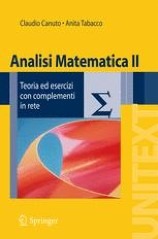
Analisi matematica II : Teoria ed esercizi con complementi in rete = Mathematical analysis 2 : Theory and exercises with online complements
Intends to support a second teaching of Mathematical Analysis according to the principles of the new Didactic Regulations. It is especially designed for those study courses (such as Engineering, Computer Science, Physics) in which the mathematical tool is a significant part of the training. The fundamental concepts and methods of the differential and integral calculus of several variables, the series of functions and the ordinary differential equations are presented with the primary objective of training the student in their operational but critical use. The didactic setting of the text follows the one used for ANALYSIS I. The method of presentation of the arguments allows a flexible and modular use of the text, in order to respond to the various possible didactic choices in the organization of a Mathematical Analysis course.
