



الصفحة 1
الصفحة 1
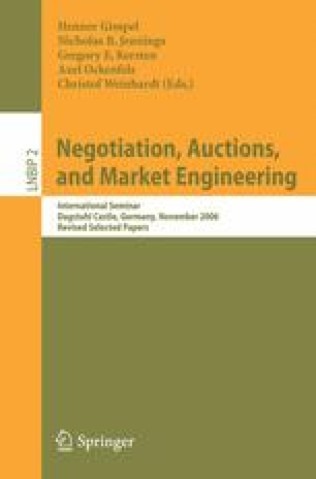
Negotiation, auctions, and market engineering ; International Seminar, Dagstuhl Castle, Germany, November 12-17, 2006, Revised Selected Papers
This book contains a selection of papers presented at the International Seminar "Negotiation and Market Engineering", held at Dagstuhl Castle, Germany, in November 2006.The 17 revised full papers presented in this volume were carefully selected and reviewed after the seminar. The papers deal with the complexity of negotiations, auctions, and markets as economic, social, and IT systems. The authors give a broad overview on the major issues to be addressed and the methodologies used to approach them, covering highly interdisciplinary research from computer science, economics, business administration, and mathematics.

Market engineering : Insights from two decades of research on markets and information
This book provides a broad range of insights on market engineering and information management. It covers topics like auctions, stock markets, electricity markets, the sharing economy, information and emotions in markets, smart decision-making in cities and other systems, and methodological approaches to conceptual modeling and taxonomy development.

Adaptive Bidding in Single-Sided Auctions under Uncertainty : An Agent-based Approach in Market Engineering
In the last years electronic markets, especially online auctions, have become very popular and received more and more attention in both, business (B2B) as well as in public practice (B2C and C2C). Science, however, is still far from having studied all phenomena and effects which can be observed on electronic markets. This book shows that and how software agents can be used to simulate bidding behaviour in electronic auctions. The main emphasis of this book is to apply computational economics to market theory. It summarizes the most common and up-to-date agent-based simulation methods and tools and develops the simulation software AMASE. On basis of the introduced methods a model is established to simulate bidding behaviour under uncertainty.
