



الصفحة 1
الصفحة 1

Industry 4.0 for SMEs : Challenges, opportunities and requirements
This book explores the concept of Industry 4.0, which presents a considerable challenge for the production and service sectors. While digitization initiatives are usually integrated into the central corporate strategy of larger companies, smaller firms often have problems putting Industry 4.0 paradigms into practice. Small and medium-sized enterprises (SMEs) possess neither the human nor financial resources to systematically investigate the potential and risks of introducing Industry 4.0. Addressing this obstacle, the international team of authors focuses on the development of smart manufacturing concepts, logistics solutions and managerial models specifically for SMEs. Aiming to provide methodological frameworks and pilot solutions for SMEs during their digital transformation, this innovative and timely book will be of great use to scholars researching technology management, digitization and small business, as well as practitioners within manufacturing companies.

Factories of the Future : The Italian Flagship Initiative
This book presents results relevant in the manufacturing research field, that are mainly aimed at closing the gap between the academic investigation and the industrial application, in collaboration with manufacturing companies. Several hardware and software prototypes represent the key outcome of the scientific contributions that can be grouped into five main areas, representing different perspectives of the factory domain

Digitization of the management accounting function : A case study analysis on manufacturing companies
Analyzes the impact of digitization on management accounting in five manufacturing companies. It is one of the first in-depth empirical studies on the intersection of management accounting and digitization. The study suggests that there are two archetypes of digitization of the management accounting function. The first archetype emphasizes top-down-driven changes that aim to enhance efficiency, such as conducting tasks with a higher degree of automation in a leaner structure with fewer resources. The second archetype is strongly driven and initiated by employees in the management accounting function (bottom-up). The focus is on improving the use of data by applying innovative analytics methods, integrating additional sources of data, and benefiting from new technologies like artificial intelligence. The results of the study also indicate that digitization of the management accounting function is mostly in line with the overall company strategy.
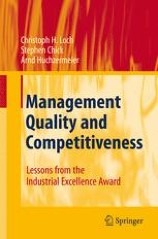
Management Quality and Competitiveness : Lessons from the Industrial Excellence Award
This book showcases examples of excellent manufacturing companies who have succeeded in creating value and job growth in Western Europe. The examples show managers of industrial firms how a clearly articulated strategic position can be combined with excellent execution to achieve competitiveness in Europe, in spite of the usually cited disadvantage of high labor costs and rigidity. Not every company is alike — strategic positions differ, and the means of execution differ, but what is common is a clear plan together with mobilization of all employees to apply their abilities in supporting this common plan. The book is indispensable reading for all managers that are interested in improving competitiveness.
