



الصفحة 1
الصفحة 1

Intelligent engineering systems and computational cybernetics
A further important component of machine intelligence is a kind of “structural uniformity” giving room and possibility to model arbitrary particular details a priori not specified and unknown.This idea is similar to the ready-to-wear industry, which introduced products, which can be slightly modified later on in contrast to tailor-made creations aiming at maximum accuracy from the beginning. These subsequent corrections can be carried out by machines automatically. This “learning ability” is a key element of machine intelligence.The past decade confirmed that the view of typical components of the present soft computing as fuzzy logic, neural computing.
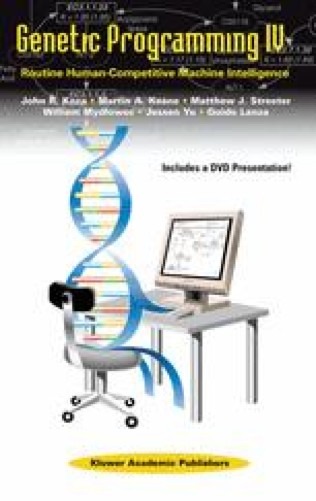
Genetic programming IV : Routine human-competitive machine intelligence
Genetic Programming IV: Routine Human-Competitive Machine Intelligence presents the application of GP to a wide variety of problems involving automated synthesis of controllers, circuits, antennas, genetic networks, and metabolic pathways. The book describes fifteen instances where GP has created an entity that either infringes or duplicates the functionality of a previously patented 20th-century invention, six instances where it has done the same with respect to post-2000 patented inventions, two instances where GP has created a patentable new invention, and thirteen other human-competitive results. The book additionally establishes: GP now delivers routine human-competitive machine intelligence GP is an automated invention machine GP can create general solutions to problems in the form of parameterized topologies GP has delivered qualitatively more substantial results in synchrony with the relentless iteration of Moore's Law

Designing a human future with machines
What is human flourishing in an age of machine intelligence, when many claim that the world's most complex problems can be reduced to narrow technical questions? Does more computing make us more intelligent, or simply more computationally powerful? We need not always resist reduction; our ability to simplify helps us interpret complicated situations. The trick is to know when and how to do so. Against Reduction offers a collection of provocative and illuminating essays that consider different ways of recognizing and addressing the reduction in our approach to artificial intelligence, and ultimately to ourselves.
Cognitive engineering : A distributed approach to machine intelligence
Cognitive Engineering: A Distributed Approach to Machine Intelligence explores the design issues of intelligent engineering systems. Beginning with the foundations of psychological modeling of the human mind, the main emphasis is given to parallel and distributed realization of intelligent models for application in reasoning, learning, planning and multi-agent co-ordination problems. The last two chapters provide case studies on human-mood detection and control, and behavioral co-operation of mobile robots. This is the first comprehensive text of its kind, bridging the gap between Cognitive Science and Cognitive Systems Engineering. Each chapter includes plenty of numerical examples and exercises with sufficient hints, so that the reader can solve the exercises on their own. Computer simulations are also included in most chapters to give a clear idea about the application of the algorithms undertaken in the book. In addition, mathematical analysis on convergence and stability of the neuro-fuzzy models will enable the reader to pursue their research career in cognitive engineering.
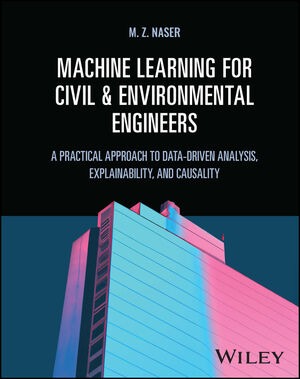
Machine learning for civil and environmental engineers : A practical approach to data-driven analysis, explainability, and causality
Introduces engineers and engineering students to the applications of artificial intelligence (AI), machine learning (ML), and machine intelligence (MI) in relation to civil and environmental engineering projects and problems, presenting state-of-the-art methodologies and techniques to develop and implement algorithms in the engineering domain.
Machine Learning Approaches in Cyber Security Analytics
Introduces various machine learning methods for cyber security analytics. With an overwhelming amount of data being generated and transferred over various networks, monitoring everything that is exchanged and identifying potential cyber threats and attacks poses a serious challenge for cyber experts. Further, as cyber attacks become more frequent and sophisticated, there is a requirement for machines to predict, detect, and identify them more rapidly. Machine learning offers various tools and techniques to automate and quickly predict, detect, and identify cyber attacks.

Machine Intelligence and Big Data Analytics for Cybersecurity Applications
Presents the latest advances in machine intelligence and big data analytics to improve early warning of cyber-attacks, for cybersecurity intrusion detection and monitoring, and malware analysis. Cyber-attacks have posed real and wide-ranging threats for the information society. Detecting cyber-attacks becomes a challenge, not only because of the sophistication of attacks but also because of the large scale and complex nature of today’s IT infrastructures. It discusses novel trends and achievements in machine intelligence and their role in the development of secure systems and identifies open and future research issues related to the application of machine intelligence in the cybersecurity field.
Big Data Intelligence for Smart Applications
Presents the latest discoveries in the field of machine intelligence and big data Proposes many case studies and applications of computational and Big data Combines theory and practice so that readers of the few books (beginners or experts)
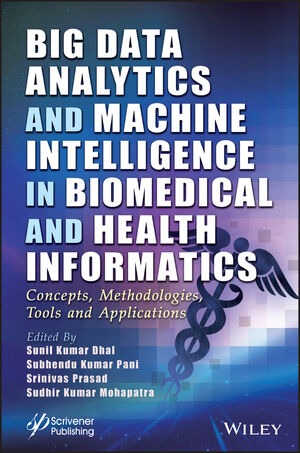
Big data analytics and machine intelligence in biomedical and health informatics : Concepts, methodologies, tools and applications
Provides coverage of developments and state-of-the-art methods in the broad and diversified data analytics field and applicable areas such as big data analytics, data mining, and machine intelligence in biomedical and health informatics. Covers the latest advances and developments in health informatics, data mining, machine learning, and artificial intelligence. They have been organized with respect to the similarity of topics addressed, ranging from issues pertaining to the Internet of Things (IoT) for biomedical engineering and health informatics, computational intelligence for medical data processing, and Internet of Medical Things??(IoMT).
Advances and Innovations in Systems, Computing Sciences and Software Engineering
Acollection of world class paper articles addressing the following topics: Image and Pattern Recognition: Compression, Image processing, Signal Processing Architectures, Signal Processing for Communication, Signal Processing Implementation, Speech Compression, and Video Coding Architectures. Languages and Systems: Algorithms, Databases, Embedded Systems and Applications, File Systems and I/O, Geographical Information Systems, Kernel and OS Structures, Knowledge Based Systems, Modeling and Simulation, Object Based Software Engineering, Programming Languages, and Programming Models and tools. Parallel Processing: Distributed Scheduling, Multiprocessing, Real-time Systems, Simulation Modeling and Development, and Web Applications. New trends in computing: Computers for People of Special Needs, Fuzzy Inference, Human Computer Interaction, Incremental Learning, Internet-based Computing Models, Machine Intelligence, Natural Language Processing, Neural Networks, and Online Decision Support System.
