



الصفحة 1
الصفحة 1

Innovations in Machine Learning : Theory and Applications
Machine learning is currently one of the most rapidly growing areas of research in computer science. In compiling this volume we have brought together contributions from some of the most prestigious researchers in this field. This book covers the three main learning systems; symbolic learning, neural networks and genetic algorithms as well as providing a tutorial on learning casual influences. Each of the nine chapters is self-contained. Both theoreticians and application scientists/engineers in the broad area of artificial intelligence will find this volume valuable. It also provides a useful sourcebook for Postgraduate since it shows the direction of current research.
Inductive logic programming ; 18th International Conference, ILP 2008 Prague, Czech Republic, September 10-12, 2008 Proceedings
This book constitutes the refereed proceedings of the 18th International Conference on Inductive Logic Programming, ILP 2008, held in Prague, Czech Republic, in September 2008.The 20 revised full papers presented together with the abstracts of 5 invited lectures were carefully reviewed and selected during two rounds of reviewing and improvement from 46 initial submissions. All current topics in inductive logic programming are covered, ranging from theoretical and methodological issues to advanced applications. The papers present original results in the first-order logic representation framework, explore novel logic induction frameworks, and address also new areas such as statistical relational learning, graph mining, or the semantic Web.

Inductive logic programming ; 17th International Conference, ILP 2007, Corvallis, OR, USA, June 19-21, 2007, Revised Selected Papers
The 18th International Conference on Inductive Logic Programming was held in Prague, September 10–12, 2008. ILP returned to Prague after 11 years, and it is tempting to look at how the topics of interest have evolved during that time. The ILP community clearly continues to cherish its beloved ?rst-order logic representation framework. This is legitimate, as the work presented at ILP 2008 demonstrated that there is still room for both extending established ILP approaches (such as inverse entailment) and exploring novel logic induction frameworks (such as brave induction). Besides the topics lending ILP research its unique focus.
Inductive logic programming ; 16th International Conference, ILP 2006, Santiago de Compostela, Spain, August 24-27, 2006, Revised Selected Papers
This book constitutes the thoroughly refereed post-proceedings of the 16th International Conference on Inductive Logic Programming, ILP 2006, held in Santiago de Compostela, Spain, in August 2006. The papers address all current topics in inductive logic programming, ranging from theoretical and methodological issues to advanced applications.
Inductive logic programming ; 15th International Conference, ILP 2005, Bonn, Germany, August 10-13, 2005, Proceedings
“Change is inevitable.” Embracing this quote we have tried to carefully exp- iment with the format of this conference, the 15th International Conference on Inductive Logic Programming, hopefully making it even better than it already was. But it will be up to you, the inquisitive reader of this book, to judge our success. The major changes comprised broadening the scope of the conference to include more diverse forms of non-propositional learning, to once again have tutorials on exciting new areas, and, for the ?rst time, to also have a discovery challenge as a platform for collaborative work. This year the conference was co-located with ICML 2005, the 22nd Inter- tional Conference on Machine Learning, and also in close proximity to IJCAI 2005, the 19th International Joint Conference on Arti?cial Intelligence. - location can be tricky, but we greatly bene?ted from the local support provided by Codrina Lauth, Michael May, and others. We were also able to invite all ILP and ICML participants to shared events including a poster session, an invited talk, and a tutorial about the exciting new area of “statistical relational lea- ing”. Two more invited talks were exclusively given to ILP participants and were presented as a kind of stock-taking—?ttingly so for the 15th event in a series—but also tried to provide a recipe for future endeavours.
Functional and logic programming ; 9th International Symposium, FLOPS 2008, Ise, Japan, April 14-16, 2008. Proceedings
This volume contains the proceedings of the 9th International Symposium on Functional and Logic Programming (FLOPS 2008), held in Ise, Japan, April 14-16, 2008 at the Ise City Plaza. FLOPS is a forum for research on all issues concerning functional progr- ming and logic programming. In particular it aims to stimulate the cro- fertilization as well as integration of the two paradigms. The Program Committee meeting was conducted electro- cally, for a period of two weeks in December 2007. After careful and thorough discussion, the ProgramCommittee selected20 papers(33%)for presentationat theconference.

Functional and logic programming ; 8th International Symposium, FLOPS 2006, Fuji-Susono, Japan, April 24-26, 2006, Proceedings
This book constitutes the refereed proceedings of the 8th International Symposium on Functional and Logic Programming, FLOPS 2006, held in Fuji-Susono, Japan, in April 2006. The 17 revised full papers presented together with 2 invited contributions were carefully reviewed and selected from 51 submissions. The papers are organized in topical sections on data types, FP extensions, type theory, LP extensions, analysis, contracts, as well as Web and GUI.

Foundations of Intelligent Systems ; Vol. 4203 ; 16th International Symposium, ISMIS 2006, Bari, Italy, September 27-29, 2006, Proceedings
This book constitutes the refereed proceedings of the 16th International Symposium on Methodologies for Intelligent Systems, ISMIS 2006. The book presents 81 revised papers together with 3 invited papers. Topical sections include active media human-computer interaction, computational intelligence, intelligent agent technology, intelligent information retrieval, intelligent information systems, knowledge representation and integration, knowledge discovery and data mining, logic for AI and logic programming, machine learning, text mining, and Web intelligence.

Foundations of information and knowledge systems ; 4th International Symposium, FoIKS 2006, Budapest, Hungary, February 14-17, 2006, Proceedings
This book constitutes the refereed proceedings of the 4th International Symposium on Foundations of Information and Knowledge Systems, held in February 2006. The 14 revised full papers presented together with three revised short papers and one invited paper were carefully reviewed and selected from 54 submissions. Among the topics covered are the theoretical foundations of information and knowledge systems, as well as mathematical fields such as discrete mathematics, combinatorics, logics and finite model theory, and applications thereof for research on database and knowledge base theory.

Engineering Societies in the Agents World VI ; 6th International Workshop, ESAW 2005, Kusadasi, Turkey, October 26-28, 2005, Revised Selected and Invited Papers
ESAW 2005 took place at the Pine Bay Hotel in Kusadasi, Turkey at the end of the October 2005. It was organized as a stand-alone event as were ESAW 2004and ESAW 2003.Following the initial ESAW vision,which wasset in 1999, by the members of the working group on “Communication, Coordination and Collaboration” of Agentlink, ESAW 2005 continued to focus on the engineering of complex software systems in terms of multi-agent societies, especially the social and environmental aspects of such societies.

Declarative programming for knowledge management ; 16th International conference on applications of declarative programming and knowledge management, INAP 2005, Fukuoka, Japan, October 22-24, 2005. Revised Selected Papers
Presents a selection of papers presented at the 16th Inter- tional Conference on Applications of Declarative Programming and Knowledge Management, INAP 2005,held in October 2005 at Waseda University, Fukuoka, Japan. These papers re?ect a snapshot of ongoing research and current app- cations in knowledge management and declarative programming.

Declarative agent languages and technologies III ; 3rd International Workshop, DALT 2005, Utrecht, The Netherlands, July 25, 2005, Selected and Revised Papers
The workshop on Declarative Agent Languages and Technologies is a we- established venue for researchers interested in sharing their experiences in the areas of declarative and formal aspects of agents and multi-agent systems, and in engineering and technology. Today it is still a challenge to develop techno- gies that can satisfy the requirements of complex agent systems. The design and development of multi-agent systems still calls for models and technologies that ensure predictability, enable feature discovery, allow for the veri?cation of properties, and guarantee ?exibility. Declarative approaches are potentially a valuable means for satisfying the needs of multi-agent system developers and for specifying multi-agent systems.

Coordination models and languages ; 9th International Conference, COORDINATION 2007, Paphos, Cyprus, June 6-8, 2007, Proceedings
he volume examines how to increase modularity, simplify reasoning, and ultimately enhance today's software development by exploring the spectrum of languages, middleware, services, and algorithms. The papers are organized in topical sections on middleware, logic programming, formal approaches, concurrency, components and services, as well as MANets.

Constraint solving and language processing
Contains selected and thoroughly revised papers plus contributions from invited speakers presented at the First International Workshop on C- straint Solving and Language Processing, held in Roskilde, Denmark, September 1–3, 2004. Constraint Programming and Constraint Solving, in particular Constraint Logic Programming, appear to be a very promising platform, perhaps the most promising present platform, for bringing forward the state of the art in natural language processing, this due to the naturalness in speci?cation and the direct relation to e?cient implementation. Language, in the present context, may - fer to written and spoken language, formal and semiformal language, and even general input data to multimodal and pervasive systems, which can be handled in very much the same ways using constraint programming. The notion of constraints, with slightly differing meanings, apply in the characterization of linguistic and cognitive phenomena, in formalized linguistic m- els as well as in implementation-oriented frameworks. Programming techniques for constraint solving have been, and still are, in a period with rapid devel- ment of new eficient methods and paradigms from which language processing can prompt. A common metaphor for human language processing is one big c- straint solving process in which the differently specified linguistic and cognitive phases take place in parallel and with mutual cooperation, which ?ts quite well with current constraint programming paradigms.

Constraint handling rules : Current research topics
The Constraint Handling Rules (CHR) language is a declarative concurrent committed-choice constraint logic programming language consisting of guarded rules that transform multisets of relations called constraints until no more change occurs. The aim of this volume was to attract high-quality research papers on these recent advances in Constraint Handling Rules.
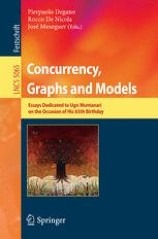
Concurrency, Graphs and Models : Essays Dedicated to Ugo Montanari on the Occasion of His 65th Birthday
The volume consists of seven sections, six of which are dedicated to the main research areas to which Ugo Montanari has contributed: Graph Transformation; Constraint and Logic Programming; Software Engineering; Concurrency; Models of Computation; and Software Verification.
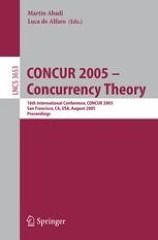
CONCUR 2005 - Concurrency Theory
This volume contains the papers presented at CONCUR 2005, the 16th - ternational Conference on Concurrency Theory. The purpose of the CONCUR series of conferences is to bring together researchers,developers, and students in order to advance the theory of concurrency and to promote its applications. The Program Committee selected 38 papers for presentation. Because of the format of the conference and the high number of submissions, many good papers could not be included. Although submissions werereadand evaluated, the papers that appear in this volume may di?er in form and contents from the corresponding submissions.

Computer science logic ; Vol. 4207 ; 20th International Workshop, CSL 2006, 15th Annual Conference of the EACSL, Szeged, Hungary, September 25-29, 2006, Proceedings
Coverage includes automated deduction and interactive theorem proving, constructive mathematics and type theory, equational logic and term rewriting, automata and formal logics, modal and temporal logic, model checking, finite model theory, and more.

Computer Science Logic ; Vol. 3634
This book constitutes the refereed proceedings of the 19th International Workshop on Computer Science Logic, CSL 2005, held as the 14th Annual Conference of the EACSL in Oxford, UK in August 2005. The 33 revised full papers presented together with 4 invited contributions were carefully reviewed and selected from 108 papers submitted. All current aspects of logic in computer science are addressed ranging from mathematical logic and logical foundations to methodological issues and applications of logics in various computing contexts. The volume is organized in topical sections on semantics and logics, type theory and lambda calculus, linear logic and ludics, constraints, finite models, decidability and complexity, verification and model checking, constructive reasoning and computational mathematics, and implicit computational complexity and rewriting.

Computer Science Logic ; 22nd International Workshop, CSL 2008 , 17th Annual Conference of the EACSL, Bertinoro, Italy, September 16-19, 2008. Proceedings
This book constitutes the refereed proceedings of the 22nd International Workshop on Computer Science Logic, CSL 2008, held as the 17th Annual Conference of the EACSL in Bertinoro, Italy, in September 2008.
