



الصفحة 1
الصفحة 1

Neuroscribe = نيوروسكرايب
Neuroscribe is a cutting-edge deep learning framework designed to address the complexities and inefficiencies encountered in existing frameworks like PyTorch and TensorFlow. Aimed at streamlining model development and enhancing performance across diverse hardware environments, NeuroScribe offers a lightweight and flexible solution. The framework features a robust tensor library, an auto-differentiation engine, a comprehensive neural network module, and advanced optimization algorithms. With built-in visualization tools and a user-friendly interface, NeuroScribe simplifies both beginner and advanced workflows. Its cross-platform compatibility, supported by CUDA and Metal Performance Shaders (MPS), ensures optimal performance, and in some scenarios, NeuroScribe demonstrates superior speed compared to leading frameworks. Additionally, NeuroScribe introduces unique libraries and features not found in other frameworks, further enhancing its versatility and appeal. The modular architecture and automatic system detection further enhance its adaptability, making NeuroScribe a versatile and powerful tool for deep learning practitioners.

Multiple Bonds between Metal Atoms
The 3rd edition of the Multiple Bonds between Metal Atoms deals with one of the most active fields of inorganic chemistry … . It presents an extensive, critical review and discussion of preparations, reactions, bonding, and physical properties of more than 4000 compounds … heartily recommend it to inorganic and materials chemists, and to all scientists concerned with the synthesis, spectroscopy, and structures of transition-metal compounds. It also belongs in academic, industrial, and government research libraries.

Multimedia Services in Intelligent Environments : Advanced Tools and Methodologies
This book presents a sample of recent research results in multimedia services. Besides the introductory chapter, this book includes fourteen additional chapters. Nine of these chapters cover various aspects of data processing in multimedia services in intelligent environments, such as storage, recognition and classification, transmission, information retrieval, and information securing. Four additional chapters present multimedia services in noise and hearing monitoring and measuring, augmented reality, automated lecture rooms and rights management and licensing. Finally, the last chapter is devoted to an intelligent recommender service in scientific digital libraries.
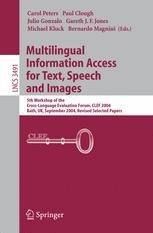
Multilingual Information Access for Text, Speech and Images ; 5th Workshop of the Cross-Language Evaluation Forum, CLEF 2004, Bath, UK, September 15-17, 2004, Revised Selected Papers
The ?fth campaign of the Cross-Language Evaluation Forum (CLEF) for Eu- pean languages was held from January to September 2004. Participation in the CLEF campaigns has increased each year and CLEF 2004 was no exception: 55 groups submitted results for one or more of the di?erent tracks compared with 42 groups in the previous year. CLEF 2004 also marked a breaking point with respect to previous campaigns. The focus was no longer mainly concentrated on multilingual document retrieval as in previous years but was diversi?ed to include di?erent kinds of text retrieval across languages (e. g. , exact answers in the question-answering track) and retrieval on di?erent kinds of media (i. e. , not just plain text but collections containing image and speech as well). In ad- tion, increasing attention was given to issues that regard system usability and user satisfaction with tasks to measure the e?ectiveness of interactive systems or system components being included in both the cross-language question - swering and image retrieval tasks with the collaboration of the coordinators of the interactive track. The campaign culminated in a two-and-a-half-day workshop held in Bath, UK, 15–17 September, immediately following the 8th European Conference on Digital Libraries. The workshop was attended by nearly 100 researchers and s- tem developers.
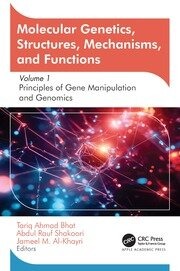
Molecular genetics, structures, mechanisms, and functions : Principles of gene manipulation and genomics ; Vol.1
Provides an overview of the future of genetic engineering and delves into the role of biotechnology and its applications in genetic engineering. It discusses the tools of recombinant technology, which have brought about revolution in our understanding of various complex biological phenomena. Chapters cover mutagenesis, construction, and sequencing of DNA libraries along with applications of genetic engineering for improving health, preventing genetic diseases, enhancing food resources, managing environmental bioremediation, and more. Topics include genetic engineering tools for restriction enzymes and vectors, gene and cell division, mutation detection and screening in plants, population genetics, sexuality in bacteria, and more. Several chapters focus on the tools of recombinant technology, such as restriction enzymes, vectors, etc., that have paved the way for creating organisms of choice and opened new horizons in the field of medicine, agriculture, and industry for human welfare.

Modern Meteor Science : An Interdisciplinary View
"During the past half century meteor research has evolved into a comprehensive multidisciplinary science … . New findings are flowing from the ever-broadening range of investigative techniques that are being employed to great effect by the contributors to this book. This comprehensive overview of leading edge research by well over one hundred authors is an essential resource volume for scientists and engineers conducting studies and exploration of the solar system. It demands a place in the libraries supporting their activities.

Modern Deep Learning Design and Application Development : Versatile Tools to Solve Deep Learning Problems
Learn how to harness modern deep-learning methods in many contexts. Packed with intuitive theory, practical implementation methods, and deep-learning case studies, this book reveals how to acquire the tools you need to design and implement like a deep-learning architect. It covers tools deep learning engineers can use in a wide range of fields, from biology to computer vision to business. With nine in-depth case studies, this book will ground you in creative, real-world deep learning thinking. You will: Improve the performance of deep learning models by using pre-trained models, extracting rich features, and automating optimization. Compress deep learning models while maintaining performance. Reframe a wide variety of difficult problems and design effective deep learning solutions to solve them. Use the Keras framework, with some help from libraries like HyperOpt, TensorFlow, and PyTorch, to implement a wide variety of deep learning approaches.

Modeling and Simulation in Scilab
Scilab is a free open-source software package for scientific computation. It includes hundreds of general purpose and specialized functions for numerical computation, organized in libraries called toolboxes, which cover such areas as simulation, optimization, systems and control, and signal processing. One important Scilab toolbox is Scicos. Scicos provides a block diagram graphical editor for the construction and simulation of dynamical systems. The objective of this book is to provide a tutorial for the use of Scilab/Scicos with a special emphasis on modeling and simulation tools. The book is divided into two parts. The first part concerns Scilab and includes a tutorial covering the language features, the data structures and specialized functions for doing graphics, importing, exporting data and interfacing external routines. It also covers in detail Scilab numerical solvers for ordinary differential equations and differential-algebraic equations. Even though the emphasis is placed on modeling and simulation applications, this part provides a global view of Scilab. The second part is dedicated to modeling and simulation of dynamical systems in Scicos. This type of modeling tool is widely used in industry because it provides a means for constructing modular and reusable models. This part contains a detailed description of the editor and its usage, which is illustrated through numerous examples.

Measuring the Value of Culture : Methods and Examples in Cultural Economics
Acknowledgement of the value of culture and cultural goods is increasing world-wide. So too is interest in finding methods to quantify this value so that governments and private sponsors can make efficient funding decisions. "Measuring the Value of Culture" documents methods that can be used to put a price on the arts and cultural goods, including theatre, heritage, cultural events (like arts festivals), museums, archaeological sites and libraries. The methods discussed include economic impact studies, which use market data, as well as non-market valuation techniques, like willingness to pay studies, and the newer choice experiments. In addition, advances in more qualitative valuation methods are considered.

Intelligent Computer Mathematics ; 13th International Conference, CICM 2020, Bertinoro, Italy, July 26–31, 2020, Proceedings
This book constitutes the refereed proceedings of the 13th International Conference on Intelligent Computer Mathematics, CICM 2020, held in Bertinoro, Italy, in July 2020*. The 15 full papers, 1 invited paper and 2 abstracts of invited papers presented were carefully reviewed and selected from a total of 35 submissions. The papers focus on advances in automated theorem provers and formalization, computer algebra systems and their libraries, and applications of machine learning, among other topics.

Information context : Nature, impact, and role ; 5th International conference on Conceptions of Library and Information Sciences, CoLIS 2005, Glasgow, UK, June 4-8, 2005 Proceedings
.CoLIS examinesthehistorical,theoretical,empiricalandtechnicalissuesrelatingtoour understanding and use of information, promoting an interdisciplinary approach to research. CoLIS seeks to provide a broad platform for the examination of context as it relates to our theoretical, empirical and technical development of information-centered disciplines. The theme for CoLIS 5 was the nature, impact and role of context within information-centered research. Context is a complex, dynamic and multi- - mensional concept that in?uences both humans and machines: how they behave individually and how they interact with each other. In CoLIS 5 we took an interdisciplinary approach to the issue of context to help us understand and the theoretical approaches to modelling and understanding context, incorporate contextual reasoning within technology, and develop a shared framework for promoting the exploration of context.

Information Access through Search Engines and Digital Libraries
he Information Management Systems group at the University of Padua, led by Maristella Agosti, has been a major contributor to information retrieval (IR) and digital libraries for nearly twenty years. This group has gained an excellent reputation in the IR community and has produced some of the best-known IR researchers, whose work spans a broad range of topics.The papers in this book deal with e.g. automated text categorizations, web link analysis algorithms, retrieval in multimedia digital libraries, and multilingual information retrieval. The presentation of original research results built on the past work of the group which at the same time summarizes past .

HIV and AIDS : Basic elements and priorities
This volume is an excellent reference for science graduates and post graduates, medical students, research scholars and scientists across the world. This book is recommended by the World Health Organization Eastern Mediterranean Region Office (WHO-EMRO) as a basic resource for medical faculty libraries.

Higher Education in the Era of the Fourth Industrial Revolution
This collection examines how higher education responds to the demands of the automation economy and the fourth industrial revolution. Considering significant trends in how people are learning, coupled with the ways in which different higher education institutions and education stakeholders are implementing adaptations, it looks at new programs and technological advances that are changing how and why we teach and learn. The book addresses trends in liberal arts integration of STEM innovations, the changing role of libraries in the digital age, global trends in youth mobility, and the development of lifelong learning programs.

Hardware Verification with C++ : A Practitioner’s Handbook
Part I makes the case for C++, and shows a standard verification system using object-oriented programming (OOP). Part II presents two open-source C++ libraries that enable efficient verification with C++ -- Teal, a C++ to Verilog interface, and Truss, a standard verification framework. Part III focuses on OOP with examples from real verification projects. Part IV puts it all together showing complete block-level and system-level verification systems. "The handbook provides a clear understanding of object-oriented programming, and how it applies to hardware verification. It is clear to me that C++, together with Teal and Truss, could form a strong platform for the next generation of hardware verification."

Halfstory Center : مركز طلابي خدمي ترفيهي
يُعد هذا المركز مساحة متكاملة تهدف إلى دعم الطلبة من خلال تقديم خدمات متنوعة تجمع بين الجوانب الأكاديمية، والخدمية، والترفيهية. يسعى المركز إلى خلق بيئة محفزة تُمكن الطلبة من تطوير مهاراتهم، وتنمية مواهبهم، وقضاء أوقات فراغهم بشكل إيجابي ومفيد. كما يضم المركز مرافق متعددة تشمل قاعات للدراسة والاجتماعات، ومركزاً للدعم الأكاديمي، ومكاتب لخدمة الطلبة، إلى جانب مساحات مخصصة للأنشطة الترفيهية مثل صالات الألعاب، ومناطق الاستراحة، والمقاهي. كما يُنظم المركز فعاليات وورش عمل وأنشطة اجتماعية وثقافية على مدار العام ويهدف المركز إلى تعزيز روح الانتماء لدى الطلبة، وتوفير بيئة داعمة تسهم في تحسين تجربتهم الجامعية على المستويين الأكاديمي والشخصي.

Geographic information metadata for spatial data infrastructures : Resources, interoperability and information retrieval
Metadata play a fundamental role in both DLs and SDIs. Commonly defined as "structured data about data" or "data which describe attributes of a resource" or, more simply, "information about data", it is an essential requirement for locating and evaluating available data. Therefore, this book focuses on the study of different metadata aspects, which contribute to a more efficient use of DLs and SDIs. The three main issues addressed are: the management of nested collections of resources, the interoperability between metadata schemas, and the integration of information retrieval techniques to the discovery services of geographic data catalogs (contributing in this way to avoid metadata content heterogeneity).

Genomics of Tropical Crop Plants
Genomics of Tropical Crop Plants summarizes recent progress on genomic research, including the development of molecular markers, genomic and cDNA libraries, expressed sequence tags (ESTs), genetic and physical maps, gene expression profiles, and whole genome sequences for 20 tropical crop plants. It offers background information about the evolutionary origin and environments of tropical crop species, international programs that are addressing the needs of tropical agriculture, and the potential for new technologies to increase the productivity and value of tropical crops. This book provides new dimensions to growing information concerning temperate crops and their morphology, physiology, and parallel evolution in diverse plant lineages.

Genetics and Genomics of Soybean
The book covers recent progress on genome research in soybeans, including the genetic map with classical, RFLP, SSR and SNP markers; genomic and cDNA libraries, functional genomics platforms (e.g., cDNA, Affymetrix and oligonucleotide based DNA microarrays); physical maps, and the efforts to fully sequence the genome. Given the pending release of the soybean genome sequence, through the efforts of the Department of Energy’s Joint Genome Institute, this book will stand as a critical source of information on soybean.

From integrated publication and information systems to information and knowledge environments : Essays dedicated to Erich J. Neuhold on the Occasion of His 65th Birthday
This book constitutes a commemorative volume devoted to Erich J. Neuhold on the occasion of his 65th birthday. The 32 invited reviewed papers presented are written by students and colleagues of Erich Neuhold throughout all periods of his scientific career. The papers are organized in the following topical sections: Database management enabling information systems Semantic Web drivers for advanced information management Securing dynamic media content integration From digital libraries to intelligent knowledge environments Visualization – key to external cognition in virtual information environments From human-computer interaction to human-artefact interaction Domains for virtual information and knowledge environments.
