



الصفحة 1
الصفحة 1

On the history of the idea of law
On the History of the Idea of Law is the first book ever to trace the development of the philosophical theory of law from its first appearance in Plato's writings to today. Professor Letwin finds important and positive insights and tensions in the theories of Plato

Methods of Legal Reasoning
The book attempts to describe and criticize four methods used in legal practice, legal dogmatics and legal theory: logic, analysis, argumentation and hermeneutics. Apart from a presentation of basic ideas connected with the above mentioned methods, the essays contained in this book seek to answer questions concerning the assumptions standing behind these methods, the limits of using them and their usefulness in the practice and theory of law. A specific feature of the book is that in one study four different, sometimes competing concepts of legal method are discussed. The panorama, sketched like this, allows one to reflect deeply on the questions concerning the methodological conditioning of legal science and the existence of a unique, specific legal method. The authors argue that there exists no such method.

Interpretation, Law and the Construction of Meaning : Collected Papers on Legal Interpretation in Theory, Adjudication and Political Practice
Given the relative indeterminacy of law, it is no surprise that the problem of interpretation has always been one of the focal points of attention for legal semiotics. Who has the power to define words and concepts? Who can successfully assume the power to speak on behalf of the legal community? Which methods are used to justify the power to define? This book discusses the questions mentioned above.

International legal theory and the cognitive turn
Significant changes in social sciences often herald changes in legal theory, including in international legal theory. In light of the cognitive turn in social sciences, this volume seeks to explore the implications of this ‘turn’ for international legal theories. Cognitive and behavioural studies are making inroads into international law literature and international policy-making,

General principles of law : the role of the judiciary
Examines the role played by domestic and international judges in the “flexibilization” of legal systems through general principles. It features revised papers that were presented at the Annual Conference of the European-American Consortium for Legal Education, held at the University of Parma.The second section contains studies on the role of general principles in selected legal systems, including International Law, European Union Law as well as Common Law systems.

Criminalising Harmful Conduct : The Harm Principle, its Limits and Continental Counterparts
This book explores the issue of legitimate criminalization in a modern, liberal society. Coverage provides a comparative study between two major criminal legal systems and its theories: the Anglo-American, on one side, and the Continental criminal legal system of Germanic legal circle, on the other.

Constitutional law : Model problems and outstanding answers
Constitutional law is one of the most engaging and yet challenging first year law classes. At the confluence of history, politics, legal theory, and judicial review, it requires students to learn a new framework for legal interpretation and thought unique from other areas of law. For the first time, Oxford University Press equips students with an accessible guide to acing these challenging constitutional law exams.

Co-governed Sovereignty Network : Legal Basis and Its Prototype & Applications with MIN Architecture
This book introduces MIN, a novel networking architecture to implement the sovereign equality of all countries in the cyberspace. Combining legal theory and network technology, it first discusses the historical development of sovereignty and expounds the legal basis of cyberspace sovereignty. Then, based on the high-performance blockchain, it describes a new network architecture designed to implement co-governance at the technical level.
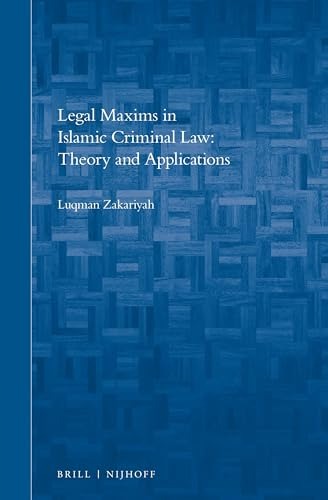
Legal maxims in islamic criminal law : Theory and applications
Delves into the theoretical and practical studies of al-Qawaid al-Fiqhiyyah in Islamic legal theory. It elucidates the importance of this concept in the application of Islamic law and demonstrates how the concept relates to the objectives of Islamic law generally.
Law as Symbolic Form : Ernst Cassirer and the Anthropocentric View of Law
In this book we describe the rule of law as the reign of persuasion rather than the reign of force, and democracy as the reign by persuasion rather than the reign by force.
Law and Politics : A Dilemma for Contemporary Legal Theory
Politics and the political discourse occupy a central position in the modern legal theoretical discussion. The goal of this book is to reconstruct and to classify, according to ideal-typical models, the different positions taken by the major contemporary legal theories as to whether and how law relates to politics. In particular, attention is focused on Kelsen, Hart, Finnis, Critical Legal Studies, Law and Economics and legal realisms.
