



الصفحة 1
الصفحة 1
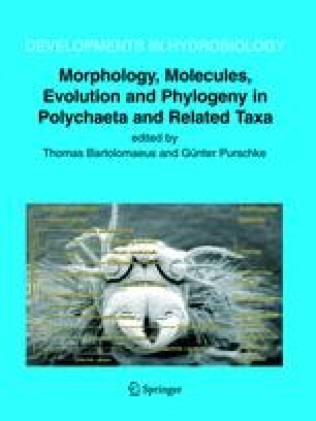
Morphology, Molecules, Evolution and Phylogeny in Polychaeta and Related Taxa; Proceedings of two ISSI Workshops, 18–22 October 1999 and 15–19 May 2000, Bern, Switzerland
Recently, evidence has been accumulated which shows that some of the groups formerly regarded as independent "phyla" such as Pogonophora (now recognized as Siboglinidae), Echiura, Myzostomida and perhaps Sipuncula, are most probably nothing else than greatly modified Annelida. The extreme morphological diversity found especially in Polychaeta displays the plasticity of a simple segmented organisation that basically is nothing else but a serial repetition of identical units. Thus, annelids are highly important to our understanding of fundamental questions about morphological and adaptive diversity, as well as clarifying evolutionary changes and phylogenetic relationships. The book aims to summarize our knowledge on Polychaetes polychaetes and their allies and gives an overview of recent advances gained by studies that employed conventional and modern methods plus, increasingly and importantly, the use of molecular markers and computer-assisted kinship analyses. It also reflects the state of art in polychaete sciences and presents new questions and controversies. As such it will significantly influence the direction of research on Polychaeta and their related taxa.

Gathering Hopewell : Society, Ritual and Ritual Interaction
In this book, twenty-one researchers in interwoven efforts immerse themselves and the reader in this vibrant archaeological record in order to richly reconstruct the faces, actions, and motivations Hopewellian people in their social and ritual life. Using a personalized and locally contextualized approach, the authors explore Hopewellian leadership, systems of social ranking and prestige, animal-totemic clan organization, kinship structures, sodalities, gender, community organizations, strategies of intercommunity alliance, and interregional travels for power questing, pilgrimage, healing, tutelage, and acquiring rituals.

Cooperation in Primates and Humans : Mechanisms and Evolution
Cooperative behavior has been one of the enigmas of evolutionary theory since the days of Darwin. The contributions to this book examine the many facets of cooperative behavior in primates and humans. Some of the world’s leading experts summarize and review the state of the art of theoretical and empirical studies of cooperation. This is the first attempt to bridge the gap between parallel research activities in primatology and studies of humans. This comparative approach highlights both common principles as well as aspects of human uniqueness with respect to cooperative behavior.

Kinship and Demographic Behavior in the Past
This book examines the role of kinship and the family’s influence on the health outcomes of their children, their children’s selection of marriage partners, couples having higher order births or reduced fertility, individual migration and origins of populations. Mortality patterns are examined to determine the influence of fertility patterns on parents’ mortality, the contribution of parents’ longevity to their children’s lifespan, and the whether a family history of disease affects the risk of dying from that same disease.This volume emphasizes the importance of studies that include and compare other factors related to social organization with information on multi-generational families. The authors elucidate previous explanations and provide provocative new results. Such intergenerational research is crucial in understanding long term demographic trends and processes.
Applied Mathematical Demography
it focus on applications of demographic models, while extending its scope to matrix models for stage-classified populations.first introduce the life table to describe age-specific mortality, and then use it to develop theory for stable populations and the rate of population increase. This theory is then revisited in the context of matrix models, for stage-classified as well as age-classified populations. Reproductive value and the stable equivalent population are introduced in both contexts, and Markov chain methods are presented to describe the movement of individuals through the life cycle. Applications of mathematical demography to population projection and forecasting, kinship, microdemography, heterogeneity, and multi-state models are considered.
