



الصفحة 1
الصفحة 1

Nonlinear Observers and Applications
The problem of state reconstruction in dynamical systems, known as observer problem, is undoubtedly crucial for controlling or just monitoring processes. For linear systems, the corresponding theory has been quite well established for several years now, and the purpose of the present book is to propose an overview on possible tools in that respect for nonlinear systems. Basic observability notions and observer structures are first recalled, together with ingredients for advanced designs on this basis. A special attention is then paid to the well-known high gain techniques with a summary of various corresponding recent results. A focus on the celebrated Extended Kalman filter is also given, in the perspectives of both nonlinear filtering and high gain observers, leading to so-called adaptive-gain observers. The more specific immersion approach for observer design is then emphasized, while optimization-based methods are also presented as an alternative to analytic observers.

Nonlinear kalman filtering for force-controlled robot tasks
This monograph focuses on how to achieve more robot autonomy by means of reliable processing skills. "Nonlinear Kalman Filtering for Force-Controlled Robot Tasks " discusses the latest developments in the areas of contact modeling, nonlinear parameter estimation and task plan optimization for improved estimation accuracy.

Modelling and Control of Mini-Flying Machines
Modelling and Control of Mini-Flying Machines is an exposition of models developed for various types of mini-aircraft. Modelling and Control of Mini-Flying Machines provides valuable insights to the application of real-time nonlinear techniques in an always challenging area.

Introduction to Mathematical Systems Theory : Linear Systems, Identification and Control
This book provides an introduction to the theory of linear systems and control for students in business mathematics, econometrics, computer science, and engineering. The focus is on discrete time systems, which are the most relevant in business applications, as opposed to continuous time systems, requiring less mathematical preliminaries. The subjects treated are among the central topics of deterministic linear system theory: controllability, observability, realization theory, stability and stabilization by feedback, LQ-optimal control theory. Kalman filtering and LQC-control of stochastic systems are also discussed, as are modeling, time series analysis and model specification, along with model validation.

Environment Learning for Indoor Mobile Robots : A Stochastic State Estimation Approach to Simultaneous Localization and Map Building
This monograph covers theoretical aspects of simultaneous localization and map building for mobile robots, such as estimation stability, nonlinear models for the propagation of uncertainties, temporal landmark compatibility, as well as issues pertaining the coupling of control and SLAM. One of the most relevant topics covered in this monograph is the theoretical formalism of partial observability in SLAM. The authors show that the typical approach to SLAM using a Kalman filter results in marginal filter stability, making the final reconstruction estimates dependant on the initial vehicle estimates. However, by anchoring the map to a fixed landmark in the scene, they are able to attain full observability in SLAM, with reduced covariance estimates.

Data assimilation fundamentals : A unified formulation of the state and parameter estimation problem
This textbook's significant contribution is the unified derivation of data-assimilation techniques from a common fundamental and optimal starting point, namely Bayes' theorem. Unique for this book is the "top-down" derivation of the assimilation methods. It starts from Bayes theorem and gradually introduces the assumptions and approximations needed to arrive at today's popular data-assimilation methods. This strategy is the opposite of most textbooks and reviews on data assimilation that typically take a bottom-up approach to derive a particular assimilation method.

Data Assimilation : The Ensemble Kalman Filter
Data Assimilation comprehensively covers data assimilation and inverse methods, including both traditional state estimation and parameter estimation. This text and reference focuses on various popular data assimilation methods, such as weak and strong constraint variational methods and ensemble filters and smoothers. It is demonstrated how the different methods can be derived from a common theoretical basis, as well as how they differ and/or are related to each other, and which properties characterize them, using several examples.It presents the mathematical framework and derivations in a way which is common for any discipline where dynamics is merged with measurements. The mathematics level is modest, although it requires knowledge of basic spatial statistics, Bayesian statistics, and calculus of variations. Readers will also appreciate the introduction to the mathematical methods used and detailed derivations, which should be easy to follow, are given throughout the book. The codes used in several of the data assimilation experiments are available on a web page.The focus on ensemble methods, such as the ensemble Kalman filter and smoother, also makes it a solid reference to the derivation, implementation and application of such techniques. Much new material, in particular related to the formulation and solution of combined parameter and state estimation problems and the general properties of the ensemble algorithms, is available here for the first time.
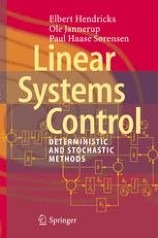
Linear Systems Control : Deterministic and Stochastic Methods
Modern control theory and in particular state space or state variable methods can be adapted to the description of many different systems because it depends strongly on physical modeling and physical intuition. The laws of physics are in the form of differential equations and for this reason, this book concentrates on system descriptions in this form. This means coupled systems of linear or nonlinear differential equations. The physical approach is emphasized in this book because it is most natural for complex systems. It also makes what would ordinarily be a difficult mathematical subject into one which can straightforwardly be understood intuitively and which deals with concepts which engineering and science students are already familiar.
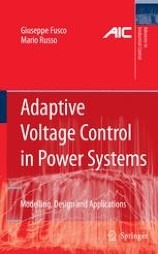
Adaptive Voltage Control in Power Systems : Modeling, Design and Applications
Adaptive Voltage Control in Power Systems, a self-contained blend of theory and novel application, is an in-depth treatment of such adaptive control schemes. The reader moves from power-system-modelling problems through illustrations of the main adaptive control systems (self-tuning, model-reference and nonlinearities compensation) to a detailed description of design methods: Kalman filtering, parameter-identification algorithms and discrete-time controller design are all represented. Case studies address applications issues in the implementation of adaptive voltage control.
