



الصفحة 1
الصفحة 1

International Handbook on Globalisation, Education and Policy Research : Global Pedagogies and Policies
The aim of this Handbook is to present a global overview of developments in education and policy change during the last decade. It has the objective of providing both a strategic education policy statement on recent shifts in education and policy research globally and offers new approaches to further exploration, development and improvement of education and policy making.attempts to address some of the above issues and problems confronting educators and policy makers globally. Different articles seek to conceptualize the on-going problems of education policy formulation and implementation, and provide a useful synthesis of the education policy research conducted in different countries, and practical implications.

Education and Social Justice
The book explores the problematic relationship between education, social justice and the State, against the background of comparative education research. Social justice is an attempt to answer the following question: How can we contribute to the creation of a more equitable, respectful, and just society for everyone? The creation of a more equitable, respectful, and just society for everyone is a dream for all empowering and egalitarian pedagogues. But it will remain a mere hollow rhetoric, or magic words, unless we debate more vigorously social inequality in the global culture. The book critiques the existing status quo of stratified school systems, and the unequal disctribution of cultural capital and value added schooling.

Education and Social Inequality in the Global Culture
The book critically examines the overall interplay between globalisation, social inequality and education. It draws upon recent studies in the areas of globalisation, educational inequalities and the role of the State. It explores conceptual frameworks and methodological approaches applicable in the research covering the State, globalisation, social stratification and education. It demonstrates the neo-liberal ideological imperatives of education and policy reforms, and illustrates the way the relationship between the State and education policy affects current models and trends in education reforms and schooling globally. Various book chapters critique the dominant discourses and debates pertaining to the newly constructed and re-invented models of neo-liberal ideology in education, set against the current climate of growing social stratification and unequal access to quality education for all.
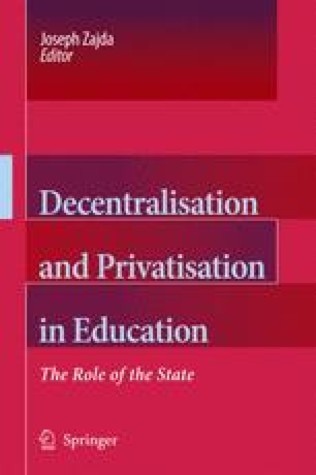
Decentralisation and Privatisation in Education : The Role of the State
The book examines the overall interplay between privatisation, decentralisation and the role of the state. The authors draw upon recent studies in the areas of decentralisation, privatisation and the role of the state in education. By referring to Bourdieu’s call for critical policy analysts to engage in a ‘critical sociology’ of their own contexts of practice, and poststructuralist and postmodernist pedagogy, this collection of book chapters demonstrate how central discourses surrounding the debate of privatisation, decentralisation and the role of the state are formed in the contexts of dominant ideology, power, and culturally and historically derived perceptions and practices.
Comparative and Global Pedagogies : Equity, Access and Democracy in Education
This book critically examines equality, equity and democracy in education, globally as well as from various perspectives. Globally, there are increasing arguments both for the democratization of education and for the use of education to promote a democratic society. It is argued that democratic schools would better prepare for active citizenship and for a strong civil society which are seen to be the foundation of a democratic state. The book further argues that while there are inspiring examples of schools that engage in peace education or emancipatory pedagogy that work across various ethnic or religious divides, on balance, the forms, structures, ideologies and purposes of formal education interact to make national and international conflict more likely.
