



الصفحة 1
الصفحة 1

Designing Inclusive Futures
Designing Inclusive Futures reflects the need to explore, in a coherent way, the issues and practicalities that lie behind design that is intended to extend our active future lives. This encompasses design for inclusion in daily life at home but also extends to the workplace and for products within these contexts.

Designing Accessible Technology
This book was stimulated by the third CWUAAT workshop, held in Cambridge, England in April 2006; the contributors representing leading researchers in the fields of Inclusive Design, Rehabilitation Robotics, Universal Access and Assistive Technology. Contributions focus on the following topics: design issues for a more inclusive world / enabling computer access and the development of new technologies / assistive technology and rehabilitation robotics and understanding users and involving them in design.

Design process Improvement : A review of current practice
Intended for business leaders who want to understand the role of design management as a driver for commercial success; design managers who want to improve their company design procedures; designers who want to know how to design more efficiently and researchers who want to explore the field of design process improvement
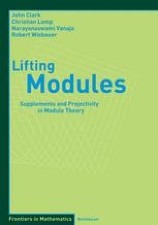
Lifting Modules : Supplements and Projectivity in Module Theory
Extending modules are generalizations of injective modules and, dually, lifting modules generalize projective supplemented modules. There is a certain asymmetry in this duality. While the theory of extending modules is well documented in monographs and text books, the purpose of our monograph is to provide a thorough study of supplements and projectivity conditions needed to investigate classes of modules related to lifting modules. The text begins with an introduction to small submodules, the radical, variations on projectivity, and hollow dimension. The subsequent chapters consider preradicals and torsion theories (in particular related to small modules), decompositions of modules (including the exchange property and local semi-T-nilpotency), supplements in modules (with specific emphasis on semilocal endomorphism rings), finishing with a long chapter on lifting modules, leading up their use in the theory of perfect rings, Harada rings, and quasi-Frobenius rings.
