



الصفحة 1
الصفحة 1

Multi-Photon Quantum Interference
Multi-Photon Quantum Interference covers the phenomena of quantum interference through the multi-photon effects of photon correlation. The author’s focus is on the temporal correlation among photons and how it influences the interference effect.

Frontiers of Optical Spectroscopy ; Investigating Extreme Physical Conditions with Advanced Optical Techniques
Advanced spectroscopic techniques allow the probing of very small systems and very fast phenomena, conditions that can be considered "extreme" at the present status of our experimentation and knowledge. Quantum dots, nanocrystals and single molecules are examples of the former and events on the femtosecond scale examples of the latter. The purpose of this book is to examine the realm of phenomena of such extreme type and the techniques that permit their investigations. Each author has developed a coherent section of the program starting at a somewhat fundamental level and ultimately reaching the frontier of knowledge in the field in a systematic and didactic fashion. The formal lectures are complemented by additional seminars.

Demonstrational Optics ; Part 2 : Coherent and Statistical Optics
Demonstrational Optics presents a new didactical approach to the study of optics. Emphasizing the importance of elaborate new experimental demonstrations, pictorial illustrations, computer simulations and models of optical phenomena in order to ensure a deeper understanding of wave and geometric optics.
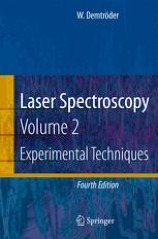
Laser Spectroscopy : Vol.2 Experimental Techniques
Keeping abreast of the latest techniques and applications, this new edition of the standard reference and graduate text on laser spectroscopy has been completely revised and expanded. While the general concept is unchanged, the new edition features a broad array of new material, e.g. frequency doubling in external cavities, reliable cw-parametric oscillators, tunable narrow-band UV sources, more sensitive detection techniques, tunable femtosecond and sub-femtosecond lasers (X-ray region and the attosecond range), control of atomic and molecular excitations, frequency combs able to synchronize independent femtosecond lasers, coherent matter waves, and still more applications in chemical analysis, medical diagnostics, and engineering.
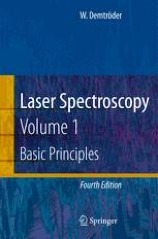
Laser Spectroscopy : Vol.1 Basic Principles
Keeping abreast of the latest techniques and applications, this new edition of the standard reference and graduate text on laser spectroscopy has been completely revised and expanded. While the general concept is unchanged, the new edition features a broad array of new material, e.g., frequency doubling in external cavities, reliable cw-parametric oscillators, tunable narrow-band UV sources, more sensitive detection techniques, tunable femtosecond and sub-femtosecond lasers (X-ray region and the attosecond range), control of atomic and molecular excitations, frequency combs able to synchronize independent femtosecond lasers, coherent matter waves, and still more applications in chemical analysis, medical diagnostics, and engineering.

Adaptive optics for industry and medicine ; Proceedings of the 4th International Workshop, Münster, Germany, Oct. 19-24, 2003
This book treats the development and application of adaptive optics for industry and medicine. The contributions describe recently developed components for adaptive-optics systems such as deformable mirrors, wavefront sensors, and mirror drivers as well as complete adaptive optical systems and their applications in industry and medicine. Applications range from laser-beam forming and adaptive aberration correction for high-power lasers to retinal imaging in ophthalmology. The contributions are based on presentations made at the 4th International Workshop on Adaptive Optics in Industry and Medicine which took place in Münster, Germany, in October 2003. This highly successful series of workshops on adaptive optics started in 1997 and continues with the 5th workshop in Beijing in 2005.
