



الصفحة 1
الصفحة 1

Interfacial Convection in Multilayer Systems
This book contains a systematic investigation of the convection in systems with interfaces. For the first time, it classifies all of the known types of convective instabilities in such systems, and discusses the peculiarities of multilayer systems. The book provides an overview of the wide variety of steady and oscillatory patterns, waves, and other dynamic phenomena characteristic for multilayer fluid systems. Various physical effects, including heat and mass transfer, thermal and mechanical couplings on the interfaces, interfacial deformability, the influence of surfactants on different types of convective motions are investigated.

Fundamentals of Structural Dynamics : Theory and Computation
Emphasizes numerical methods, nonlinear response of structures, and the analysis of continuous systems (e.g., wave propagation). Fundamentals of Structural Dynamics: Theory and Computation builds the theory of structural dynamics from simple single-degree-of-freedom systems through complex nonlinear beams and frames in a consistent theoretical context supported by an extensive set of MATLAB codes that not only illustrate and support the principles, but provide powerful tools for exploration. The book is designed for students learning structural dynamics for the first time but also serves as a reference for professionals throughout their careers.

Fluid dynamics of cavitation and cavitating turbopumps
The book focuses on the fluid dynamics of cavitation with special reference to high power density turbopumps, where it represents the major source of performance and life degradation and often generates the conditions for the onset of dangerous fluid dynamic instabilities. To this purpose the first part of the book covers the more fundamental aspects of cavitation (nucleation, bubble dynamics, thermodynamic effects, cavitation erosion, stability of parallel bubbly flows) and the main kinds of cavitating flows (attached cavitation, cloud cavitation, supercavitation, ventilated supercavities, vortex cavitation, shear cavitation). The second part focuses on the hydrodynamics and instabilities of cavitating turbopumps (cavitation surge, rotating cavitation, higher order cavitation surge, rotordynamic whirl forces). Finally, the third part illustrates the alternative approaches for modeling and engineering simulation of cavitating flows.

Electromagnetic Field Matter Interactions in Thermoelasic Solids and Viscous Fluids
This book in two parts delivers a thorough derivation of nonrelativistic interaction models of electromagnetic field theories with thermoelastic solids and viscous fluids, the intention being to derive unique representations for the observable field quantities. Part I, a revised and updated version of LNP 88 "Field Matter Interactions in Thermoelastic Solids," investigates the foundations and the equivalence of various formulations of the interaction of the electromagnetic field with thermoelastic solids in the classical continuum physics limit, while Part II extensively surveys two major fields of applications, namely, magnetoelastic instabilities and vibrations, and electrorheological fluids.

Cosmic Ray Interactions, Propagation, and Acceleration in Space Plasmas
"The book consists of four Chapters. Chapter 1 shortly describes main properties of space plasmas and primary CR, different types of CR interactions with space plasmas components Chapter 2 considers the problem of CR propagation in space plasmas described by the kinetic equation and different types of diffusion approximations ,Chapter 3 is devoted to CR non-linear effects in space plasmas caused by CR pressure and CR kinetic stream instabilities with the generation of Alfvèn turbulence In Chapter 4 different processes of CR acceleration in space plasmas are considered: the development of the Fermi statistical mechanism, acceleration in the turbulent plasma, Alfven mechanism of magnetic pumping, induction mechanisms, acceleration during magnetic collapse and compression, cumulative acceleration mechanism near the zero lines of a magnetic field, acceleration in shear flows, shock-wave diffusion (regular) acceleration. The book ends with a list providing more than 1,300 full references, a discussion on future developments and unsolved problems, as well as Object and Author indexes. "

Collective Phenomena in Synchrotron Radiation Sources : Prediction, Diagnostics, Countermeasures
This book helps to dispel the notion that collective phenomena, which have become increasingly important in modern storage rings, are an obscure and inaccessible topic. Despite an emphasis on synchrotron light sources, the basic concepts presented here are valid for other facilities as well. Graduate students, scientists and engineers working in an accelerator environment will find this to be a systematic exposition of the principles behind collective instabilities and lifetime-limiting effects. Experimental methods to identify and characterize collective effects are also surveyed. Among other measures to improve the performance of a projected or existing facility, a detailed account of feedback control of instabilities is given.
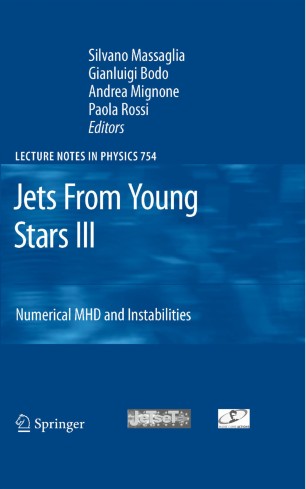
Jets From Young Stars III : Numerical MHD and Instabilities
This volume contains the lecture notes of the Third JETSET School on Jets from Young Stars focussing on Numerical MHD and Instabilities. The introductory lectures presented here cover the basic concepts of the numerical methods for the integration of hydrodynamic and magnetohydrodynamic equations and of the applications of these methods to the treatment of the instabilities relevant for the physics of stellar jets. The first part of the book contains an introduction to the finite difference and finite volume methods for computing the solutions of hyperbolic partial differential equations and a discussion of approximate Riemann solvers for both hydrodynamic and magnetohydrodynamic problems. The second part is devoted to the discussion of some of the main instability processes that may take place in stellar jets, namely: the Kelvin-Helmholtz, the radiative shock, the pressure driven and the thermal instabilities.

Compressor Instability with Integral Methods
Compressor Instability with Integral Methods" is a book, to bring together the quick integral approaches and advances in the field for the prediction of stall and surge problem in compressor. This book is useful for people involved in the flow analysis, design and testing of rotating machinery. For students, it can be used as a specialized topic of senior undergraduate or graduate study. The book can also be served as a self-study material to those who keen to acquire this knowledge. In brief, this book focuses on the numerical/computational analysis for the effect of distorted inlet flow propagation on the rotating stall and surge in axial compressors. It gains insight into the basic phenomena controlling these flow instabilities, and reveals the influence of inlet parameters on rotating stall and surge.

Bifurcations, Instabilities, Degradation in Geomechanics
Leading international researchers and practitioners of bifurcations and instabilities in geomechanics debate the developments and applications which have occurred over the last few decades. The topics covered include modeling of bifurcation, structural failure of geomaterials and geostructures, advanced analytical, numerical and experimental techniques, and application and development of generalised continuum models etc. In addition analytical solutions, numerical methods, experimental techniques, and case histories are presented. Beside fundamental research findings, applications in geotechnical, petroleum, mining, and bulk materials engineering are emphasised.
