



الصفحة 1
الصفحة 1

Nanoinformatics
Brings out the state of the art on how informatics-based tools are used and expected to be used in nanomaterials research. There has been great progress in the area in which “big-data” generated by experiments or computations are fully utilized to accelerate discovery of new materials, key factors, and design rules. Data-intensive approaches play indispensable roles in advanced materials characterization. "Materials informatics" is the central paradigm in the new trend. "Nanoinformatics" is its essential subset, which focuses on nanostructures of materials such as surfaces, interfaces, dopants, and point defects, playing a critical role in determining materials properties. There have been significant advances in experimental and computational techniques to characterize individual atoms in nanostructures and to gain quantitative information. The collaboration of researchers in materials science and information science is growing actively and is creating a new trend in materials science and engineering.
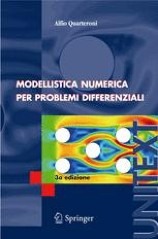
Modellistica Numerica per Problemi Differenziali = Numerical Modeling for Differential Problems
This text introduces the fundamental concepts for the numerical modeling of partial differential problems. We consider the classic linear elliptic, parabolic and hyperbolic equations, but also other equations, such as those of diffusion and transport, of Navier-Stokes, and the conservation laws. Numerous physical examples underlying these equations are provided, their main mathematical properties are studied, then numerical resolution methods based on finite elements, finite differences, finite volumes and spectral methods are proposed and analyzed. In particular, the algorithmic and computer implementation aspects are discussed and some easy-to-use programs in C ++ language are provided. The text does not presuppose an advanced mathematical knowledge of partial differential equations: the strictly indispensable concepts in this regard are reported in the Appendix. The volume is therefore suitable for students of scientific degree courses (Engineering, Mathematics, Physics, Chemistry, Information Sciences) and recommended for researchers from the academic and extra-academic world who want to approach this interesting branch of applied mathematics.

Modelling and Identification with Rational Orthogonal Basis Functions
Models of dynamical systems are of great importance in almost all fields of science and engineering and specifically in control, signal processing and information science.

Medical Reprints: 3D ed.
3D printing or additive manufacturing is a novel method of manufacturing parts directly from a digital model by using layer by layer material build-up approaches. This discovery is predicted to have the greatest impact on the future industries. Additive manufacturing has numerous applications in different areas including healthcare. Applications encompass many medical fields such as dentistry, surgery, and medical devices as well as the pharmaceutical field. Due to transplant donor deficiencies, ‘bioprinting’ has been invented to print biocompatible organs. Adding ‘time’ as a 4th dimension, 4D printing uses ‘smart materials’ to initiate the ‘smart drugs’ era.

Introduzione al Calcolo Scientifico : Esercizi e problemi risolti con MATLAB = Introduction to scientific computing : Exercises and problem solved with MATLAB
Introduces the fundamental concepts for the numerical modeling of partial differential problems. We consider the classic linear elliptic, parabolic and hyperbolic equations, but also other equations, such as those of diffusion and transport, of Navier-Stokes, and the conservation laws. Numerous physical examples underlying these equations are provided, their main mathematical properties are studied, then numerical resolution methods based on finite elements, finite differences, finite volumes and spectral methods are proposed and analyzed. In particular, the algorithmic and computer implementation aspects are discussed and some easy-to-use programs in C ++ language are provided. The text does not presuppose an advanced mathematical knowledge of partial differential equations: the strictly indispensable concepts in this regard are reported in the Appendix. THE VOLUME is therefore suitable for students of scientific degree courses (Engineering, Mathematics, Physics, Chemistry, Information Sciences) and recommended for researchers from the academic and extra-academic world who want to approach this interesting branch of applied mathematics.

Intelligent Control and Automation ; International Conference on Intelligent Computing, ICIC 2006, Kunming, China, August, 2006
"Intelligent Control and Automation" constitutes the results of the International Conference on Intelligent Computing, ICIC 2006, held in Kunming, China, in August 2006. Lecture Notes in Computer Science (LNCS), Lecture Notes in Artificial Intelligence (LNAI), Lecture Notes in Bioinformatics (LNBI), Lecture Notes in Control and Information Sciences (LNCIS). Includes a Special Session on Smart and Intelligent Home Technology.

Intelligent Computing in Signal Processing and Pattern Recognition ; International Conference on Intelligent Computing, ICIC 2006, Kunming, China, August, 2006
Constitutes the results of the International Conference on Intelligent Computing, ICIC 2006, held in Kunming, China, in August 2006. The carefully reviewed contributions are included in five volumes of edited books, including one volume of Lecture Notes in Computer Science (LNCS), one volume of Lecture Notes in Artificial Intelligence (LNAI), one volume of Lecture Notes in Bioinformatics (LNBI), and two volumes of Lecture Notes in Control and Information Sciences (LNCIS). The 149 revised full papers of this volume were reviewed and selected from over 3000 submissions, covering the field of Intelligent Computing in Signal Processing and Pattern Recognition, as well as a Special Session on Computing for Searching Strategies to Control Dynamic Processes.

Innovations in 3D Geoinformation Science
Covers various aspects of spatial data modelling specifically regarding three-dimensional (3D) modelling and structuring. The realization of "true" 3D geoinformation spatial systems requires a high input, and the developmental process is taking place in various research centers and universities around the globe.

Innovations and Advanced Techniques in Computer and Information Sciences and Engineering
Innovations and Advanced Techniques in Computer and Information Sciences and Engineering is a collection of world class paper articles addressing the following topics: Signal and Image Processing: Content Based Video Retrieval, Character Recognition, Incremental Learning for Speech Recognition, Signal Processing Theory and Methods, and Vision-based Monitoring Systems. Software and Systems: Activity-Based Software Estimation, Algorithms, Genetic Algorithms, Information Systems Security, Programming Languages, Software Protection Techniques, Software Protection Techniques, and User Interfaces. Distributed Processing: Asynchronous Message Passing System, Heterogeneous Software Environments, Mobile Ad Hoc Networks, Resource Allocation, and Sensor Networks. Advanced and innovative techniques in computing: e-Science and Virtual Instrumentation, Fault-Tolerant Scheduling, Grid Computing, Microcracking in Cortical Bones, Service-oriented Architectures, and Virtualization in Data Warehouses.
Information Science and Applications ; Proceedings of ICISA 2020
This book presents select proceedings of 11th International Conference on Information Science and Applications 2020 (ICISA 2020) and provides a snapshot of the latest issues encountered in technical convergence and convergences of security technology. It explores how information science is core to most current research, industrial and commercial activities and consists of contributions covering topics including Ubiquitous Computing, Networks and Information Systems, Multimedia and Visualization, Middleware and Operating Systems, Security and Privacy, Data Mining and Artificial Intelligence, Software Engineering, and Web Technology. Also the proceedings introduce the most recent information technology and ideas, applications and problems related to technology convergence, illustrated through case studies, and reviews converging existing security techniques. Through this book, readers can gain an understanding of the current state-of-the-art information strategies and technologies of convergence security.

Information Fusion and Geographic Information Systems ; Proceedings of the Third International Workshop
This volume contains the papers presented at the International Workshop “Inf- mation Fusion and Geographical Information Systems” (IF&GIS’07) held in St. Petersburg, Russia, 2007. Research in the Geosciences field interprets the concept of Information Fusion as a synonym of an approach that permits research into all the problems and issues which program-makers and scientific researchers are faced with. Thus, topics that are to be covered during the workshop relate to issues such as harmonization, - tegration and information fusion. At the same time the spectrum of problems - der discussion exceeds the current bounds of developing GIS applications. This is a significant modern trend since GIS technology is more often used as an interface in support and decision making systems. As a result, it is difficult to consider Geoinformation Science without considering related scientific directions such as Ontology, Artificial Intelligent Systems and Situation Management.

Information context : Nature, impact, and role ; 5th International conference on Conceptions of Library and Information Sciences, CoLIS 2005, Glasgow, UK, June 4-8, 2005 Proceedings
.CoLIS examinesthehistorical,theoretical,empiricalandtechnicalissuesrelatingtoour understanding and use of information, promoting an interdisciplinary approach to research. CoLIS seeks to provide a broad platform for the examination of context as it relates to our theoretical, empirical and technical development of information-centered disciplines. The theme for CoLIS 5 was the nature, impact and role of context within information-centered research. Context is a complex, dynamic and multi- - mensional concept that in?uences both humans and machines: how they behave individually and how they interact with each other. In CoLIS 5 we took an interdisciplinary approach to the issue of context to help us understand and the theoretical approaches to modelling and understanding context, incorporate contextual reasoning within technology, and develop a shared framework for promoting the exploration of context.
Information and self-organization : A macroscopic approach to complex systems
This book presents the concepts needed to deal with self-organizing complex systems from a unifying point of view that uses macroscopic data. The various meanings of the concept "information" are discussed and a general formulation of the maximum information (entropy) principle is used. With the aid of results from synergetics, adequate objective constraints for a large class of self-organizing systems are formulated and examples are given from physics, life and computer science. The relationship to chaos theory is examined and it is further shown that, based on possibly scarce and noisy data, unbiased guesses about processes of complex systems can be made and the underlying deterministic and random forces determined. This allows for probabilistic predictions of processes, with applications to numerous fields in science, technology, medicine and economics. The extensions of the third edition are essentially devoted to an introduction to the meaning of information in the quantum context. Indeed, quantum information science and technology is presently one of the most active fields of research at the interface of physics, technology and information sciences and has already established itself as one of the major future technologies for processing and communicating information on any scale.

Immunoinformatics
Immunoinformatics is an emerging subdiscipline of bioinformatics. It utilizes mathematics, information science, computer engineering, genomics, proteomics and immunological methods to bridge immunology and informatics. Similar to bioionformatics which became a driving force in genome research, immunoinformatics enables data-driven research strategies and systems approaches that aim at understanding the networks regulating the immune system. Considering the breath of topic, Immunoinformatics was composed to provide a cross-section of research ranging from data integration, epitope predictions to systems level applications. In ten chapters experts in the field introduce and discuss research strategies for immunologists and bioinformaticians who wish to endeavour existing and new approaches to gain insight into the workings of the immune system.

Health Information Science ; 9th International Conference, HIS 2020, Amsterdam, The Netherlands, October 20–23, 2020, Proceedings
This book constitutes the proceedings of the 9th International Conference on Health Information Science, HIS 2020, which took place in Amsterdam, The Netherlands, during October 20-23, 2020. The 11 full papers and 6 short papers presented in this volume were carefully reviewed and selected from 62 submissions. They were organized in topical sections named: mental health; medical record processing; medical information systems; medical diagnosis with machine learning; and health behavior and medication.

Handbook of research on methodologies for design and production practices in interior architecture
The aim of this book is to broaden the understanding of the processes in the practice of architectural design, presenting new approaches and alternative methods in the field of Interior Architecture

Geographic Information Science ; 5th International Conference, GIScience 2008, Park City, UT, USA, September 23-26, 2008. Proceedings
This book constitutes the refereed proceedings of the 5th International Conference on Geographic Information Secience, GIScience 2008, held in Park City, UT, USA, in September 2008.The 24 revised full papers presented were carefully reviewed and selected from 77 submissions. Among the traditional topics addressed are spatial relations, geographic dynamics, and spatial data types. A significant number of papers deal with navigation networks, location-based services, and spatial information query and retrieval. Geo-sensors, mobile computing, and Web mapping rank among the important new directions.
Geographic Information Science ; 4th International Conference, GIScience 2006, Münster, Germany, September 20-23, 2006, Proceedings
The GIScience conference series (www. giscience. org) was created as a forum for all researchers who are interested in advancing research in the fundam- tal aspects of geographic information science.The conferences focus on emerging topics and basic research ?ndings across all s- tors of geographic information science. After three highly successful conferences in the United States, this year’s GIScience conference was held in Europe for the ?rst time. The GIScience conferences have been a meeting point for researchers coming from various disciplines, including cognitive science, computer science, engine- ing, geography,information science, mathematics, philosophy, psychology,social science, and statistics. The advancement of geographic information science - quiressuchinterdisciplinarybreadth,andthisisalsowhatmakestheconferences so exciting. In order to account for the di?erent needs of the involved scienti?c disciplines with regard to publishing their research results.

Geographic Hypermedia : Concepts and Systems
This book introduces a new paradigm, Geographic Hypermedia, which emerges from the convergence of Geographic Information Science and - permedia technology. Both GI Science and hypermedia have been rapidly evolving fields. The initial idea of Geographic Hypermedia was born in 2004 when the editors had been invited to organize a workshop in conju- tion with the ‘Hypertext’ conference organized annually by the Special - terest Group of the Association for Computing Machinery. The purpose of the workshop was to examine how hypermedia concepts and tools may be applied in geographical domains. The workshop was eventually held in conjunction with the Maps and the Internet Commission of the International Cartographic Association at the annual meeting of the Association of American Geographers in Denver, Colorado, in April 2005. The Denver workshop was a successful event, bringing together mul- disciplinary researchers and professionals in the area of Geographic - permedia.

Encyclopedia of GIS "Geographical Information Sciences"
provides up-to-date information on emerging topics such as spatial big data, smart-phone GIS, urban computing and mobile recommender systems. It also expands the first edition’s rich set of GIS-related commercial and societal applications such as geo-targeting, geo-fencing and understanding climate changes, while enabling more comprehensive coverage of classical GIS topics such as map projections, global positioning systems and spatial cognition. The entries explain the key software, data sets and processes used by geographers and computational scientists. Additionally, the reference emphasizes the role of GIS in business and mobile intelligence. By offering more diversified GIS-related topics from theory and research than most of the other available literature, the authors equip newcomers to the field with principles as well as applications.
