



الصفحة 1
الصفحة 1

Discontinuous Galerkin Methods for Viscous Incompressible Flow
Guido Kanschat reviews several discontinuous Galerkin schemes for elliptic and viscous flow problems. Setting out from Nitsche's method for weak boundary conditions, he studies the interior penalty and LDG methods. Combined with a stable advection discretization, they yield stable DG methods for linear flow problems of Stokes and Oseen type which are applied to the Navier-Stokes problem. The author not only presents the analytical techniques used to study these methods but also devotes a major discussion to the efficient numerical solution of discrete problems.

Computational Turbulent Incompressible Flow: Applied Mathematics : Body and Soul 4
This is Volume 4 of the book series of the Body & Soul mathematics education reform program, and presents a unified new approach to computational simulation of turbulent.

Computational Fluid Dynamics for Engineers
This book introduces a wide range of Computational Fluid Dynamics (CFD) methods used in the aerospace industry to solve engineering problems. Its format is arranged so that students and practicing engineers can understand the fundamental principles used in CFD, with sample computer programs for the solution of model problems. The emphasis is on two-dimensional equations in order to present the material in a modest sized book. Source codes for selected problems are given so that the reader can understand how those methods are implemented in FORTRAN and C languages, while exercises provide more hands-on experience.
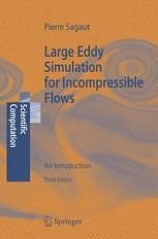
Large Eddy Simulation for Incompressible Flows : An Introduction
First concise textbook on Large-Eddy Simulation, a very important method in scientific computing and engineeringFrom the foreword to the third edition written by Charles Meneveau: ".

Characteristics Finite Element Methods in Computational Fluid Dynamics
This book details a systematic characteristics-based finite element procedure to investigate incompressible, free-surface and compressible flows. The fluid dynamics equations are derived from basic thermo-mechanical principles and the multi-dimensional and infinite-directional upstream procedure is developed by combining a finite element discretization of a characteristics-bias system with an implicit Runge-Kutta time integration. For the computational solution of the Euler and Navier Stokes equations, the procedure relies on the mathematics and physics of multi-dimensional characteristics. As a result, the procedure crisply captures contact discontinuities, normal as well as oblique shocks, and generates essentially non-oscillatory solutions for incompressible, subsonic, transonic, supersonic, and hypersonic inviscid and viscous flows.
