



الصفحة 1
الصفحة 1
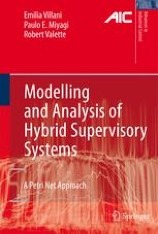
Modelling and Analysis of Hybrid Supervisory Systems : A Petri Net Approach
Modelling and Analysis of Hybrid Supervisory Systems introduces a modelling formalism that merges Petri nets, differential equation systems and object-oriented methods; a formalism that is adequate for modelling complex and large-scale systems. To guide the designer and conduct hybrid modelling, the book describes a method that starts from the requirements of a supervisory system and results in a proposal for such a system. The method is mainly based on Unified Modelling Language diagrams, well-known tools in both academia and industry. In order to ensure that the supervisory system will behave as expected under any operational circumstances, a validation procedure that allows verification of the formal properties of the hybrid model is presented.

Modeling Solid Oxide Fuel Cells : Methods, Procedures and Techniques
The volume is structured in two parts. Part one presents the basic theory, and the general equations describing SOFC operation phenomena. Part two deals with the application of the theory to practical examples, where different SOFC geometries, configurations (from single cells to hybrid systems), operating conditions (steady-state and dynamic), and different phenomena (e.g. performance, temperature and chemical species, and mechanical stress distribution) are analyzed in detail.
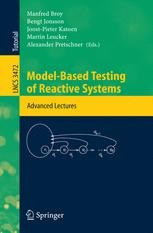
Model-Based Testing of Reactive Systems : Advanced Lectures
This book is based on a seminar held in Dagstuhl Castle, Germany, in January 2004. It presents 19 carefully reviewed and revised lectures given at the seminar in a well-balanced way ensuring competent complementary coverage of all relevant aspects. An appendix provides a glossary for model-based testing and basics on finite state machines and on labelled transition systems. The lectures are presented in topical sections on testing of finite state machines, testing of labelled transition systems, model-based test case generation, tools and case studies, standardized test notation and execution architectures, and beyond testing.

Mathematical Problems from Applied Logic II : Logics for the XXIst Century
Mathematical Problems from Applied Logic II presents chapters from selected, world renowned, logicians. Important topics of logic are discussed from the point of view of their further development in light of requirements arising from their successful application in areas such as Computer Science and AI language. Fields covered include: logic of provability, applications of computability theory to biology, psychology, physics, chemistry, economics, and other basic sciences; computability theory and computable models; logic and space-time geometry; hybrid systems; logic and region-based theory of space.

Hybrid Systems: Computation and Control ; 10th International Workshop, HSCC 2007, Pisa, Italy, April 3-5, 2007, Proceedings
Constitutes the refereed proceedings of the 10th International Conference on Hybrid Systems: Computation and Control, HSCC 2007, held in Pisa, Italy in April 2007.

Hybrid Systems : Computation and Control ; Vol.3927 ; 9th International Workshop, HSCC 2006, Santa Barbara, CA, USA, March 29-31, 2006, Proceedings
The focus is on modeling, analysis, and implementation of dynamic and reactive systems involving both discrete and continuous behaviors. Topics addressed include tools for analysis and verification, control and optimization, modeling, engineering applications, and new directions in language support and implementation.
Hybrid Systems : Computation and Control ; 11th International Workshop, HSCC 2008, St. Louis, MO, USA, April 22-24, 2008. Proceedings
Contains the proceedings ofthe 11th Workshop on Hybrid Systems: Computation and Control (HSCC 2008) held in St. Louis, Missouriduring April 22–24,2008.The annual workshop on hybrid systems focuses on research inbedded ,reactive systems in volving theinterplay between symbolic/switchingand continuous dynamical behaviors. HSCC attracts academic as well as industrial researchers to exchange information on the latest developments of applications and theoretical advancements in the design, analysis, control, optimization, and implementation of hybrid systems, with particular attention to embedded and networked control systems. We would like to thank the Program Committee members and the reviewers for an excellent job of evaluating the submissions and participating in the online Program Committee discussions.

Hybrid Systems : Computation and Control ; Vol. # 3414 ; 8th International Workshop, HSCC 2005, Zurich, Switzerland, March 9-11, 2005, Proceedings
Contains the proceedings of the 8th Workshop on Hybrid S- tems: Computation and Control(HSCC2005)heldinZurich, Switzerlandduring March 9-11, 2005. The annual workshop on hybrid systems attracts researchers from academia and industry interested in modeling, analysis, and implemen- tion of dynamic and reactive systems involving both discrete and continuous - haviors. This year's HSCC was technically co-sponsored by the IEEE Control Systems Society. The program consisted of 3 invited talks and 40 regular papers selected from 91 regular submissions. The program covered topics such as tools for analysis and verification, control and optimization, modeling, engineering applications, and emerging directions in programming language support and implementation. We would like to thank the Program Committee members and reviewers for an excellent job of evaluating the submissions and participating in the online Program Committee discussions.

Hybrid Intelligent Systems : Analysis and Design
The objective of this edited volume is to offer a general view at the recent conceptual developments of Soft Computing (SC) regarded as a general methodology supporting the design of hybrid systems along with their diversified applications to modeling, simulation and control of non-linear dynamical systems. As of now, SC methodologies embrace neural networks, fuzzy logic, genetic algorithms and chaos theory. Each of these methodologies exhibits well delineated advantages and disadvantages. Interestingly, they have been found useful in solving a broad range of problems. However, many real-world complex problems require a prudent, carefully orchestrated integration of several of these methodologies to fully achieve the required efficiency, accuracy, and interpretability of the solutions. In this edited volume, an overview of SC methodologies, and their applications to modeling, simulation and control, will be given in an introductory paper by the Editors. Then, detailed methods for integrating the different SC methodologies in solving real-world problems will be given in the papers by the other authors in the book. The edited volume will cover a wide spectrum of applications including areas such as: robotic dynamic systems, non-linear plants, manufacturing systems, and time series prediction.

High performance computing on vector systems 2007 ; Conference proceedings
The following book presents contributions from the 6th TERAFLOP Workshop which was hosted by Tohoku University in Sendai, Japan in Autumn 2006 and the 7th Workshop in Stuttgart which was held in spring 2007 in Stuttgart. Focus is layed on current applications and future requirements, as well as developments of next generation hardware architectures and installations. The papers presented in this book lay out the wide range of fields in which sustained performance can be achieved if engineering knowledge, numerical mathematics and computer science skills are brought together. With the advent of hybrid systems, the Teraflop workbench project will continue the support of leading edge computations for future applications.

Foundations of software science and computation structures ; Vol. 3921 ; 9th International conference, FOSSACS 2006, Held as part of the joint European conferences on theory and practice of software, ETAPS 2006, Vienna, Austria, March 25-31, 2006, proceedings
This book constitutes the refereed proceedings of the 9th International Conference on Foundations of Software Science and Computation Structures, FOSSACS 2006, held in Vienna, Austria in March 2006 as part of ETAPS. The 28 revised full papers presented together with 1 invited paper were carefully reviewed and selected from 107 submissions. The papers are organized in topical sections on mobile processes, software science, distributed computation, categorical models, real time and hybrid systems, process calculi, automata and logic, domains, lambda calculus, types, and security.

Formal Modeling and Analysis of Timed Systems ; Vol. 3829 ; 3rd International Conference, FORMATS 2005, Uppsala, Sweden, September 26-28, 2005, Proceedings
This book constitutes the thoroughly refereed post-proceedings of the Third International Conference on Formal Modeling and Analysis of Timed Systems, FORMATS 2005, held in Uppsala, Sweden in September 2005 in conjunction with ARTIST2 summer school on Component Modelling, Testing and Verification, and Static analysis of embedded systems. The 19 revised full papers presented together with the abstracts of 3 invited talks were carefully selected from 43 submissions. The papers cover work on semantics and modeling of timed systems, formalisms for modeling and verification including timed automata, hybrid automata, and timed petri nets, games for verification and synthesis, model-checking, case studies and issues related to implementation, security and performance analysis.
Do Smart Adaptive Systems Exist? : Best Practice for Selection and Combination of Intelligent Methods
This book is intended as a reference and a guide summarising and focusing on best practices when using intelligent techniques and building systems requiring a degree of adaptation and intelligence. Another attractive feature of the book is that it brings together experts from neural network, fuzzy, machine learning, evolutionary and hybrid systems communities who will provide their views on how these different intelligent technologies have contributed and will contribute to creation of smart adaptive systems of the future.
Distributed Ledgers : Design and Regulation of Financial Infrastructure and Payment Systems
In this book, Robert Townsend steps back from the hype and controversy surrounding DLT (and the related, but not synonymous, innovations of blockchain and Bitcoin) to offer an economic analysis of what distributed ledgers can do and a blueprint for the optimal design and regulation of financial systems. He analyzes four crucial components of distributed ledgers—ledgers as accounts, e-messages and e-value transfers, cryptography, and contracts—assessing each in terms of both economics and computer science, and forges some middle ground. Relatedly, Townsend highlights hybrid systems in which some of these components allow useful innovation while legacy or alternative pieces deal with the problem of scale.

Cyber-physical systems : A model-based approach
In this concise yet comprehensive textbook, future inventors are introduced to the key concepts of Cyber-Physical Systems (CPS). Using modeling as a way to develop deeper understanding of the computational and physical components of these systems, one can express new designs in a way that facilitates their simulation, visualization, and analysis. Concepts are introduced in a cross-disciplinary way.

CONCUR 2007 – Concurrency Theory ; 18th International Conference, CONCUR 2007, Lisbon, Portugal, September 3-8, 2007, Proceedings
This book includes model checking, process calculi, minimization and equivalence checking, types, semantics, probability, bisimulation and simulation, real time, and formal languages.

Computer Aided Verification ; 20th International Conference, CAV 2008 Princeton, NJ, USA, July 7-14, 2008 Proceedings
This book constitutes the refereed proceedings of the 20th International Conference on Computer Aided Verification, CAV 2008, held in Princeton, NJ, USA, in July 2008.

Computer Aided Systems Theory – EUROCAST 2005 ; 10th International Conference on Computer Aided Systems Theory, Las Palmas de Gran Canaria, Spain, February 7-11, 2005, Revised Selected Papers
The concept of CAST, computer aided systems Theory, was introduced by F. Pichler of Linz in the late 1980s to include those computer theoretical and practical developments used as tools to solve problems in system science. It was considered as the third component (the other two being CAD and CAM) that would provide for a complete picture of the path from computer and systems sciences to practical developments in science and engineering. Selected papers were published as Springer Lecture Notes in Computer Science vols. 410, 585, 763, 1030, 1333, 1728, 2178 and 2809 and in several special issues of Cybernetics and Systems: an lnternational

Computational intelligence ; Vol. 174 : Engineering of hybrid systems
Hybrid Intelligent Systems has become an important research topic in computer science and a key application field in science and engineering. This book offers a gentle introduction to the engineering aspects of hybrid intelligent systems, also emphasizing the interrelation with the main intelligent technologies such as genetic algorithms? evolutionary computation, neural networks, fuzzy systems, evolvable hardware, DNA computing, artificial immune systems. A unitary whole of theory and application, the book provides readers with the fundamentals, background information, and practical methods.
Cells and Robots : Modeling and Control of Large-Size Agent Populations
Cells and Robots is an outcome of the multidisciplinary research extending over Biology, Robotics and Hybrid Systems Theory. It is inspired by modeling reactive behavior of the immune system cell population, where each cell is considered as an independent agent. In our modeling approach, there is no difference if the cells are naturally or artificially created agents, such as robots. This appears even more evident when we introduce a case study concerning a large-size robotic population scenario. Under this scenario, we also formulate the optimal control of maximizing the probability of robotic presence in a given region and discuss the application of the Minimum Principle for partial differential equations to this problem. Simultaneous consideration of cell and robotic populations is of mutual benefit for Biology and Robotics, as well as for the general understanding of multi-agent system dynamics.The text of this monograph is based on the PhD thesis of the first author. The work was a runner-up for the fifth edition of the Georges Giralt Award for the best European PhD thesis in Robotics, annually awarded by the European Robotics Research Network (EURON).
