



الصفحة 1
الصفحة 1
Motivic Homotopy Theory : Lectures at a Summer School in Nordfjordeid, Norway, August 2002
This book is based on lectures given at a summer school held in Nordfjordeid on the Norwegian west coast in August 2002. In the little town with the sp- tacular surroundings where Sophus Lie was born in 1842, the municipality, in collaboration with the mathematics departments at the universities, has established the “Sophus Lie conference center”. The purpose is to help or- nizing conferences and summer schools at a local boarding school during its summer vacation, and the algebraists and algebraic geometers in Norway had already organized such summer schools for a number of years. In 2002 a joint project with the algebraic topologists was proposed.
Morse Theoretic Methods in Nonlinear Analysis and in Symplectic Topology
It covered an ample spectrum of subjects which are re ected in the present volume: Morse theory and related techniques in in nite dim- sional spaces, Floer theory and its recent extensions and generalizations, Morse and Floer theory in relation to string topology, generating functions, structure of the group of Hamiltonian difieomorphisms and related dynamical problems, applications to robotics and many others. We thank all our main speakers for their stimulating lectures and all p- ticipants for creating a friendly atmosphere

Metric Structures for Riemannian and Non-Riemannian Spaces
The first stages of the new developments were presented in Gromov's course in Paris, which turned into the famous "Green Book" by Lafontaine and Pansu (1979). The present English translation of that work has been enriched and expanded with new material to reflect recent progress. Additionally, four appendices—by Gromov on Levy's inequality, by Pansu on "quasiconvex" domains, by Katz on systoles of Riemannian manifolds, and by Semmes overviewing analysis on metric spaces with measures—as well as an extensive bibliography and index round out this unique and beautiful book.

Mathematical Survey Lectures 1943-2004
This collection traces the career of Beno Eckmann, whose work ranges across a broad spectrum of mathematical concepts from topology and differential geometry through homological algebra to group theory. One of our most influential living mathematicians, Eckmann has been associated for nearly his entire professional life with the Swiss Federal Institute of Technology Zurich (ETH), as student, lecturer, professor, and professor emeritus.

Homotopy-Based Methods in Water Engineering
Exploring the concept of homotopy from topology, different kinds of homotopy-based methods have been proposed for analytically solving nonlinear differential equations, given by approximate series solutions. Homotopy-Based Methods in Water Engineering attempts to present the wide applicability of these methods to water engineering problems. It solves all kinds of nonlinear equations, namely algebraic/transcendental equations, ordinary differential equations (ODEs), systems of ODEs, partial differential equations (PDEs), system of PDEs, and integro-differential equations using the homotopy-based methods
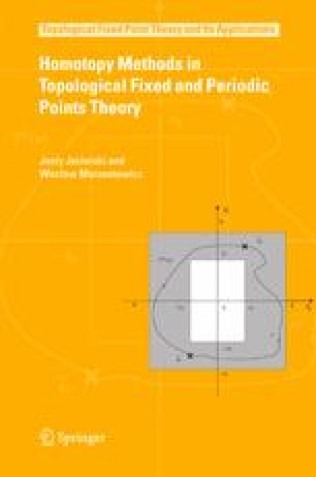
Homotopy Methods in Topological Fixed and Periodic Points Theory
The notion of a fixed point plays a crucial role in numerous branches of mat- maticsand its applications. Informationabout the existence of such pointsis often the crucial argument in solving a problem. In particular, topological methods of fixed point theory have been an increasing focus of interest over the last century. These topological methods of fixed point theory are divided, roughly speaking, into two types. The ?rst type includes such as the Banach Contraction Principle where the assumptions on the space can be very mild but a small change of the map can remove the fixed point. The second type, on the other hand, such as the Brouwer and Lefschetz Fixed Point Theorems, give the existence of a fixed point not only for a given map but also for any its deformations. This book is an exposition of a part of the topological fixed and periodic point theory, of this second type, based on the notions of Lefschetz and Nielsen numbers. Since both notions are homotopyinvariants, the deformationis used as an essential method, and the assertions of theorems typically state the existence of fixed or periodic points for every map of the whole homotopy class, we refer to them as homotopy methods of the topological fixed and periodic point theory.

Handbook of topological fixed point theory
This book is the first in the world literature presenting all new trends in topological fixed point theory. Until now all books connected to the topological fixed point theory were devoted only to some parts of this theory. The content is also likely to stimulate the interest of mathematical economists, population dynamics experts as well as theoretical physicists exploring the topological dynamics.

Geometry and Dynamics of Groups and Spaces : In Memory of Alexander Reznikov
Alexander Reznikov (1960-2003) was a brilliant and highly original mathematician. This book presents 18 articles by prominent mathematicians and is dedicated to his memory. The book further provides an extensive survey on Kleinian groups in higher dimensions and some articles centering on Reznikov as a person.

Geometric Topology : Localization, Periodicity and Galois Symmetry : the 1970 MIT notes
The seminal `MIT notes' of Dennis Sullivan were issued in June 1970 and were widely circulated at the time, but only privately. The notes had a major influence on the development of both algebraic and geometric topology, pioneering the localization and completion of spaces in homotopy theory, including P-local, profinite and rational homotopy theory, the Galois action on smooth manifold structures in profinite homotopy theory, and the K-theory orientation of PL manifolds and bundles. This is the first time that this major work has actually been published, and made available to anyone interested in topology.

Essential Topology
Taking a direct route, Essential Topology brings the most important aspects of modern topology within reach of a second-year undergraduate student. Based on courses given at the University of Wales Swansea, it begins with a discussion of continuity and, by way of many examples, leads to the celebrated ""Hairy Ball theorem"" and on to homotopy and homology: the cornerstones of contemporary algebraic topology. While containing all the key results of basic topology, Essential Topology never allows itself to get mired in details. Instead, the focus throughout is on providing interesting examples that clarify the ideas and motivate the student, reflecting the fact that these are often the key examples behind current research.

Elliptic Theory and Noncommutative Geometry : Nonlocal Elliptic Operators
This comprehensive yet concise book deals with nonlocal elliptic differential operators, whose coefficients involve shifts generated by diffeomorophisms of the manifold on which the operators are defined. The main goal of the study is to relate analytical invariants (in particular, the index) of such elliptic operators to topological invariants of the manifold itself. This problem can be solved by modern methods of noncommutative geometry. This is the first and so far the only book featuring a consistent application of methods of noncommutative geometry to the index problem in the theory of nonlocal elliptic operators. Although the book provides important results, which are in a sense definitive, on the above-mentioned topic, it contains all the necessary preliminary material, such as C*-algebras and their K-theory or cyclic homology.

Combinatorial Algebraic Topology
Combinatorial algebraic topology is a fascinating and dynamic field at the crossroads of algebraic topology and discrete mathematics. This volume is the first comprehensive treatment of the subject in book form. The first part of the book constitutes a swift walk through the main tools of algebraic topology, including Stiefel-Whitney characteristic classes, which are needed for the later parts. Readers - graduate students and working mathematicians alike - will probably find particularly useful the second part, which contains an in-depth discussion of the major research techniques of combinatorial algebraic topology. Our presentation of standard topics is quite different from that of existing texts. In addition, several new themes, such as spectral sequences, are included.
Mathematical Analysis : Linear and Metric Structures and Continuity
The book is divided into three parts. The first part introduces the basic ideas of linear and metric spaces, including the Jordan canonical form of matrices and the spectral theorem for self-adjoint and normal operators. The second part examines the role of general topology in the context of metric spaces and includes the notions of homotopy and degree. The third and final part is a discussion on Banach spaces of continuous functions, Hilbert spaces and the spectral theory of compact operators.
Lagrangian and Hamiltonian Methods for Nonlinear Control 2006 ; Proceedings from the 3rd IFAC Workshop, Nagoya, Japan, July 2006
A Differential-Geometric Approach for Bernstein’s Degrees-of-Freedom Problem.- Nonsmooth Riemannian Optimization with Applications to Sphere Packing and Grasping.- Synchronization of Networked Lagrangian Systems.- An Algorithm to Discretize One-Dimensional Distributed Port Hamiltonian Systems.- Virtual Lagrangian Construction Method for Infinitedimensional Systems with Homotopy Operators.- Direct Discrete-Time Design for Sampled-Data Hamiltonian Control Systems.- Kinematic Compensation in Port-Hamiltonian Telemanipulation.- Interconnection and Damping Assignment Passivity-Based Control of a Four-Tank System.- Towards Power-based Control Strategies for a Class of Nonlinear Mechanical Systems.- Power Shaping Control of Nonlinear Systems: A Benchmark Example.- Total Energy Shaping Control of Mechanical Systems: Simplifying the Matching Equations via Coordinate Changes.- Simultaneous Interconnection and Damping Assignment Passivity–Based Control: Two Practical Examples.
K-Theory : An Introduction
From the Preface: K-theory was introduced by A. Grothendieck in his formulation of the Riemann- Roch theorem. For each projective algebraic variety, Grothendieck constructed a group from the category of coherent algebraic sheaves, and showed that it had many nice properties. Atiyah and Hirzebruch considered a topological analog defined for any compact space X, a group K{X) constructed from the category of vector bundles on X. It is this ''topological K-theory" that this book will study. Topological K-theory has become an important tool in topology. Using K- theory, Adams and Atiyah were able to give a simple proof that the only spheres which can be provided with H-space structures are S1, S3 and S7. Moreover, it is possible to derive a substantial part of stable homotopy theory from K-theory.
Braid Groups
Braids and braid groups have been at the heart of mathematical development over the last two decades. Braids play an important role in diverse areas of mathematics and theoretical physics. The special beauty of the theory of braids stems from their attractive geometric nature and their close relations to other fundamental geometric objects, such as knots, links, mapping class groups of surfaces, and configuration spaces. In this presentation the authors thoroughly examine various aspects of the theory of braids, starting from basic definitions and then moving to more recent results. The advanced topics cover the Burau and the Lawrence--Krammer--Bigelow representations of the braid groups, the Alexander--Conway and Jones link polynomials, connections with the representation theory of the Iwahori--Hecke algebras, and the Garside structure and orderability of the braid groups.
An Introduction to Manifolds
Manifolds, the higher-dimensional analogs of smooth curves and surfaces, are fundamental objects in modern mathematics. Combining aspects of algebra, topology, and analysis, manifolds have also been applied to classical mechanics, general relativity, and quantum field theory. In this streamlined introduction to the subject, the theory of manifolds is presented with the aim of helping the reader achieve a rapid mastery of the essential topics. By the end of the book the reader should be able to compute, at least for simple spaces, one of the most basic topological invariants of a manifold, its de Rham cohomology. Along the way the reader acquires the knowledge and skills necessary for further study of geometry and topology.
Algebraic Cobordism
Algebraic Cobordism: is a theory satisfies the analogues of Quillen's theorems: the cobordism of the base field is the Lazard ring and the cobordism of a smooth variety is generated over the Lazard ring by the elements of positive degrees.
