



الصفحة 1
الصفحة 1

Noncommutative Geometry and Number Theory : Where Arithmetic meets Geometry and Physics
This volume collects and presents up-to-date research topics in arithmetic and noncommutative geometry and ideas from physics that point to possible new connections between the fields of number theory, algebraic geometry and noncommutative geometry. The articles collected in this volume present new noncommutative geometry perspectives on classical topics of number theory and arithmetic such as modular forms, class field theory, the theory of reductive p-adic groups, Shimura varieties, the local Lfactors of arithmetic varieties. They also show how arithmetic appears naturally in noncommutative geometry and in physics, in the residues of Feynman graphs, in the properties of noncommutative tori, and in the quantum Hall effect.

Nearrings and Nearfields ; Proceedings of the Conference on Nearrings and Nearfields, Hamburg, Germany July 27 - August 3, 2003
This present volume is the Proceedings of the 18th International Conference on Nearrings and Nearfields held at the Helmut-Schmidt-Universitat, Universitat der Bundeswehr Hamburg, from July 27-August 3, 2003. It contains the written versions of the lectures by the five invited speakers. These concern recent developments of planar nearrings, nearrings of mappings, group nearrings and loop-nearrings. One of them is a long and very substantial research paper "The Z-Constrained Conjecture". These are followed by 13 contributions reflecting the diversity of the subject of nearrings and related structures. Besides the purely algebriac structure theory, these papers show many connections of nearring theory with group theory, combinatorics, geometries, and topology, and all contain original research.
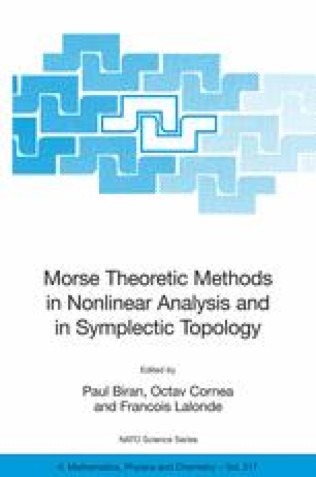
Morse Theoretic Methods in Nonlinear Analysis and in Symplectic Topology
It covered an ample spectrum of subjects which are re ected in the present volume: Morse theory and related techniques in in nite dim- sional spaces, Floer theory and its recent extensions and generalizations, Morse and Floer theory in relation to string topology, generating functions, structure of the group of Hamiltonian difieomorphisms and related dynamical problems, applications to robotics and many others. We thank all our main speakers for their stimulating lectures and all p- ticipants for creating a friendly atmosphere

Modern Differential Geometry in Gauge Theories : Maxwell Fields ; Vol. I
Differential geometry, in the classical sense, is developed through the theory of smooth manifolds. Modern differential geometry from the author’s perspective is used in this work to describe physical theories of a geometric character without using any notion of calculus (smoothness). Instead, an axiomatic treatment of differential geometry is presented via sheaf theory (geometry) and sheaf cohomology (analysis). Using vector sheaves, in place of bundles, based on arbitrary topological spaces, this unique approach in general furthers new perspectives and calculations that generate unexpected potential applications .Volume 1, the focus is on Maxwell fields. All the basic concepts of this mathematical approach are formulated and used thereafter to describe elementary particles, electromagnetism, and geometric prequantization. Maxwell fields are fully examined and classified in the language of sheaf theory and sheaf cohomology.

Mixed Hodge Structures
The text of this book has its origins more than twenty- ve years ago. In the seminar of the Dutch Singularity Theory project in 1982 and 1983, the second-named author gave a series of lectures on Mixed Hodge Structures and Singularities, accompanied by a set of hand-written notes. The publication of these notes was prevented by a revolution in the subject due to Morihiko Saito: the introduction of the theory of Mixed Hodge Modules around 1985. Understanding this theory was at the same time of great importance and very hard, due to the fact that it uni es many di erent theories which are quite complicated themselves: algebraic D-modules and perverse sheaves. The present book intends to provide a comprehensive text about Mixed Hodge Theory with a view towards Mixed Hodge Modules.

Mathematical Survey Lectures 1943-2004
This collection traces the career of Beno Eckmann, whose work ranges across a broad spectrum of mathematical concepts from topology and differential geometry through homological algebra to group theory. One of our most influential living mathematicians, Eckmann has been associated for nearly his entire professional life with the Swiss Federal Institute of Technology Zurich (ETH), as student, lecturer, professor, and professor emeritus.

Introduction to Modern Number Theory: Fundamental Problems, Ideas and Theories
"Introduction to Modern Number Theory" surveys from a unified point of view both the modern state and the trends of continuing development of various branches of number theory. Motivated by elementary problems, the central ideas of modern theories are exposed. Some topics covered include non-Abelian generalizations of class field theory, recursive computability and Diophantine equations, zeta- and L-functions. This substantially revised and expanded new edition contains several new sections, such as Wiles' proof of Fermat's Last Theorem, and relevant techniques coming from a synthesis of various theories. Moreover, the authors have added a part dedicated to arithmetical cohomology and noncommutative geometry, a report on point counts on varieties with many rational points, the recent polynomial time algorithm for primality testing, and some others subjects.

Homology modeling : Methods and protocols
It Provides state-of-the-art methodologies and reviews of important topics in the field of homology modeling. From homology modeling in the twilight zone and improving accuracy through sequence space analysis to approaches to construct multi-protein complex models, the book explores a wide variety of uses and applications of this valuable technique.

Handbook of K-Theory
This handbook offers a compilation of techniques and results in K-theory.Many chapters present historical background; some present previously unpublished results, whereas some present the first expository account of a topic; many discuss future directions as well as open problems. The overall intent of this handbook is to offer the interested reader an exposition of our current state of knowledge as well as an implicit blueprint for future research.

Gruppi : Una introduzione a idee e metodi della Teoria dei Gruppi = Groups : An introduction to the ideas and methods of Group Theory
Born from the university courses of Group Theory held by the author for several years, this book deals with the fundamental arguments of the theory: abelian, nilpotent and solvable groups, free groups, permutations, representations and cohomology. After the first notions, Hölder's program for the classification of finite groups is exposed. A long chapter is dedicated to the action of a group on a set and to the permutations, both under the algebraic and combinatorial aspects, with references to the theory of equations. Some questions of a logical nature are also considered, such as the decidability of the word problem for certain classes of groups. An essential aspect of the book is the presence of a great variety of exercises, about 400, mostly solved.

Geometry of Principal Sheaves
The book provides a detailed introduction to the theory of connections on principal sheaves in the framework of Abstract Differential Geometry (ADG). This is a new approach to differential geometry based on sheaf theoretic methods, without use of ordinary calculus. This point of view complies with the demand of contemporary physics to cope with non-smooth models of physical phenomena and spaces with singularities. Starting with a brief survey of the required sheaf theory and cohomology, the exposition then moves on to differential triads (the abstraction of smooth manifolds) and Lie sheaves of groups (the abstraction of Lie groups). Having laid the groundwork, the main part of the book is devoted to the theory of connections on principal sheaves, incorporating connections on vector

Geometric Methods in Algebra and Number Theory
The transparency and power of geometric constructions has been a source of inspiration to generations of mathematicians. The beauty and persuasion of pictures, communicated in words or drawings, continues to provide the intuition and arguments for working with complicated concepts and structures of modern mathematics. This volume contains a selection of articles exploring geometric approaches to problems in algebra, algebraic geometry and number theory.

Foundations of Systematics and Biogeography
the book highlights three principal messages: biological classifications and their explanatory mechanisms are separate notions; most, if not all, homology concepts pre-date the works of Darwin; and that the foundation of all comparative biology is the concept of relationship - neither 'similarity' nor 'genealogical hypotheses of descent' are sufficient. Foundations of Systematics and Biogeography is an ideal volume for students, academics, researchers and professionals in the fields of systematics, biogeography, evolutionary biology and palaeontology.

Evolutionary Genomics : Statistical and Computational Methods
This book addresses the challenge of analyzing and understanding the evolutionary dynamics of complex biological systems at the genomic level, and elaborates on some promising strategies that would bring us closer to uncovering of the vital relationships between genotype and phenotype. After a few educational primers, the book continues with sections on sequence homology and alignment, phylogenetic methods to study genome evolution, methodologies for evaluating selective pressures on genomic sequences as well as genomic evolution in light of protein domain architecture and transposable elements, population genomics and other omics, and discussions of current bottlenecks in handling and analyzing genomic data. Written for the highly successful Methods in Molecular Biology series, chapters include the kind of detail and expert implementation advice that lead to the best results.

Essential Topology
Taking a direct route, Essential Topology brings the most important aspects of modern topology within reach of a second-year undergraduate student. Based on courses given at the University of Wales Swansea, it begins with a discussion of continuity and, by way of many examples, leads to the celebrated ""Hairy Ball theorem"" and on to homotopy and homology: the cornerstones of contemporary algebraic topology. While containing all the key results of basic topology, Essential Topology never allows itself to get mired in details. Instead, the focus throughout is on providing interesting examples that clarify the ideas and motivate the student, reflecting the fact that these are often the key examples behind current research.

Enumerative Invariants in Algebraic Geometry and String Theory : Lectures given at the C.I.M.E. Summer School held in Cetraro, Italy June 6–11, 2005
Starting in the middle of the 80s, there has been a growing and fruitful interaction between algebraic geometry and certain areas of theoretical high-energy physics, especially the various versions of string theory. Physical heuristics have provided inspiration for new mathematical definitions (such as that of Gromov-Witten invariants) leading in turn to the solution of problems in enumerative geometry. Conversely, the availability of mathematically rigorous definitions and theorems has benefited the physics research by providing the required evidence in fields where experimental testing seems problematic. The aim of this volume, a result of the CIME Summer School held in Cetraro, Italy, in 2005, is to cover part of the most recent and interesting findings in this subject.

Elliptic Theory and Noncommutative Geometry : Nonlocal Elliptic Operators
This comprehensive yet concise book deals with nonlocal elliptic differential operators, whose coefficients involve shifts generated by diffeomorophisms of the manifold on which the operators are defined. The main goal of the study is to relate analytical invariants (in particular, the index) of such elliptic operators to topological invariants of the manifold itself. This problem can be solved by modern methods of noncommutative geometry. This is the first and so far the only book featuring a consistent application of methods of noncommutative geometry to the index problem in the theory of nonlocal elliptic operators. Although the book provides important results, which are in a sense definitive, on the above-mentioned topic, it contains all the necessary preliminary material, such as C*-algebras and their K-theory or cyclic homology.

Eisenstein Series and Applications
Eisenstein series are an essential ingredient in the spectral theory of automorphic forms and an important tool in the theory of L-functions. They have also been exploited extensively by number theorists for many arithmetic purposes. Bringing together contributions from areas that are not usually interacting with each other, this volume introduces diverse users of Eisenstein series to a variety of important applications. With this juxtaposition of perspectives, the reader obtains deeper insights into the arithmetic of Eisenstein series. The exposition focuses on the common structural properties of Eisenstein series occurring in many related applications that have arisen in several recent developments in arithmetic: Arakelov intersection theory on Shimura varieties, special values of L-functions and Iwasawa theory, and equidistribution of rational/integer points on homogeneous varieties.

Dirac Operators in Representation Theory
This monograph presents a comprehensive treatment of important new ideas on Dirac operators and Dirac cohomology. Dirac operators are widely used in physics, differential geometry, and group-theoretic settings (particularly, the geometric construction of discrete series representations). The related concept of Dirac cohomology, which is defined using Dirac operators, is a far-reaching generalization that connects index theory in differential geometry to representation theory. Using Dirac operators as a unifying theme, the authors demonstrate how some of the most important results in representation theory fit together when viewed from this perspective.

Data Integration in the Life Sciences ; 5th International Workshop, DILS 2008, Evry, France, June 25-27, 2008. Proceedings
This book constitutes the refereed proceedings of the 5th International Workshop on Data Integration in the Life Sciences, DILS 2008, held in Evry, France in June 2008.
