



الصفحة 1
الصفحة 1

Geographies of the University
Raises awareness of the histories, geographies, and practices of universities and analyzes their role as key actors in today’s global knowledge economy. Universities are centers of research, teaching, and expertise with significant economic, social, and cultural impacts at different geographical scales. Scholars from a variety of disciplines and countries offer original analyses and discussions along five main themes: historical perspectives on the university as a site of knowledge production, cultural encounter, and political interest; institutional perspectives on university governance and the creation of innovative environments; relationships between universities and the city; the impact of universities on national and regional economies and cultures; and the processes of internationalization through student mobility, the creation of education hubs, and global regionalism in higher education.

Fish, Fishing and Community in North Korea and Neighbours : Vibrant Matter(s)
This book explores the histories and geographies of fishing in North Korea and the surrounding nations.

Culture history and convergent evolution : Can we detect populations in prehistory?
This volume brings together diverse contributions from leading archaeologists and paleoanthropologists, covering various spatial and temporal periods to distinguish convergent evolution from cultural transmission in order to see if we can discover ancient human populations. With a focus on lithic technology, analyzes ancient materials and cultures to systematically explore the theoretical and physical aspects of culture, convergence, and populations in human evolution and prehistory. will be of interest to academics, students and researchers in archaeology, paleoanthropology, genetics, and paleontology.

Martin Waldseemüller’s 'Carta marina' of 1516 : Study and transcription of the long legends
This book presents the first detailed study of one of the most important masterpieces of Renaissance cartography, Martin Waldseemüller’s Carta marina of 1516. By transcribing, translating into English, and detailing the sources of all of the descriptive texts on the map, as well as the sources of many of the images, the book makes the map available to scholars in a wholly unprecedented way.
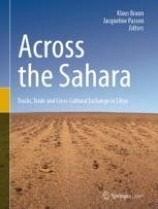
Across the Sahara : Tracks, trade and cross-cultural exchange in Libya
Provides a multi-perspective approach to the caravan trade in the Sahara during the 19th century. Based on travelogues from European travelers, recently found Arab sources, historical maps and results from several expeditions, the book gives an overview of the historical periods of the caravan trade as well as detailed information about the infrastructure which was necessary to establish those trade networks.
