



الصفحة 1
الصفحة 1

Modeling with Itô Stochastic Differential Equations
This modeling procedure is thoroughly explained and illustrated for randomly varying systems in population biology, chemistry, physics, engineering, and finance. Introductory chapters present the fundamental concepts of random variables, stochastic processes, stochastic integration, and stochastic differential equations. These concepts are explained in a Hilbert space setting which unifies and simplifies the presentation. Computer programs, given throughout the text, are useful in solving representative stochastic problems. Analytical and computational exercises are provided in each chapter that complement the material in the text.

Metric Spaces
This volume provides a complete introduction to metric space theory for undergraduates. It covers the topology of metric spaces, continuity, connectedness, compactness and product spaces, and includes results such as the Tietze-Urysohn extension theorem, Picard's theorem on ordinary differential equations, and the set of discontinuities of the pointwise limit of a sequence of continuous functions.

Metodi Matematici della Fisica = Mathematical Methods of Physics
This text draws its origin from my old notes, prepared for the course of Mathematical Methods of Physics and gradually arranged, refined and updated over the course of many years of teaching. The aim has always been to provide as simple and direct a presentation as possible of the mathematical methods relevant to Physics: Fourier series, Hilbert spaces, linear operators, functions of complex variables, Fourier and Laplace transforms, distributions. In addition to these basic topics, a brief introduction to the first notions of group theory, Lie algebras and symmetries in view of their applications to Physics is presented in the Appendix.

Measure, Integration & Real Analysis
This book welcomes students into the fundamental theory of measure, integration, and real analysis. Focusing on an accessible approach, Axler lays the foundations for further study by promoting a deep understanding of key results.

Measure Theory and Probability Theory
The book can be used as a text for a two semester sequence of courses in measure theory and probability theory, with an option to include supplemental material on stochastic processes and special topics.Prerequisites are kept to the minimal level of an understanding of basic real analysis concepts such as limits, continuity, differentiability, Riemann integration, and convergence of sequences and series. A review of this material is included in the appendix. The book starts with an informal introduction that provides some heuristics into the abstract concepts of measure and integration theory, which are then rigorously developed. The first part of the book can be used for a standard real analysis course for both mathematics and statistics Ph.D. students as it provides full coverage of topics such as the construction of Lebesgue-Stieltjes measures on real line and Euclidean spaces, the basic convergence theorems, L^p spaces, signed measures, Radon-Nikodym theorem, Lebesgue's decomposition theorem and the fundamental theorem of Lebesgue integration on R, product spaces and product measures, and Fubini-Tonelli theorems. It also provides an elementary introduction to Banach and Hilbert spaces, convolutions, Fourier series and Fourier and Plancherel transforms.

Introduction to Symplectic Dirac Operators
One of the basic ideas in differential geometry is that the study of analytic properties of certain differential operators acting on sections of vector bundles yields geometric and topological properties of the underlying base manifold. Symplectic spinor fields are sections in an L^2-Hilbert space bundle over a symplectic manifold and symplectic Dirac operators, acting on symplectic spinor fields, are associated to the symplectic manifold in a very natural way. Hence they may be expected to give interesting applications in symplectic geometry and symplectic topology. These symplectic Dirac operators are called Dirac operators, since they are defined in an analogous way as the classical Riemannian Dirac operator known from Riemannian spin geometry. They are called symplectic because they are constructed by use of the symplectic setting of the underlying symplectic manifold. This volume is the first one that gives a systematic and self-contained introduction to the theory of symplectic Dirac operators and reflects the current state of the subject. At the same time, it is intended to establish the idea that symplectic spin geometry and symplectic Dirac operators may give valuable tools in symplectic geometry and symplectic topology,

Interest Rate Models : an Infinite Dimensional Stochastic Analysis Perspective
Interest Rate Models: an Infinite Dimensional Stochastic Analysis Perspective studies the mathematical issues that arise in modeling the interest rate term structure. These issues are approached by casting the interest rate models as stochastic evolution equations in infinite dimensions. The book is comprised of three parts. Part I is a crash course on interest rates, including a statistical analysis of the data and an introduction to some popular interest rate models. Part II is a self-contained introduction to infinite dimensional stochastic analysis, including SDE in Hilbert spaces and Malliavin calculus. Part III presents some recent results in interest rate theory, including finite dimensional realizations of HJM models, generalized bond portfolios, and the ergodicity of HJM models.

Hilbert Space Operators in Quantum Physics
The second edition of this course-tested book provides a detailed and in-depth discussion of the foundations of quantum theory as well as its applications to various systems. The exposition is self-contained; in the first part the reader finds the mathematical background in chapters about functional analysis, operators on Hilbert spaces and their spectral theory, as well as operator sets and algebras. This material is used in the second part to a systematic explanation of the foundations, in particular, states and observables, properties of canonical variables, time evolution, symmetries and various axiomatic approaches. In the third part, specific physical systems and situations are discussed. Two chapters analyze Schrödinger operators and scattering, two others added in the second edition are devoted to new important topics, quantum waveguides and quantum graphs.

Gradient Flows : in Metric Spaces and in the Space of Probability Measures ; 2nd ed.
Devoted to a theory of gradient flows in spaces which are not necessarily endowed with a natural linear or differentiable structure, this book focuses on gradient flows in metric spaces. It covers gradient flows in the space of probability measures on a separable Hilbert space, endowed with the Kantorovich-Rubinstein-Wasserstein distance.

Gradient Flows : In Metric Spaces and in the Space of Probability Measures ; 1st ed.
This book is devoted to a theory of gradient flows in spaces which are not nec- sarily endowed with a natural linear or differentiable structure. It is made of two parts, the first one concerning gradient flows in metric spaces and the second one 2 1 devoted to gradient flows in the L -Wasserstein space of probability measures on p a separable Hilbert space X (we consider the L -Wasserstein distance, p? (1,?), as well). The two parts have some connections, due to the fact that the Wasserstein space of probability measures provides an important model to which the “metric” theory applies, but the book is conceived in such a way that the two parts can be read independently, the first one by the reader more interested to Non-Smooth Analysis and Analysis in Metric Spaces, and the second one by the reader more oriented to theapplications in Partial Differential Equations, Measure Theory and Probability.

Generalized Convexity, Generalized Monotonicity and Applications ; Proceedings of the 7th International Symposium on Generalized Convexity and Generalized Monotonicity
This volume contains a collection of refereed articles on generalized convexity and generalized monotonicity. The first part of the book contains invited papers with applications of (generalized) convexity to such diverse fields as algebraic dynamics of the Gamma function values, discrete optimization, Lipschitzian stability of parametric constraint systems, and monotonicity of functions. The second part contains contributions presenting the latest developments in generalized convexity and generalized monotonicity: its connections with discrete and with continuous optimization, multiobjective optimization, fractional programming, nonsmooth Aanalysis, variational inequalities, and its applications to concrete problems such as finding equilibrium prices in mathematical economics, or hydrothermal scheduling.

Frames and Bases : An Introductory Course
During the last several years, frames have become increasingly popular; they have appeared in a large number of applications, and several concrete constructions of frames of various types have been presented. Most of these constructions were based on quite direct methods rather than the classical sufficient conditions for obtaining a frame. Consequently, there is a need for an updated book on frames, which moves the focus from the classical approach to a more constructive one.

Evolutionary Equations : Picard's Theorem for Partial Differential Equations, and Applications
This book provides a solution theory for time-dependent partial differential equations, which classically have not been accessible by a unified method. Instead of using sophisticated techniques and methods, the approach is elementary in the sense that only Hilbert space methods and some basic theory of complex analysis are required. Nevertheless, key properties of solutions can be recovered in an elegant manner.
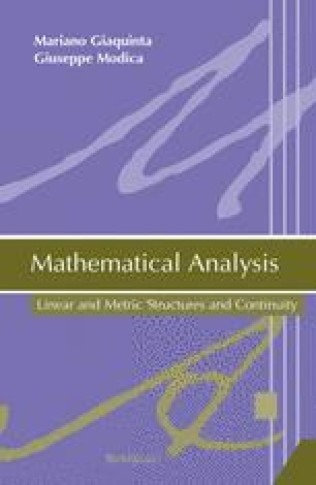
Mathematical Analysis : Linear and Metric Structures and Continuity
The book is divided into three parts. The first part introduces the basic ideas of linear and metric spaces, including the Jordan canonical form of matrices and the spectral theorem for self-adjoint and normal operators. The second part examines the role of general topology in the context of metric spaces and includes the notions of homotopy and degree. The third and final part is a discussion on Banach spaces of continuous functions, Hilbert spaces and the spectral theory of compact operators.
Linear Functional Analysis
This introduction to the ideas and methods of linear functional analysis shows how familiar and useful concepts from finite-dimensional linear algebra can be extended or generalized to infinite-dimensional spaces. Aimed at advanced undergraduates in mathematics and physics, the book assumes a standard background of linear algebra, real analysis (including the theory of metric spaces), and Lebesgue integration, although an introductory chapter summarizes the requisite material. The initial chapters develop the theory of infinite-dimensional normed spaces, in particular Hilbert spaces, after which the emphasis shifts to studying operators between such spaces. Functional analysis has applications to a vast range of areas of mathematics; the final chapters discuss the particularly important areas of integral and differential equations.
Kernel Methods for Machine Learning with Math and Python: 100 Exercises for Building Logic
Addresses the fundamentals of kernel methods for machine learning by considering relevant math problems and building Python programs. The book’s main features are as follows: Includes 100 exercises, which have been carefully selected and refined. As their solutions are provided in the main text, readers can solve all of the exercises by reading the book. / The mathematical premises of kernels are proven and the correct conclusions are provided, helping readers to understand the nature of kernels. / Source programs and running examples are presented to help readers acquire a deeper understanding of the mathematics used. / Once readers have a basic understanding of the functional analysis topics covered in Chapter 2, the applications are discussed in the subsequent chapters. Here, no prior knowledge of mathematics is assumed. / Considers both the kernel for reproducing kernel Hilbert space (RKHS) and the kernel for the Gaussian process; a clear distinction is made between the two.
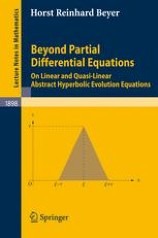
Beyond partial differential equations : On linear and Quasi-Linear abstract hyperbolic evolution equations
The present volume is self-contained and introduces to the treatment of linear and nonlinear (quasi-linear) abstract evolution equations by methods from the theory of strongly continuous semigroups.
Arithmetical investigations : Representation theory, orthogonal polynomials, and quantum interpolations
In this volume the author further develops his philosophy of quantum interpolation between the real numbers and the p-adic numbers. The p-adic numbers contain the p-adic integers Zp which are the inverse limit of the finite rings Z/pn. This gives rise to a tree, and probability measures w on Zp correspond to Markov chains on this tree. From the tree structure one obtains special basis for the Hilbert space L2(Zp,w). The real analogue of the p-adic integers is the interval [-1,1], and a probability measure w on it gives rise to a special basis for L2([-1,1],w) - the orthogonal polynomials, and to a Markov chain on "finite approximations" of [-1,1]. For special (gamma and beta) measures there is a "quantum" or "q-analogue" Markov chain, and a special basis, that within certain limits yield the real and the p-adic theories. This idea can be generalized variously. In representation theory, it is the quantum general linear group GLn(q)that interpolates between the p-adic group GLn(Zp), and between its real (and complex) analogue -the orthogonal On (and unitary Un )groups. There is a similar quantum interpolation between the real and p-adic Fourier transform and between the real and p-adic (local unramified part of) Tate thesis, and Weil explicit sums.
An Introduction to Operators on the Hardy-Hilbert Space
The subject of this book is operator theory on the Hardy space H2, also called the Hardy-Hilbert space. The goal is to provide an elementary and engaging introduction to this subject that will be readable by everyone who has understood introductory courses in complex analysis and in functional analysis.
An Introduction to Infinite-Dimensional Analysis
In this revised and extended version of his course notes from a 1-year course at Scuola Normale Superiore, Pisa, the author provides an introduction – for an audience knowing basic functional analysis and measure theory but not necessarily probability theory – to analysis in a separable Hilbert space of infinite dimension.Starting from the definition of Gaussian measures in Hilbert spaces, concepts such as the Cameron-Martin formula, Brownian motion and Wiener integral are introduced in a simple way. These concepts are then used to illustrate some basic stochastic dynamical systems (including dissipative nonlinearities) and Markov semi-groups, paying special attention to their long-time behavior: ergodicity, invariant measure. Here fundamental results like the theorems of Prokhorov, Von Neumann, Krylov-Bogoliubov and Khas'minski are proved. The last chapter is devoted to gradient systems and their asymptotic behavior.
