



الصفحة 1
الصفحة 1

Musculoskeletal Sonography : Technique, Anatomy, Semeiotics and Pathological Findings in Rheumatic Diseases
Ultrasonography is effective in the evaluation of joint involvement in patients with rheumatic diseases, and may be useful in diagnosis and in monitoring the synovial inflammation by power Doppler technique, with great sensitivity in comparison with clinical examination. The high-resolution US combined with power Doppler technique is also able to detect the peripheral entheseal abnormality, the bone erosion and the tendon involvement. The purpose of this book is to elucidate the examination technique, the sonographic changes in musculoskeletal rheumatic involvement and the ultrasound assessment of joint rheumatic diseases. The atlas is enriched with several figures, in which the US picture is compared with that of conventional radiography, CT and MRI.

International Classification of HRCT for Occupational and Environmental Respiratory Diseases
Many international experts collaborated in creating this groundbreaking work, a principal-coding system, and in developing reference films and imaging parameters for the International Classification of HRCT for Occupational and Environmental Respiratory Diseases. The book is an authoritative guide to the recognition of dust diseases of the lung, using radiological imaging techniques, with special emphasis on high-resolution computerized tomography (CT). The classification is a powerful, essential tool for recording patient data on CT in a globally standardized semiquantitative way. The system is also applicable to surveillance and screening for occupational and environmental respiratory diseases. The book is a valuable resource not only for radiologists but for all who work in occupational medicine and public health.

Immunogenetics: Methods and Protocols
Explores techniques for working in the field of immunogenetics, i.e. fundamental and translational research into the adaptive immune receptor repertoire. Many chapters are dedicated to lab protocols, bioinformatics, and immunoinformatics analysis of high-resolution immunome analysis, exemplified by numerous applications. Additionally, the newest technological variations on these protocols are discussed, including non-amplicon, single-cell, and cell-free strategies. Written for the highly successful Methods in Molecular Biology series, chapters include introductions to their respective topics, lists of the necessary materials and reagents, step-by-step, readily reproducible laboratory protocols, and tips on troubleshooting and avoiding known pitfalls.

High-Resolution Sonography of the Peripheral Nervous System
This second, revised edition reflects these ongoing developments in various ways: many state of the art high-resolution images are included, the text has been adapted to reflect the current state of the literature, and information is presented using a more modern layout.

High-Resolution Methods for Incompressible and Low-Speed Flows
This book covers the basic techniques for simulating incompressible and low-speed flows with high fidelity in conjunction with high-resolution methods. This includes techniques for steady and unsteady flows with high-order time integration and multigrid methods.

High-Resolution If-To-Baseband ΣΔ Adc For Car Radios
High-Resolution IF-to-Baseband SigmaDelta ADC for Car Radios addresses the theory, system level design and circuit implementation of a high-resolution continuous-time IF-to-baseband quadrature SigmaDelta ADC. The target application of this ADC is in AM/FM/IBOC car radios. The ADC achieves a dynamic range of 118dB, which eliminates the need for an IF VGA or AM channel filter in car radios.

High-Resolution Approaches in Stratigraphic Paleontology
This volume delves into a spectrum of theoretical as well as applied aspects of high-resolution stratigraphic approaches in paleontology. It explores how increasingly detailed knowledge of the fossil record can enhance our understanding of the evolution of life on Earth and also allows geoscientists to address a broad range of important evolutionary and environmental questions in this arena.

High resolution morphodynamics and sedimentary evolution of estuaries
This book focuses on the use of high-resolution geophysical techniques, field observations and modeling to investigate the morphodynamics of estuaries on both glaciated and non-glaciated coasts and on different time scales. Papers in this book offer a new approach to nearshore and estuary studies, with an emphasis on multidisciplinary techniques and data integration. Results of these studies have important implications for estuary resource management and shoreline stability. This book will be of interest to sedimentologists, coastal and Quaternary geologists, environmental scientists, and coastal managers.

High Resolution Infrared Spectroscopy in Astronomy ; Proceedings of an ESO Workshop Held at Garching, Germany, 18-21 November 2003
Two specialized new instruments for ESO's VLT, VISIR and CRIRES, spawned the idea for this workshop. CRIRES is a dedicated very high resolution infrared spectrograph; VISIR features a high resolution spectroscopic mode. Together, the instruments combine the sensitivity of an 8m-telescope with the now well-established reliability of VLT-facility instruments. High resolution here means that lines in cool stellar atmospheres and HII-regions can be resolved. The astrophysical topics discussed in this rather specialized workshop range from the inner solar system to active galactic nuclei. There are many possibilities for new discoveries with these instruments, but the unique capability, which becomes available through high-resolution infrared spectroscopy, is the observation of molecular rotational-vibrational transitions in many astrophysical environments. Particularly interesting and surprising in this context, many papers on modeling and laboratory spectroscopy at the workshop appear to indicate that astronomical observations are lagging a bit behind in this field. The papers are an interesting mix of reports from existing high resolution facilities, reports on modeling efforts of synthetic spectra and reports on laboratory spectra. In this sense, a fruitful exchange between molecular physics and astronomy was again accomplished and is documented in this volume.
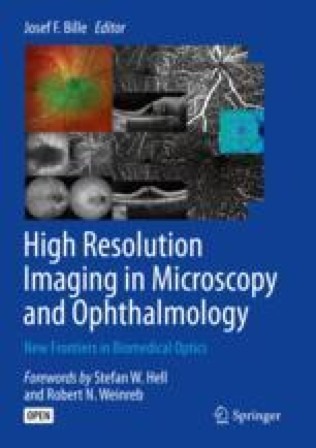
High Resolution Imaging in Microscopy and Ophthalmology : New Frontiers in Biomedical Optics
This book provides a comprehensive overview of the application of the newest laser and microscope/ophthalmoscope technology in the field of high resolution imaging in microscopy and ophthalmology. Starting by describing High-Resolution 3D Light Microscopy with STED and RESOLFT, the book goes on to cover retinal and anterior segment imaging and image-guided treatment and also discusses the development of adaptive optics in vision science and ophthalmology. Using an interdisciplinary approach, the reader will learn about the latest developments and most up to date technology in the field and how these translate to a medical setting.

Handbook of microscopy for nanotechnology
Handbook of Microscopy for Nanotechnology aims to provide an overview of the basics and applications of various microscopy techniques for nanotechnology. This handbook highlights various key microcopic techniques and their applications in this fast-growing field. Topics to be covered include the following: scanning near field optical microscopy, confocal optical microscopy, atomic force microscopy, magnetic force microscopy, scanning turning microscopy, high-resolution scanning electron microscopy, orientational imaging microscopy, high-resolution transmission electron microscopy, scanning transmission electron microscopy, environmental transmission electron microscopy, quantitative electron diffraction, Lorentz microscopy, electron holography, 3-D transmission electron microscopy, high-spatial resolution quantitative microanalysis, electron-energy-loss spectroscopy and spectral imaging, focused ion beam, secondary ion microscopy, and field ion microscopy.

Glycopeptides and Glycoproteins : Synthesis, Structure, and Application
Their structure, biosynthesis, and mode of action are summarized in the fth chapter. The last chapter covers current methods for the determination of high-resolution structures of glycopeptides and glycoproteins mainly based onNMRspectroscopy, X-raycrystallography,and molecular modeling.This series presents critical reviews of the present position and future trends in modern chemical research Short and concise reports on chemistry.

Fundamentals of anatomy and physiology of speech, language, and hearing
Each topic is explored in bullet-point form with augmentative paragraph information, in-depth box features, and detailed illustrations. High-resolution Anatomage virtual dissection table figures derived from real cadavers offer an unparalleled glimpse into the anatomical structures of the human body, featuring true-to-life colors and an impressive level of detail. Topics explored include respiration, phonation, articulation, swallowing, resonance, hearing, balance, neuroanatomy, and neurophysiology.

Flux-corrected transport : Principles, algorithms, and applications
Addressing students and researchers as well as CFD practitioners, this book describes the state of the art in the development of high-resolution schemes based on the Flux-Corrected Transport (FCT) paradigm. Intended for readers who have a solid background in Computational Fluid Dynamics, the book begins with historical notes by J.P. Boris and D.L. Book. Review articles that follow describe recent advances in the design of FCT algorithms as well as various algorithmic aspects. The topics addressed in the book and its main highlights include: the derivation and analysis of classical FCT schemes with special emphasis on the underlying physical and mathematical constraints; flux limiting for hyperbolic systems; generalization of FCT to implicit time-stepping and finite element discretizations on unstructured meshes and its role as a subgrid scale model for Monotonically Integrated Large Eddy Simulation (MILES) of turbulent flows. The proposed enhancements of the FCT methodology also comprise the prelimiting and 'failsafe' adjustment of antidiffusive fluxes, the use of characteristic variables, and iterative flux correction. The cause and cure of detrimental clipping/terracing effects are discussed. Many numerical examples are presented for academic test problems and large-scale applications alike.

Machine learning methods for reverse engineering of defective structured surfaces
Pascal Laube presents machine learning approaches for three key problems of reverse engineering of defective structured surfaces: parametrization of curves and surfaces, geometric primitive classification and inpainting of high-resolution textures. The proposed methods aim to improve the reconstruction quality while further automating the process. The contributions demonstrate that machine learning can be a viable part of the CAD reverse engineering pipeline.

Charged Particle Traps : Physics and Techniques of Charged Particle Field Confinement
This book provides an introduction and guide to modern advances in charged particle (and antiparticle) confinement by electromagnetic fields. Confinement in different trap geometries, the influence of trap imperfections, classical and quantum mechanical description of the trapped particle motion, different methods of ion cooling to low temperatures, and non-neutral plasma properties (including Coulomb crystals) are the main subjects. They form the basis of such applications of charged particle traps as high-resolution optical and microwave spectroscopy, mass spectrometry, atomic clocks, and, potentially, quantum computing.

Atlas of Regional Anatomy of the Brain Using MRI : with functional correlations
The volume provides a unique review of the essential topographical anatomy of the brain from an MRI perspective, correlating high-quality anatomical plates with the corresponding high-resolution MRI images. The book includes a historical review of brain mapping and an analysis of the essential reference planes used for the study of the human brain. Subsequent chapters provide a detailed review of the sulcal and the gyral anatomy of the human cortex, guiding the reader through an interpretation of the individual brain atlas provided by high-resolution MRI.
Advanced machine learning and deep learning approaches for remote sensing
Provides research on how technologies such as artificial intelligence-based machine learning and deep learning can be applied to remote sensing. Through this, we can see the process of solving the existing problems of image and image signal processing for remote sensing. These techniques are computationally intensive and require the help of high-performance computing devices. With the development of devices such as GPUs, remote sensing technology, and aerial sensing technology, it is possible to monitor the Earth with high-resolution images and to obtain vast amounts of Earth observation data. The papers published in this reprint describe recent advances in big data processing and artificial intelligence-based technologies for remote sensing technology.
