



الصفحة 1
الصفحة 1

Innovative Tools and methods using BIM for an efficient renovation in buildings
This book describes a BIM-based toolkit that has been developed according to the latest research activities on building information modelling and semantic interoperability to optimize the building process. It highlights the impacts of using such new tools to fast renovation activities starting from the decision-making and design stages to the construction site management with the possibility to monitor occupants' and owners’ feedback during the realization process. In this process, a framework has been developed and implemented to allow stakeholders involved in a renovation project to efficiently compile, maintain, and add data about (i) building elements, (ii) building services systems, (iii) tenants, operators, and owners of the building, and (iv) current and predicted performance of the building from the various data sources available. The framework applies and specializes the existing practices in the Semantic Web, Linked Data, and ontology domain to the management of renovation projects. It has been designed to be open so that any system which implements the required functions and uses the specified conventions will be able to achieve semantic interoperability with other framework-compliant systems in the renovation domain. Finally, this book represents the validation process of the toolkit that has been held in three demo sites: a social housing building in Italy and two private residential buildings in Poland and Finland. The outcome shows that the toolkit facilitates the renovation process with relevant reductions of time, costs, and energy consumption and that the inhabitants can take advantage of the increase in building performances, quality, and comfort.

Data-driven BIM for Energy Efficient Building Design
Conceptualises the scale and spectrum of Building Information Modelling (BIM) and Artificial Intelligence (AI) approaches in energy efficient building design and to develop its functional solutions with a focus on four crucial aspects of building envelop, building layout, occupant behaviour and heating, ventilation and air-conditioning (HVAC) systems. Drawn from theoretical development on the sustainability, informatics and optimisation paradigms in built environment, the energy efficient building design will be marked through the power of data and BIM-intelligent agents during the design phase.
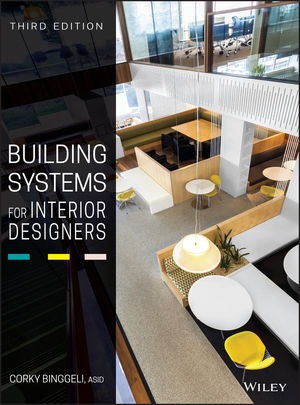
Building Systems for Interior Designers ; 3rd ed.
The ultimate interior designer's guide to building systems and safety Building Systems for Interior Designers, Third Edition is the single-source technical reference that every designer needs, and an ideal solution for NCIDQ exam preparation. Addresses the special concerns of the interior designer within the context of the entire design team. New coverage includes the latest information on sustainable design and energy conservation, expanded coverage of security and building control systems, and a new and expanded art program with over 250 new illustrations. Covering systems from HVAC to water to waste to lighting, this book explains technical building systems and engineering issues in a clear and accessible way to help interior designers communicate more effectively with architects, engineers, and contractors.
Building Services Design for Energy Efficient Buildings
"The following issues are addressed: background issues on climate change, whole-life performance and design collaboration / generic strategies for energy efficient, low-carbon design / health and wellbeing and post occupancy evaluation / building ventilation / air conditioning and HVAC system selection / thermal energy generation and distribution systems / low-energy approaches for thermal control / electrical systems, data collection, controls and monitoring / building thermal load assessment / building electric power load assessment / space planning and design integration with other disciplines."
Building Physics : Heat, Ventilation, Moisture, Light, Sound, Fire, and Urban Microclimate
Presents the theoretical background of building physics, dealing with the evaluation of physical phenomena related to heat transfer and energy use in buildings, water and water vapour transfer in building structures, daylighting and electric lighting of buildings, sound transmission in building structures and protection against noise, the occurrence and spread of fires in buildings and the thermal response of cities. It contains numerical and computational evaluation methods, numerous computational case studies and examples of experimental analyses. The book demonstrates that the considered physical processes affect the quality of living and working comfort in indoor and outdoor environment.
Advanced sensors technologies applied in mobile robot
Contains contributions on the latest developments in mobile robotic systems and related research. Various topics with different ideas and applications from mobile robotics have found their place. New ideas are presented for mobile robots that specialise in cleaning floors, power lines and HVAC systems. We also find innovative approaches for navigation path planning using local minima-free potential fields, novel path primitives and/or their parameterisation for minimum-time planning, and various control approaches ranging from visual serving to model predictive and adaptive trajectory tracking, applied to wheeled robots, humanoid manipulators and flying robots. Localisation approaches using LiDAR, motion capture systems, fingerprint-based and biomechanical gait systems are also discussed.
