



الصفحة 1
الصفحة 1

Screw Compressors : Three Dimensional Computational Fluid Dynamics and Solid Fluid Interaction
This book - the authors' second book on screw compressors – presents the results of the most up to date methods of three-dimensional modeling of the fluid dymanics and the solid-fluid interaction within these machines, which are still being developed. By including them in the design process, it is possible, not only to predict flow patterns more accurately, and hence improve the design of the critical components, but also to determine how the pressure and temperature distribution within the compressor distorts the rotors and casing and how this, in turn, has an interactive effect on the performance.

Computational Fluid Dynamics for Engineers
This book introduces a wide range of Computational Fluid Dynamics (CFD) methods used in the aerospace industry to solve engineering problems. Its format is arranged so that students and practicing engineers can understand the fundamental principles used in CFD, with sample computer programs for the solution of model problems. The emphasis is on two-dimensional equations in order to present the material in a modest sized book. Source codes for selected problems are given so that the reader can understand how those methods are implemented in FORTRAN and C languages, while exercises provide more hands-on experience.
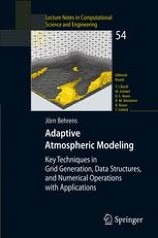
Adaptive Atmospheric Modeling : Key Techniques in Grid Generation, Data Structures, and Numerical Operations with Applications
This is an overview of the development of adaptive techniques for atmospheric modeling. Written in an educational style, it functions as a starting point for readers interested in adaptive modeling, in atmospheric sciences and beyond. Coverage includes paradigms of adaptive techniques, such as error estimation and adaptation criteria. Mesh generation methods are presented for triangular/tetrahedral and quadrilateral/hexahedral meshes, with a special section on initial meshes for the sphere.
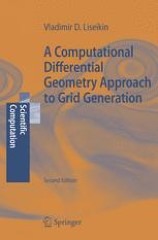
A Computational Differential Geometry Approach to Grid Generation
This monograph gives a detailed treatment of applications of geometric methods to advanced grid technology. It focuses on and describes a comprehensive approach based on the numerical solution of inverted Beltramian and diffusion equations with respect to monitor metrics for generating both structured and unstructured grids in domains and on surfaces.
