



الصفحة 1
الصفحة 1

Nonlinear Physical Oceanography : A Dynamical Systems Approach to the Large Scale Ocean Circulation and El Niño
Taken from a review of the first edition in SIAM:"This text is different from most others in that it combines several different disciplines and draws on many scientific studies in order to deduce mechanisms of ocean circulation.

Nonlinear Dynamics in Geosciences
Nonlinear Dynamics in Geosciences is comprised of the proceedings of "20 Years of Nonlinear Dynamics in Geosciences", held June 11-16, 2006 in Rhodes, Greece as part of the Aegean Conferences. The volume brings together the most up-to-date research from the atmospheric sciences, hydrology, geology, and other areas of geosciences, and discusses the advances made in the last two decades and the future directions of nonlinear dynamics. Topics covered include predictability, ensemble prediction, nonlinear prediction, nonlinear time series analysis, low-dimensional chaos, nonlinear modeling, fractals and multifractals, bifurcation, complex networks, self-organized criticality, extreme events, and other aspects of nonlinear science.

Intraseasonal Variability in the Atmosphere-Ocean Climate System
As the first comprehensive and authoritative review of intra-seasonal variability (ISV), this multi-author work balances coverage of observation, theory and modeling and provides a single source of reference for all those interested in this important, multi-faceted natural phenomenon and its relation to major short-term climatic variations. Commencing with an overview of ISV and observations from an historical perspective, the book offers successive chapters that deal with the role of ISV in monsoon variability on the monsoon regions of South Asia, East Asia and South America, in North America, and in the oceans. The coupling between ocean and atmosphere is considered, together with the function of angular momentum and Earth rotation.

Hot house : Global climate change and the human condition
Global warming is extremely complex because it deals with so many different characteristics of the Earth and their complex interactions. It is addressed by almost all sciences including many aspects of geosciences, atmospheric, the biological sciences, and even astronomy. It has recently become the concern of other diverse disciplines such as economics, agriculture, demographics and population statistics, medicine, engineering, and political science. This book attempts to address these complex interactions, integrate them, and derive meaningful conclusions and possible solutions.

High resolution numerical modelling of the atmosphere and ocean
This book includes 15 individual papers that highlight the emerging research in atmospheric and oceanic science that has been made possible by exploiting newly available computational resources. Results from regional atmospheric, global atmospheric, global ocean, and global coupled ocean-atmosphere models are discussed in the various contributions.

eIoT : The Development of the Energy Internet of Things in Energy Infrastructure
This book explores the collision between the sustainable energy transition and the Internet of Things (IoT). In that regard, this book’s arrival is timely. Not only is the Internet of Things for energy applications, herein called the energy Internet of Things (eIoT), rapidly developing but also the transition towards sustainable energy to abate global climate is very much at the forefront of public discourse. It is within the context of these two dynamic thrusts, digitization and global climate change, that the energy industry sees itself undergoing significant change in how it is operated and managed. The goal of this book is to provide a single integrated picture of how eIoT can come to transform our energy infrastructure. This book links the energy management change drivers mentioned above to the need for a technical energy management solution. It, then, describes how eIoT meets many of the criteria required for such a technical solution.

Counteracting Urban Heat Island Effects in a Global Climate Change Scenario
Urban Heat Islands (UHIs) are a microclimatic phenomenon which manifests as a significant increase in the temperature of cities compared to their surrounding areas. Recently the phenomenon has been enforced by the tendency to climate change and in particular by extreme climate events. This book presents and analyzes the results of a project to develop and apply mitigation and adaptation strategies and measures for counteracting the global urban heat islands phenomenon, supported by the EU’s Central Europe Regional Development Fund.
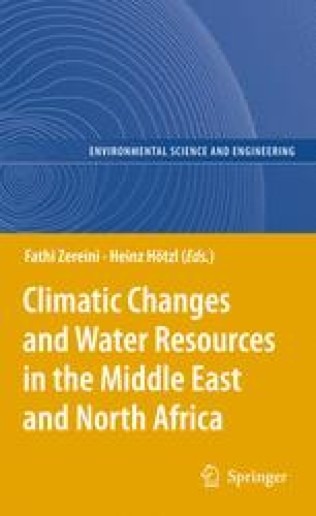
Climatic Changes and Water Resources in the Middle East and North Africa
The subject is described and discussed in three main chapters and different case studies.All topics in this book are complimentary and contribute to a comprehensive understanding of the interactions between global climate change, world water cycle and water resources. A valuable and meaningful interdisciplinary mixture of topics is combined in this book.

Challenges to Marine Ecosystems ; Proceedings of the 41st European Marine Biology Symposium
This volume presents a representative sample of contributions to the 41st European Marine Biology Symposium held in September 2005 in Cork, Ireland. The theme of the symposium was ‘Challenges to Marine Ecosystems’ and this was divided into four sub themes; Genetics, Marine Protected Areas, Global Climate Change and Marine Ecosystems, Sustainable Fisheries and Agriculture.
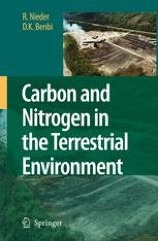
Carbon and nitrogen in the terrestrial environment
Carbon and Nitrogen in the Terrestrial Environment is a comprehensive, interdisciplinary description of C and N fluxes between the atmosphere and the terrestrial biosphere; issues related to C and N management in different ecosystems and their implications for the environment and global climate change; and the approaches to mitigate emission of greenhouse gases.Drawing upon the most up-to-date books, journals, bulletins, reports, symposia proceedings and internet sources documenting interrelationships between different aspects of C and N cycling in the terrestrial environment, Carbon and Nitrogen in the Terrestrial Environment fills the gap left by most of the currently available books on C and N cycling. They either deal with a single element of an ecosystem, or are related to one or a few selected aspects like soil organic matter (SOM) and agricultural or forest management, emission of greenhouse gases, global climate change or modeling of SOM dynamics.
Beyond Kyoto : A new global climate certificate system : Continuing Kyoto commitsments or a global ´Cap and Trade´ scheme for a sustainable climate policy?
This book shows how humankind can ‘prevent dangerous interference with the c- mate system’ without dangerous interference with the global economic system. In the two underlying studies on behalf of the Ministry of Environment and Transport of i the German federal state of Baden-Württemberg, the results have been elaborated through scientific evaluation of different climate protection systems and intensive developmental work on an efficient climate protection system. The results will be presented in nine chapters according to the following nine basic R&D steps: 1. Quantifying the ‘ultimate climate objective’ of the world community in order ‘to prevent dangerous interference with the climate system,’ thus achieving climate sustainability; 2. Development of a comprehensive standard system for evaluating the prospect of success for different climate protection systems; 3. Based on this scientific standard system, evaluation of the current Kyoto system and of the most important proposals for ‘incremental regime evolution’ of the Kyoto system. Unfortunately, it must be noted that these systems are incapable of achi- ing climate sustainability; 4. Evaluating three proposals for ‘structural regime change’ of the Kyoto system. Following this objective evaluation process and numeric comparison of the diff- ent proposals, 5. Description of the eight basic elements of GCCS and its in-depth ‘critical asse- ment;’ 6.

Atlas of global change risk of population and economic systems
Iillustrates the spatial distribution of the global change risk of population and economic systems with the maps of environment, global climate change, global population and economic systems, and global change risk. The risks of global change are mapped at 0.25 degree grid unit. The risk results and their contribution rates of the world at national level are unprecedentedly derived and ranked. The book can be a good reference for researchers and students in the field of global climate change and natural disaster risk management, as well as risk managers and enterpriser to understand the global change risk of population and economic systems.
Assessment of climate change over the Indian Region : A report of the Ministry of Earth Sciences (MoES), Government of India
Discusses the impact of human-induced global climate change on the Indian subcontinent and regional monsoon, the adjoining Indian Ocean and the Himalayas. It also examines the regional climate change projections based on the climate models used by the IPCC Fifth Assessment Report (AR5) and national climate change modeling studies using the IITM Earth System Model (ESM) and CORDEX South Asia datasets
