



الصفحة 1
الصفحة 1

Il cancro e la ricerca del senso perduto = Cancer and the search for lost meaning
Cancer disease can be approached with the aim of killing diseased cells or with that of making them go backwards on the road that leads from a state of natural equilibrium to the disease. This book tells an original research by the author inspired by this biological vision of cancer, research that led to the production and use of anticancer products. Inevitably, the history of research slips into a vision of the world and of life that presents the features of a documented critique of the values and priorities that characterize the world in which we live. A profound and human book, which makes you think, which makes you hope.

Genome Editing : Gene Therapy or Gene Optimization?
Genome editing technology is considered one of the most revolutionary techniques lately. The ability of modifying the human genome has been one of the biggest dreams for therapist for the reason that the genetic modification with exogenous DNA can be considered a problem solver for many diseases and disorders (genetic disorders), especially those with high risks and low survival rates, on this case, gene therapy appears as the tool to be used, with its many protocols and approaches. Gene therapy is based on delivering a therapeutic gene throw suitable vectors, which is most of the time-modified viruses to carry the therapeutic genes to the target cells and so on providing the functional copy of the defective gene.
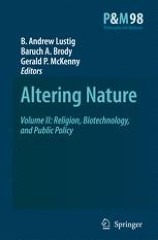
Altering nature ; Vol.2 : Religion, Biotechnology, and Public Policy
The two volumes of Altering Nature consider the complex ways that concepts of 'nature' and 'the natural' are understood and the relevance of those understandings to discussions of biotechnology.Volume Two, Religion, Biotechnology, and Public Policy, reviews recent religious and ethical analyses of four specific areas of biotechnology: assisted reproduction, genetic therapy and enhancement, human-machine incorporation, and biodiversity. It identifies and explores the richer normative themes that inform particular debates and suggests ways that policy choices in biotechnology may be illuminated by devoting greater attention to religious perspectives.
