



الصفحة 1
الصفحة 1

Gravity, Black Holes, and the Very Early Universe : An Introduction to General Relativity and Cosmology
In the early 1900s, Albert Einstein formulated two theories that would forever change the landscape of physics: the Special Theory of Relativity and the General Theory of Relativity. By 1925, quantum mechanics had been born out of the dissection of these two theories, and shortly after that, relativistic quantum field theory. We now had in place some important ties between the laws of physics and the types of particle interactions the new physics was uncovering. Gravity is one of the four types of forces that are found throughout the universe. In fact, although it is a relatively weak force, it operates at huge distances, and so must be accounted for in any cosmological system. Unfortunately, gravity continues to defy our neat categorization of how all the forces in nature work together.

Frontiers of Fundamental Physics ; Proceedings of the Sixth International Symposium "Frontiers of Fundamental and Computational Physics", Udine, Italy, 26-29 September 2004
The Sixth International Symposium "Frontiers of Fundamental and Computational Physics", Udine, Italy, 26-29 September 2004, aimed at providing a platform for a wide range of physicists to meet and share thoughts on the latest trends in various, mainly cross-disciplinary research areas. This includes the exploration of frontier lines in High Energy Physics, Theoretical Physics, Gravitation and Cosmology, Astrophysics, Condensed Matter Physics, Fluid Mechanics. Such frontier lines were unified by the use of computers as an, often primary, research instruments, or dealing with issues related to information theory.

Einsteins General Theory of Relativity : With Modern Applications in Cosmology
Einstein’s General Theory of Relativity: With Modern Applications in Cosmology by Oyvind Gron and Sigbjorn Hervik is about gravity and the concept of gravity as Albert Einstein saw it- curved spaces, four-dimensional manifolds and geodesics. The book starts with the 1st principals of relativity and an introduction to Einstein’s field equations. Next up are the three classical tests of the relativity theory and an introduction to black holes.

Einsteins Enigma or Black Holes in My Bubble Bath
Einstein's Enigma or Black Holes in My Bubble Bath tells the story of gravitation theory from the early historic origins to the latest developments in astrophysics, focusing on Albert Einstein's theory of general relativity and black-hole physics. Through engaging conversations and napkin-scribbled diagrams come tumbling the rudiments of relativity, spacetime and much of modern physics, narrated with high didactic and literary talent, and each embedded in casual lessons given by a worldly astrophysicist to his friend Alfie, a freelance organiser of proposals. Join the intellectual fun and exalt in the frothy ideas while vicariously taking relaxing baths in this magical bathtub.
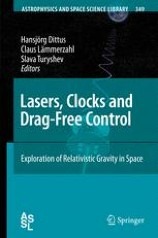
Lasers, Clocks and Drag-Free Control : Exploration of Relativistic Gravity in Space
Over the next decade the gravitational physics community will benefit from dramatic improvements in many technologies critical to testing gravity. Highly accurate deep space navigation, interplanetary laser communication, interferometry and metrology, high precision frequency standards, precise pointing and attitude control, together with drag-free technologies, will revolutionize the field of experimental gravitational physics. The centennial of the general theory of relativity in 2015 will motivate a significant number of experiments designed to test this theory with unprecedented accuracy.
