



الصفحة 1
الصفحة 1

Modern Differential Geometry in Gauge Theories : Maxwell Fields ; Vol. I
Differential geometry, in the classical sense, is developed through the theory of smooth manifolds. Modern differential geometry from the author’s perspective is used in this work to describe physical theories of a geometric character without using any notion of calculus (smoothness). Instead, an axiomatic treatment of differential geometry is presented via sheaf theory (geometry) and sheaf cohomology (analysis). Using vector sheaves, in place of bundles, based on arbitrary topological spaces, this unique approach in general furthers new perspectives and calculations that generate unexpected potential applications .Volume 1, the focus is on Maxwell fields. All the basic concepts of this mathematical approach are formulated and used thereafter to describe elementary particles, electromagnetism, and geometric prequantization. Maxwell fields are fully examined and classified in the language of sheaf theory and sheaf cohomology.

Foliations and Geometric Structures
Offers basic material on distributions and foliations. This book introduces and builds the tools needed for studying the geometry of foliated manifolds. Its main theme is to investigate the interrelations between foliations of a manifold on the one hand, and the many geometric structures that the manifold may admit on the other hand.

Explorations in Mathematical Physics : The Concepts Behind an Elegant Language
This book takes you on a tour of the main ideas forming the language of modern mathematical physics. Here you will meet novel approaches to concepts such as determinants and geometry, wave function evolution, statistics, signal processing, and three-dimensional rotations. You'll see how the accelerated frames of special relativity tell us about gravity. On the journey, you'll discover how tensor notation relates to vector calculus, how differential geometry is built on intuitive concepts, and how variational calculus leads to field theory. You will meet quantum measurement theory, along with Green functions and the art of complex integration, and finally general relativity and cosmology.
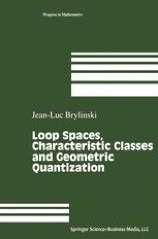
Loop Spaces, Characteristic Classes and Geometric Quantization
This book deals with the differential geometry of manifolds, loop spaces, line bundles and groupoids, and the relations of this geometry to mathematical physics. Various developments in mathematical physics (e.g., in knot theory, gauge theory, and topological quantum field theory) have led mathematicians and physicists to search for new geometric structures on manifolds and to seek a synthesis of ideas from geometry, topology and category theory. In this spirit, this book develops the differential geometry associated to the topology and obstruction theory of certain fiber bundles (more precisely, associated to grebes). The theory is a 3-dimensional analog of the familiar Kostant--Weil theory of line bundles. In particular the curvature now becomes a 3-form.
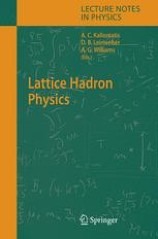
Lattice Hadron Physics
This series of lectures draws upon the developments made in recent years in implementing chirality on the lattice via the overlap formalism. These developments exploit chiral effective field theory in order to extrapolate lattice results to physical quark masses, new forms of improving operators to remove lattice artefacts, analytical studies of finite volume effects in hadronic observables, and state-of-the-art lattice calculations of excited resonances. This volume is designed to assist those outside the field who want quickly to becoming literate in these topics. So it is intended for graduate students and experienced researchers in other areas of hadronic physics to provide the background through which they can appreciate, if not become active in, contemporary lattice gauge theory and its applications to hadronic phenomena.
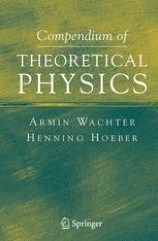
Compendium of Theoretical Physics
Mechanics, Electrodynamics, Quantum Mechanics, and Statistical Mechanics and Thermodynamics comprise the canonical undergraduate curriculum of theoretical physics. In Compendium of Theoretical Physics, Armin Wachter and Henning Hoeber offer a concise, rigorous and structured overview that will be invaluable for students preparing for their qualifying examinations, readers needing a supplement to standard textbooks, and research or industrial physicists seeking a bridge between extensive textbooks and formula books. The authors take an axiomatic-deductive approach to each topic, starting the discussion of each theory with its fundamental equations. By subsequently deriving the various physical relationships and laws in logical rather than chronological order, and by using a consistent presentation and notation throughout, they emphasize the connections between the individual theories. The reader’s understanding is then reinforced with exercises, solutions and topic summaries.
