



الصفحة 1
الصفحة 1

Modern Hematology : Biology and Clinical Management
The first chapters of this book contain a self-contained introduction to path integrals in Euclidean quantum mechanics and statistical mechanics. The resulting high-dimensional integrals can be estimated with the help of Monte Carlo simulations based on Markov processes. The most commonly used algorithms are presented in detail so as to prepare the reader for the use of high-performance computers as an “experimental” tool for this burgeoning field of theoretical physics. Several chapters are then devoted to an introduction to simple lattice field theories and a variety of spin systems with discrete and continuous spins, where the ubiquitous Ising model serves as an ideal guide for introducing the fascinating area of phase transitions. As an alternative to the lattice formulation of quantum field theories, variants of the flexible renormalization group methods are discussed in detail. Since, according to our present-day knowledge, all fundamental interactions in nature are described by gauge theories, the remaining chapters of the book deal with gauge theories without and with matter.

Modern Differential Geometry in Gauge Theories : Maxwell Fields ; Vol. I
Differential geometry, in the classical sense, is developed through the theory of smooth manifolds. Modern differential geometry from the author’s perspective is used in this work to describe physical theories of a geometric character without using any notion of calculus (smoothness). Instead, an axiomatic treatment of differential geometry is presented via sheaf theory (geometry) and sheaf cohomology (analysis). Using vector sheaves, in place of bundles, based on arbitrary topological spaces, this unique approach in general furthers new perspectives and calculations that generate unexpected potential applications .Volume 1, the focus is on Maxwell fields. All the basic concepts of this mathematical approach are formulated and used thereafter to describe elementary particles, electromagnetism, and geometric prequantization. Maxwell fields are fully examined and classified in the language of sheaf theory and sheaf cohomology.

Magnetic Monopoles
This monograph addresses the field theoretical aspects of magnetic monopoles. Written for graduate students as well as researchers, the author demonstrates the interplay between mathematics and physics. He delves into details as necessary and develops many techniques that find applications in modern theoretical physics. This introduction to the basic ideas used for the description and construction of monopoles is also the first coherent presentation of the concept of magnetic monopoles. It arises in many different contexts in modern theoretical physics, from classical mechanics and electrodynamics to multidimensional branes. The book summarizes the present status of the theory and gives an extensive but carefully selected bibliography on the subject. The first part deals with the Dirac monopole, followed in part two by the monopole in non-abelian gauge theories. The third part is devoted to monopoles in supersymmetric Yang-Mills theories.
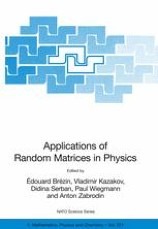
Applications of random matrices in physics
Random matrices are widely and successfully used in physics for almost 60-70 years, beginning with the works of Dyson and Wigner. Although it is an old subject, it is constantly developing into new areas of physics and mathematics. It constitutes now a part of the general culture of a theoretical physicist. Mathematical methods inspired by random matrix theory become more powerful, sophisticated and enjoy rapidly growing applications in physics. Recent examples include the calculation of universal correlations in the mesoscopic system, new applications in disordered and quantum chaotic systems, in combinatorial and growth models, as well as the recent breakthrough, due to the matrix models, in two dimensional gravity and string theory and the non-abelian gauge theories. The book consists of the lectures of the leading specialists and covers rather systematically many of these topics.

An introduction to relativistic processes and the standard model of electroweak interactions
The first part of the volume is devoted to the description of scattering processes in the context of relativistic quantum field theory. The use of the semi-classical approximation allows us to illustrate the relevant computation techniques in a reasonably small amount of space. Our approach to relativistic processes is original in many respects. The second part contains a detailed description of the construction of the standard model of electroweak interactions, with special attention to the mechanism of particle mass generation. The extension of the standard model to include neutrino masses is also described. We have included a number of detailed computations of cross sections and decay rates of pedagogical and phenomenological relevance.
