



الصفحة 1
الصفحة 1

Nonlinear Dynamics in Geosciences
Nonlinear Dynamics in Geosciences is comprised of the proceedings of "20 Years of Nonlinear Dynamics in Geosciences", held June 11-16, 2006 in Rhodes, Greece as part of the Aegean Conferences. The volume brings together the most up-to-date research from the atmospheric sciences, hydrology, geology, and other areas of geosciences, and discusses the advances made in the last two decades and the future directions of nonlinear dynamics. Topics covered include predictability, ensemble prediction, nonlinear prediction, nonlinear time series analysis, low-dimensional chaos, nonlinear modeling, fractals and multifractals, bifurcation, complex networks, self-organized criticality, extreme events, and other aspects of nonlinear science.

Nonlinear dynamics in complex systems via fractals and fractional calculus
Current advances in the knowledge of nonlinear dynamical networks, systems and processes, as well as their unified repercussions, allow us to include some typical complex natural phenomena, from the nanoscale to an extra-galactic scale, in an unitarian comprehensive manner. In other words, the physical, biological and financial data, as well as technological ones (mechanical or electronic devices), of complex systems available today can be managed by the same unique conceptual approach, both analytically and through a computer simulation, using effective nonlinear dynamics procedures. This volume collected some important advances in the fields of fractal curves, fractal analysis and fractional calculus, as well as new solutions of fractal differential equations.

Non-Euclidean Geometries : János Bolyai Memorial Volume
Some of the papers present new discoveries about the life and works of János Bolyai and the history of non-Euclidean geometry, others deal with geometrical axiomatics; polyhedra; fractals; hyperbolic, Riemannian and discrete geometry; tilings; visualization; and applications in physics. This book is intended for those who teach, study, and do research in geometry and history of mathematics. Cultural historians, physicists, and computer scientists will also find it an important source of information.

Modeling in Biopharmaceutics, Pharmacokinetics and Pharmacodynamics : Homogeneous and Heterogeneous Approaches
The state of the art in Biopharmaceutics, Pharmacokinetics, and Pharmacodynamics Modeling is presented in this book. It shows how advanced physical and mathematical methods can expand classical models in order to cover heterogeneous drug-biological processes and therapeutic effects in the body. The book is divided into four parts; the first deals with the fundamental principles of fractals, diffusion and nonlinear dynamics; the second with drug dissolution, release, and absorption; the third with empirical, compartmental, and stochastic pharmacokinetic models, and the fourth mainly with nonclassical aspects of pharmacodynamics. The classical models that have relevance and application to these sciences are also considered throughout. Many examples are used to illustrate the intrinsic complexity of drug administration related phenomena in the human, justifying the use of advanced modeling methods.

Mathematics and Technology
Mathematics and Technology presents technological applications of mathematics making use of elegant mathematical concepts. The selected subjects consist of: public key cryptography, error correcting codes, the global positioning system (GPS) and cartography, image compression using fractals and the JPEG format, digital recording, robot movement, DNA computing, Google's PageRank algorithm, savings and loans, gamma ray surgery and random number generators. The authors highlight how mathematical modeling, together with the power of mathematical tools, have been crucial for innovation in technology. The exposition is clear, straightforward, motivated by excellent examples, and user-friendly. Numerous exercises at the end of every chapter reinforce the material. An engaging quality is the various historical notes accompanying the mathematical development.

Image Processing : Dealing with Texture ; 2nd ed.
Updates the classic work on texture analysis theory and methods without abandoning the foundational essentials of this landmark work. Like the first, the new edition offers an analysis of texture in digital images that are essential to a diverse range of applications such as: robotics, defense, medicine and the geo-sciences. Designed to easily locate information on specific problems, the text is structured around a series of helpful questions and answers. Updated to include the most recent developments in the field, many chapters have been completely revised including: Fractals and Multifractals, Image Statistics, Texture Repair, Local Phase Features, Dual Tree Complex Wavelet Transform, Ridgelets and Curvelets and Deep Texture Features. The book takes a two-level mathematical approach: light math is covered in the main level of the book, with harder math identified in separate boxes.

Hierarchy in Natural and Social Sciences
This book reviews ancient and modern representations and explanations of hierarchies, and compares their relevance in a variety of fields, such as language, societies, cities, and living species. It throws light on concepts and models such as scaling laws, fractals and self-organisation that are fundamental in the dynamics and morphology of complex systems.This book addresses a wide audience of biologists and social scientists, as well as managers and executives in a variety of institutions.

Handbook of Mathematical Geosciences : Fifty Years of IAMG
Presents a compilation of invited path-breaking research contributions by award-winning geoscientists who have been instrumental in shaping the IAMG. It contains 45 chapters that are categorized broadly into five parts (i) theory, (ii) general applications, (iii) exploration and resource estimation, (iv) reviews, and (v) reminiscences covering related topics like mathematical geosciences, mathematical morphology, geostatistics, fractals and multifractals, spatial statistics, multipoint geostatistics, compositional data analysis, informatics, geocomputation, numerical methods, and chaos theory in the geosciences.

Grammatical Picture Generation : A Tree-Based Approach
The book presents important types of picture generators, using a tree-based approach to stress their common algorithmic basis, the treatment influenced by the theory of computation, and the theory of formal languages in particular. It guides the reader through the basics of the tree-based approach on to dedicated chapters on line-drawing languages, collage grammars, iterated function systems, grid picture languages, languages of fractals, and languages of coloured collages, while presenting results about (un)decidable, NP-complete, or efficiently solvable problems, normal forms, hierarchies of language classes, and related phenomena.

Fractals in Engineering : New Trends in Theory and Applications
The strong potential of this research can be seen in real industrial situations with recent progress being made in areas such as chemical engineering, internet traffic, physics and finance. Image processing continues to be a major field of application for fractal analysis and is well-represented here. Consisting of papers written by a world-wide pool of experts, the multidisciplinary approach of this third volume will be of particular interest to industrial researchers and practitioners as well as to academics from many backgrounds.

Fractals in Biology and Medicine : Beyond Planting Trees
This volume it highlights the potential that fractal geometry offers for elucidating and explaining the complex make-up of cells, tissues and biological organisms either in normal or in pathological conditions, including the structural changes that occur in tumours. It helps develop the concepts, questions and methods required in research on fractal biology and natural phenomena and to evidence the pitfalls of a too simplistic application of these principles in investigating topical subjects of biology and medicine. It discusses present and future applications of fractal geometry, bringing together cellular and molecular biology, engineering, mathematics, physics, medicine and other disciplines and allowing an interdisciplinary vision.

Fractal Dimensions of Networks
The goal of the book is to provide a unified treatment of fractal dimensions of sets and networks. Since almost all of the major concepts in fractal dimensions originated in the study of sets, the book achieves this goal by first clearly presenting, with an abundance of examples and illustrations, the theory and algorithms for sets, and then showing how the theory and algorithms have been applied to networks. For example, the book presents the classical theory and algorithms for the box counting dimension for sets, and then presents the box counting dimension for networks. All the major fractal dimensions are studied, e.g., the correlation dimension, the information dimension, the Hausdorff dimension, the multifractal spectrum, as well as many lesser known dimensions. Algorithm descriptions are accompanied by worked examples, with many applications of the methods presented.

Fractal Behaviour of the Earth System
In this volume a collection of - pers considers the fractal behavior of the Earth's continental crust. Surface gravity anomalies are known to exhibit power-law spectral behavior under a wide range of conditions and scales. La Manna utilize multifractal models to explain the behavior of well logs from the main KTB borehole in Germany.

Fluctuations, Information, Gravity and the Quantum Potential
A main theme of the book outlines the role of the quantum potential in quantum mechanics and general relativity and one of its origins via fluctuations formulated in terms of Fisher information. Another theme is the description of various approaches to Bohmian mechanics and their role in quantum mechanics and general relativity. Along the way various approaches to, for instance, the Dirac equation, the Einstein equations, the Klein-Gordon equation, the Maxwell equations and the Schr?dinger equations are described. Statistics and geometry are intertwined in various ways and, among other matters, the aether, cosmology, entropy, fractals, quantum Kaehler geometry, the vacuum and the zero point field are discussed. There is also some speculative material and some original work along with material extracted from over 1000 references and the work is current up to April 2005.
Diffusion in Condensed Matter : Methods, Materials, Models
Diffusion as the process of particle transport due to stochastic movement is a phenomenon of crucial relevance for a large variety of processes and materials. This comprehensive, handbook-style survey of diffusion in condensed matter gives detailed insight into diffusion as the process of particle transport due to stochastic movement. Leading experts in the field describe in 23 chapters the different aspects of diffusion, covering microscopic and macroscopic experimental techniques and exemplary results for various classes of solids, liquids and interfaces as well as several theoretical concepts and models. Students and scientists in physics, chemistry, materials science, and biology will benefit from this detailed compilation.

Critical Phenomena in Natural Sciences : Chaos, Fractals, Selforganization and Disorder : Concepts and Tools
Concepts, methods and techniques of statistical physics in the study of correlated, as well as uncorrelated, phenomena are being applied ever increasingly in the natural sciences, biology and economics in an attempt to understand and model the large variability and risks of phenomena. This is the first textbook written by a well-known expert that provides a modern up-to-date introduction for workers outside statistical physics. The emphasis of the book is on a clear understanding of concepts and methods, while it also provides the tools that can be of immediate use in applications. Although this book evolved out of a course for graduate students, it will be of great interest to researchers and engineers, as well as to post-docs in geophysics and meteorology.
Mathematica for Theoretical Physics : Electrodynamics, Quantum Mechanics, General Relativity, and Fractals
Mathematica for Theoretical Physics: Electrodynamics, Quantum Mechanics, General Relativity, and Fractals This second edition of Baumann's Mathematica® in Theoretical Physics shows readers how to solve physical problems and deal with their underlying theoretical concepts while using Mathematica® to derive numeric and symbolic solutions. Each example and calculation can be evaluated by the reader, and the reader can change the example calculations and adopt the given code to related or similar problems. The second edition has been completely revised and expanded into two volumes: The first volume covers classical mechanics and nonlinear dynamics. Both topics are the basis of a regular mechanics course. The second volume covers electrodynamics, quantum mechanics, relativity, and fractals and fractional calculus. New examples have been added and the representation has been reworked to provide a more interactive problem-solving presentation. This book can be used as a textbook or as a reference work, by students and researchers alike. A brief glossary of terms and functions is contained in the appendices.
Mathematica for Theoretical Physics : Classical Mechanics and Nonlinear Dynamics
Mathematica for Theoretical Physics: Classical Mechanics and Nonlinear Dynamics This second edition of Baumann's Mathematica® in Theoretical Physics shows readers how to solve physical problems and deal with their underlying theoretical concepts while using Mathematica® to derive numeric and symbolic solutions. Each example and calculation can be evaluated by the reader, and the reader can change the example calculations and adopt the given code to related or similar problems. The second edition has been completely revised and expanded into two volumes: The first volume covers classical mechanics and nonlinear dynamics. Both topics are the basis of a regular mechanics course. The second volume covers electrodynamics, quantum mechanics, relativity, and fractals and fractional calculus. New examples have been added and the representation has been reworked to provide a more interactive problem-solving presentation. This book can be used as a textbook or as a reference work, by students and researchers alike. A brief glossary of terms and functions is contained in the appendices.
Lectures on Probability Theory and Statistics : Ecole d'Eté de Probabilités de Saint-Flour XXXIII - 2003
Contains two of the three lectures that were given at the 33rd Probability Summer School in Saint-Flour (July 6-23, 2003). Amir Dembo’s course is devoted to recent studies of the fractal nature of random sets, focusing on some fine properties of the sample path of random walk and Brownian motion. In particular, the cover time for Markov chains, the dimension of discrete limsup random fractals, the multi-scale truncated second moment and the Ciesielski-Taylor identities are explored. Tadahisa Funaki’s course reviews recent developments of the mathematical theory on stochastic interface models, mostly on the so-called nabla varphi interface model. The results are formulated as classical limit theorems in probability theory, and the text serves with good applications of basic probability techniques.
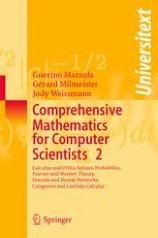
Comprehensive mathematics for computer scientists 2 : Calculus and ODEs, splines, probability, fourier and wavelet theory, fractals and neural networks, categories and lambda calculus
This second volume of a comprehensive tour through mathematical core subjects for computer scientists completes the first volume in two - gards: Part III first adds topology, di?erential, and integral calculus to the t- ics of sets, graphs, algebra, formal logic, machines, and linear geometry, of volume 1. With this spectrum of fundamentals in mathematical e- cation, young professionals should be able to successfully attack more involved subjects, which may be relevant to the computational sciences. In a second regard, the end of part III and part IV add a selection of more advanced topics. In view of the overwhelming variety of mathematical approaches in the computational sciences, any selection, even the most empirical, requires a methodological justi?cation. Our primary criterion has been the search for harmonization and optimization of thematic - versity and logical coherence. This is why we have, for instance, bundled such seemingly distant subjects as recursive constructions, ordinary d- ferential equations, and fractals under the unifying perspective of c- traction theory.
