



الصفحة 1
الصفحة 1

Guida alla teoria degli insiemi = Guide to set theory
Teachers are in difficulty with regard to the space and emphasis to be given to set theory topics, in their preparation and in their work, because they have not been provided with adequate knowledge at the university. It is safe to say, on the basis of much experience, that the average mathematician, even the researcher, does not know what set theory is. Two prejudices stand in the way of a good knowledge of the theory: one, of a minimalist type, is its identification with an unspecified "set theory", an austere language that is too demanding if one wants to impose it prematurely; the other is of a maximalist type and consists in the supposed and effective link with the more subtle questions of the foundations of mathematics. But the theory has an important mathematical content, and with many implications of didactic interest.

Ennio De Giorgi : Selected Papers
The book contains a selection of 43 scientific papers by the great mathematician Ennio De Giorgi (1928-1996), which display the broad range of his achievements and his entire intellectual career as a problem solver and as a proponent of deep and ambitious mathematical theories. All papers are written in English and 17 of them appear also in their original Italian version in order to give an impression of De Giorgi’s original style. The editors also provide a short biography of Ennio De Giorgi and a detailed account of his scientific achievements, ranging from his seminal paper on the solution of Hilbert’s 19th problem to the theory of perimeter and minimal surfaces, the theory of G-convergence and the foundations of mathematics.
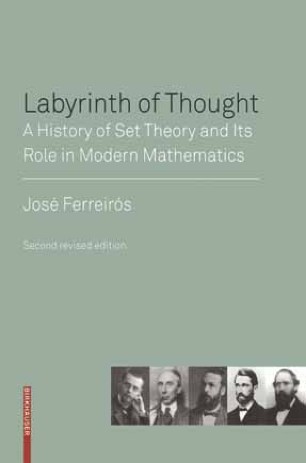
Labyrinth of Thought : A History of Set Theory and Its Role in Modern Mathematics
Labyrinth of Thought discusses the emergence and development of set theory and the set-theoretic approach to mathematics during the period 1850-1940. Rather than focusing on the pivotal figure of Georg Cantor, it analyzes his work and the emergence of transfinite set theory within the broader context of the rise of modern mathematics. The text has a tripartite structure.A new Epilogue for this second edition offers further reflections on the foundations of set theory, including the "dichotomy conception" and the well-known iterative conception.
Completeness theory for propositional logics
Completeness is one of the most important notions in logic and the foundations of mathematics. Many variants of the notion have been de?ned in literature. We shallconcentrateonthesevariants,andaspects,of completenesswhicharede?ned in propositional logic. Completeness means the possibility of getting all correct and reliable sc- mata of inference by use of logical methods. The word ‘all’, seemingly neutral, is here a crucial point of distinction. Assuming the de?nition as given by E. Post we get, say, a global notion of completeness in which the reliability refers only to syntactic means of logic and outside the correct schemata of inference there are only inconsistent ones. It is impossible, however, to leave aside local aspects of the notion when we want to make it relative to some given or invented notion of truth. Completeness understood in this sense is the adequacy of logic in relation to some semantics, and the change of the logic is accompanied by the change of its semantics.
