



الصفحة 1
الصفحة 1

New Materials in Civil Engineering
A valuable guide to the properties, selection criteria, products, applications, lifecycle and recyclability of advanced materials. It presents an A-to-Z approach to all types of materials, highlighting their key performance properties, principal characteristics and applications. Traditional materials covered include concrete, soil, steel, timber, fly ash, geosynthetic, fiber-reinforced concrete, smart materials, carbon fiber and reinforced polymers. In addition, the book covers nanotechnology and biotechnology in the development of new materials.

Metakaolin and Fly Ash as Mineral Admixtures for Concrete
Deals with modern theoretical concepts related to the impact of fly ash and metakaolin admixtures on structure formation processes of concrete. Results of the effect of fly ash, metakaolin and their composition on properties of self-compacting and self-leveling concrete are presented. Based on mathematical models, obtained using mathematical experiments planning methodology, the impact of the main factors and their combination on workability, strength and other properties that determine efficiency and durability of concrete are analyzed. Using calculated dependencies, a methodology for designing optimal compositions of concrete containing active mineral admixtures and superplasticizers is proposed. Features of industrial production of concrete for the proposed compositions are discussed. The book is intended for specialists working in the production of concrete and reinforced concrete products and elements. It can also be used by construction engineers to design compositions of cost-effective self-compacting and self-leveling concrete as well as to determine the rational direction of using technogenic raw materials like ash and metakaolin.

Improving concrete and mortar using modified ash and slag cements
Presents the results of a study of high-tech concrete on composite Portland cement and slag Portland cement. The possibilities of significantly improving the properties of cements and concrete with the introduction of superplasticizers and hardening activators are shown. Experimental dependences that make it possible to predict the properties of concrete and mortars and to design mixtures with given properties are given.

Development of geopolymer from pond ash-thermal power plant waste : Novel constructional materials for civil engineers
Demonstrates how to utilize fly ash/pond ash (waste materials from thermal power plants) to produce a novel material called 'Geopolymer' (GP). Red mud, slags, etc., are mixed with fly ash to produce GP with enhanced strength. As shown in a few European countries, GP can replace cement, and some permanent structures constructed with GP are now appearing in a few advanced countries. GP, and geopolymer concrete, is considered suitable for the construction of roads, buildings, etc., and will eventually, fully or partially, replace cement.
Building construction and technology
Highlights various aspects of building construction industry based on data from field studies. It discusses the challenges, methodologies, technological applications in building construction, technology, and management. The book presents new approaches to effective building construction and an understanding of the impact of applications of latest technologies.
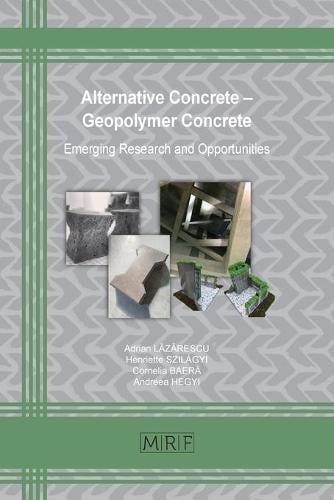
Alternative concrete - geopolymer concrete : Emerging research and opportunities
Focuses on fly ash-based alkali-activated geopolymer concrete, its production and characteristic properties. The re-use of waste materials and industrial by-products, such as fly ash, is not only economically of interest but also helps to reduce carbon dioxide emissions. The carbon footprint of these materials is much lower than that of concrete using ordinary Portland cement. They thus offer new sustainable solutions to the construction industry.
