



الصفحة 1
الصفحة 1
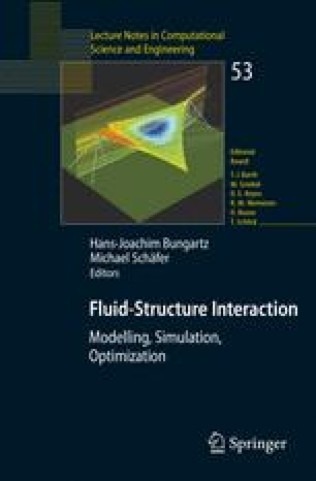
Fluid-structure interaction : Modelling, simulation, optimisation
Fluid-structure interactions (FSI), that is interactions of some movable or deformable structure with an internal or surrounding fluid flow, are among the most important and, with respect to both modelling and computational issues, the most challenging multi-physics problems. The variety of FSI occurrences is abundant and ranges from tent-roofs to micropumps, from parachutes via airbags to blood flow in arteries.
IUTAM Symposium on Fluid-Structure Interaction in Ocean Engineering ; Proceedings of the IUTAM Symposium held in Hamburg, Germany, July 23-26, 2007
This book collects contributions from leading scientists working on the following topics: Ocean waves, probabilistic models of sea waves, fluid-loading on structures including pipes, cables, drill-strings etc., behavior of floating systems, stability and capsizing of ships, coupled structural behavior, sloshing in tanks, CFD validation and verification.
Computational Acoustics of Noise Propagation in Fluids - Finite and Boundary Element Methods
Among numerical methods applied in acoustics, the Finite Element Method (FEM) is normally favored for interior problems whereas the Boundary Element Method (BEM) is quite popular for exterior ones. That is why this valuable reference provides a complete survey of methods for computational acoustics, namely FEM and BEM. It demonstrates that both methods can be effectively used in the complementary cases. The chapters by well-known authors are evenly balanced: 10 chapters on FEM and 10 on BEM. An initial conceptual chapter describes the derivation of the wave equation and supplies a unified approach to FEM and BEM for the harmonic case. A categorization of the remaining chapters and a personal outlook complete this introduction. In what follows, both FEM and BEM are discussed in the context of very different problems.
Aging, shaking, and cracking of infrastructures : From mechanics to concrete dams and nuclear structures
Focuses on the safety assessment of existing structures subjected to multi-hazard scenarios through advanced numerical methods. Whereas the focus is on concrete dams and nuclear containment structures, the presented methodologies can also be applied to other large-scale ones. This book is composed of seven sections: Fundamentals: theoretical coverage of solid mechnics, plasticity, fracture mechanics, creep, / seismology, dynamic analysis, probability and statistics / Damage: that can affect concrete structures, such as cracking of concrete, AAR, chloride ingress, and rebar corrosion, / Finite Element: formulation for both linear and nonlinear analysis including stress, heat and fracture mechanics, / Engineering Models: for soil/fluid-structure interaction, uncertainty quantification, probablilistic and random finite element analysis, machine learning, performance based earthquake engineering, ground motion intensity measures, seismic hazard analysis, capacity/fragility functions and damage indeces, / Applications to dams through potential failure mode analyses, risk-informed decision making, deterministic and probabilistic examples, / Applications to nuclear structures through modeling issues, aging management programs, critical review of some analyses, / Other applications and case studies: massive RC structures and bridges, detailed assessment of a nuclear containment structure evaluation for license renewal.

Advanced computational methods and geomechanics
Helps readers comprehensively grasp the intrinsic features of typical advanced computational methods. These methods are created in recent three decades for the understanding of the post-failure of geo-materials accompanied with discontinuous and finite deformation/dislocation, as well as the violent fluid-structure interaction accompanied with strong distortion of water surface. The strong points and weak points of the formalisms for governing equations, the discretization schemes, the nodal interpolation /approximation of field variables, and their connectivity (via support domains, covers, or enrichments), the basic algorithms, etc., are clarified.
