



الصفحة 1
الصفحة 1

Modelling, Monitoring and Diagnostic Techniques for Fluid Power Systems
Modelling, Monitoring and Diagnostic Techniques for Fluid Power Systems covers the background theory of fluid power and indicates the range of concepts necessary for a modern approach to condition monitoring and fault diagnosis in a readable and understandable fashion. The theory is constantly leavened by 15 years' worth of practical measurements by the author, working in association with major fluid power companies, and real industrial case studies – hot-strip-mill monitoring in conjunction with Corus p.l.c. being just one example. Comprising four parts, it provides: • an introduction to component behaviour. • a guide to the modelling methods employed for circuit analysis. • methods for doing condition monitoring. • common faults and breakdowns.

Modelling and Estimation Strategies for Fault Diagnosis of Non-Linear Systems : From Analytical to Soft Computing Approaches
This monograph presents a variety of techniques that can be used for designing robust fault diagnosis schemes for non-linear systems. The introductory part of the book is of a tutorial value and can be perceived as a good starting point for the new-comers to this field. Subsequently, advanced robust observer structures are presented. Parameter estimation based techniques are discussed as well. A particular attention is drawn to experimental design for fault diagnosis. The book also presents a number of robust soft computing approaches utilizing evolutionary algorithms and neural networks. All approaches described in this book are illustrated by practical applications.

Model-based Fault Diagnosis Techniques : Design Schemes, Algorithms, and Tools
The objective of this book is to introduce basic model-based FDI schemes, advanced analysis and design algorithms and the needed mathematical and control theory tools at a level for graduate students and researchers as well as for engineers.

Frontiers in Computing Technologies for Manufacturing Applications
Frontiers in Computing Technologies for Manufacturing Applications presents an overview of the state-of-the-art intelligent computing in manufacturing. Modeling, data processing, algorithms and computational analysis of difficult problems found in advanced manufacturing are discussed. It is the first book to bring together combinatorial optimization, information systems and fault diagnosis and monitoring in a consistent manner. Techniques are presented in order to aid decision makers needing to consider multiple, conflicting objectives in their decision processes. In particular, the use of metaheuristic optimization techniques for multi-objective problems is discussed. Readers will learn about computational technologies that can improve the performance of manufacturing systems ranging from manufacturing equipment to supply chains.

Fault-Diagnosis Systems : An Introduction from Fault Detection to Fault Tolerance
This book gives an introduction into the field of fault detection, fault diagnosis and fault-tolerant systems with methods which have proven their performance in practical applications. It guides the reader in a structured tutorial style: supervision methods, reliability, safety, system integrity and related terminology; fault detection with signal-based methods for periodic and stochastic signals; fault detection with process model-based methods like parameter estimation, state estimation, parity equations and principal component analysis; fault diagnosis with classification and inference methods; fault-tolerant systems with hardware and analytical redundancy; many practical simulation examples and experimental results for processes like electrical motors, pumps, actuators, sensors and automotive components; end-of-chapter exercises for self testing or for practice.
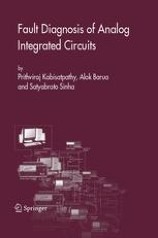
Fault Diagnosis of Analog Integrated Circuits
Fault Diagnosis of Analog Integrated Circuits is a textbook for advanced undergraduate and graduate level students as well as practicing engineers. The objective of this book is to study the testing and fault diagnosis of analog and analog part of mixed signal circuits. A background in analog integrated circuit, artificial neural network is desirable but not essential.

Fault Diagnosis and Tolerance in Cryptography ; 3rd International Workshop, FDTC 2006, Yokohama, Japan, October 10, 2006, Proceedings
The sophistication of the underlying cryptographic algorithms, the high complexity of the implementations, and the easy access and low cost of cryptographic devices resulted in increased concerns regarding the reliability and security of crypto-devices. The effectiveness of side channel attacks on cryptographic devices, like timing and power-based attacks, has been known for some time. Several recent investigations have demonstrated the need to develop methodologies and techniques for designing robust cryptographic systems (both hardware and software) to protect them against both accidental faults and maliciously injected faults with the purpose of extracting the secret key. This trend has been particularly motivated by the fact that the equipment needed to carry out a successful side channel attack based on fault injection is easily accessible at a relatively low cost (for example, laser beam technology), and that the skills needed to use it are quite common.

Diagnosis and Fault-Tolerant Control
The book presents effective model-based analysis and design methods for fault diagnosis and fault-tolerant control. Architectural and structural models are used to analyse the propagation of the fault throughout the process, to test the fault detectability and to find the redundancies in the process that can be used to ensure fault tolerance. Design methods for diagnostic systems and fault-tolerant controllers are presented for processes that are described by analytical models, by discrete-event models or that can be dealt with as quantised systems. Five case studies on pilot processes show the applicability of the presented methods. The theoretical results are illustrated by two running examples used throughout the book.

Data-Driven Fault Detection and Reasoning for Industrial Monitoring
Assesses the potential of data-driven methods in industrial process monitoring engineering. The process modeling, fault detection, classification, isolation, and reasoning are studied in detail. These methods can be used to improve the safety and reliability of industrial processes. Fault diagnosis, including fault detection and reasoning, has attracted engineers and scientists from various fields such as control, machinery, mathematics, and automation engineering. Combining the diagnosis algorithms and application cases, this book establishes a basic framework for this topic and implements various statistical analysis methods for process monitoring.

Computational Intelligence in Fault Diagnosis
Presenting the latest developments and research results on fault diagnosis approaches using computational intelligence methodologies, this book opens with a review of the state-of-the-art before moving on to focus on various theoretical aspects of computational intelligence methodologies applied to real-world fault diagnosis problems.
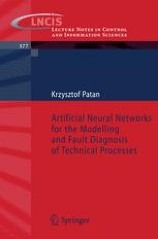
Artificial neural networks for the Modelling and Fault Diagnosis of Technical Processes
In this book, a wide spectrum of fault diagnosis techniques have been developed. A major category of fault diagnosis techniques is the model based one, where an analytical model of the plant to be monitored is assumed to be available.

Artificial intelligence applications and innovations II; IFIP TC12 and WG12.5 ; 2nd IFIP conference on artificial intelligence applications and innovations (AIAI-2005), Sept. 7-9, 2005, Beijing, China
Artificial Intelligence is one of the oldest and most exciting subfields of computing, covnering such areas as intelligent robotics, intelligent planning and scheduling, model-based reasoning, fault diagnosis, natural language processing, maching translation, knowledge representation and reasoning, knowledge-based systems, knowledge engineering, intelligent agents, machine learning, neural nets, genetic algorithms and knowledge management. The papers in this volume comprise the refereed proceedings of the Second International Conference on Artificial Intelligence Applications and Innovations,held in Beijing, China in 2005.
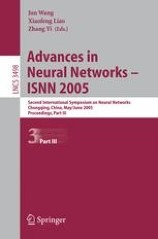
Advances in neural networks - ISNN 2005 ; Vol. 3498 ; 2nd International Symposium on Neural Networks, Chongqing, China, May 30 - June 1, 2005, Proceedings, Part III
The three volume set LNCS 3496/3497/3498 constitutes the refereed proceedings of the Second International Symposium on Neural Networks, ISNN 2005, held in Chongqing, China in May/June 2005. The 483 revised papers presented were carefully reviewed and selected from 1.425 submissions. The papers are organized in topical sections on theoretical analysis, model design, learning methods, optimization methods, kernel methods, component analysis, pattern analysis, systems modeling, signal processing, image processing, financial analysis, control systems, robotic systems, telecommunication networks, incidence detection, fault diagnosis, power systems, biomedical applications, industrial applications, and other applications.
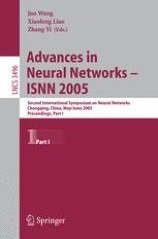
Advances in neural networks - ISNN 2005 ; Vol. 3496 ; 2nd International symposium on neural networks, Chongqing, China, May 30 - June 1, 2005, Proceedings, Part I
The three volume set LNCS 3496/3497/3498 constitutes the refereed proceedings of the Second International Symposium on Neural Networks, ISNN 2005, held in Chongqing, China in May/June 2005. The 483 revised papers presented were carefully reviewed and selected from 1.425 submissions. The papers are organized in topical sections on theoretical analysis, model design, learning methods, optimization methods, kernel methods, component analysis, pattern analysis, systems modeling, signal processing, image processing, financial analysis, control systems, robotic systems, telecommunication networks, incidence detection, fault diagnosis, power systems, biomedical applications, industrial applications, and other applications.

Advanced Intelligent Computing Theories and Applications : With Aspects of Artificial Intelligence ; 3rd International Conference on Intelligent Computing, ICIC 2007, Qingdao, China, August 21-24, 2007, Proceedings
The International Conference on Intelligent Computing (ICIC) was formed to provide an annual forum dedicated to the emerging and challenging topics in artificial intelligence, machine learning, bioinformatics, and computational biology, etc. It aims to bring gether researchers and practitioners from both academia and industry to share ideas, problems and solutions related to the multifaceted aspects of intelligent computing.This year, the conference concentrated mainly on the theories and methodologies as well as the emerging applications of intelligent computing. Its aim was to unify the picture of contemporary intelligent computing techniques as an integral concept that highlights the trends in advanced computational intelligence and bridges theoretical research with applications.
