



الصفحة 1
الصفحة 1

Novel Trends in Brain Science : Brain Imaging, Learning and Memory, Stress and Fear, and Pain
With the development of neural science, knowledge of the molecules and neurons that comprise the brain has increased exponentially in the past two decades. In Novel Trends in Brain Science, leading neuroscientists from Japan and Taiwan describe the latest and most relevant research in brain science, including state-of-the-art brain-imaging technologies such as fMRI, MR-DTI, TMS, and MEG, and also discuss learning, memory, emotions, and pain. With a wide range of contributors, the book presents valuable insights into functional neuroimaging, white matter tractography, synaptic plasticity, emoti.

MRI in Clinical Practice
The book covers the basic Physics behind MRI, quality assurance, up-to-date safety guidelines and a useful gallery of image artefacts. Part of the book focuses on the specific areas of the body in which MRI is currently exploited, describing how MRI is performed in practice. In each of these sections, a common theme is followed with illustrations of MR images acquired with clinically relevant settings and typical imaging protocols are also explicitly stated. Additional information is provided which includes a subjective view of the strengths and weaknesses of MRI in comparison to other imaging modalities. As well as covering routine clinical techniques, the latest advanced methods (e.g. spectroscopy, fMRI, diffusion, high field MRI) are discussed and placed into the context of clinical application.

Medical Imaging and Informatics ; 2nd International Conference, MIMI 2007, Beijing, China, August 14-16, 2007 Revised Selected Papers
This book constitutes the thoroughly refeered post-conference proceedings of the Second Interational Conference on Medical Imaging and Informatics, MIMI 2007, held in Beijing, China, in August 2007.The 40 revised full papers presented together with 4 keynote talks were carefully reviewed and selected from 110 submissions. The papers are organized in topical sections on medical image segmentation and registration, medical informatics, PET, fMRI, ultrasound and thermal imaging, 3D reconstruction and visualization. The volume is rounded off by 4 papers from 2 workshops on legal, ethical and social issues in medical imaging and informatics, as well as on computer-aided diagnosis (CAD).

Information Processing in Medical Imaging ; 20th International Conference, IPMI 2007, Kerkrade, The Netherlands, July 2-6, 2007, Proceedings
The 20th International Conference on Information Processing in Medical Im- ing(IPMI)washeldduringJuly2–6,2007,atRolducAbbey,locatedinKerkrade in the south of the Netherlands. IPMI is one of the longest running conferences in medical imaging.
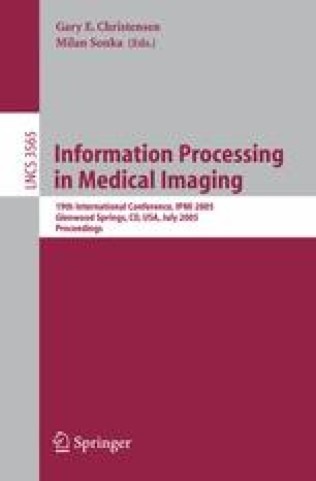
Information processing in medical imaging ; 19th International conference, IPMI 2005, Glenwood Springs, CO, USA, July 10-15, 2005, Proceedings
The nineteenth biennial International Conference on Information Processing in Medical Imaging (IPMI) was held July 11–15, 2005 in Glenwood Springs, CO, USA on the Spring Valley campus of the Colorado Mountain College. Following the successful meeting in beautiful Ambleside in England, this year’s conference addressed important recent developments in a broad range of topics related to the acquisition, analysis and application of biomedical images. Interest in IPMI has been steadily growing over the last decade. This is p- tially due to the increased number of researchers entering the ?eld of medical imagingasaresultoftheWhitakerFoundationandtherecentlyformedNational Institute of Biomedical Imaging and Bioengineering. This year, there were 245 full manuscripts submitted to the conference which was twice the number s- mitted in 2003 and almost four times the number of submissions in 2001. Of these papers, 27 were accepted as oral presentations, and 36 excellent subm- sions that could not be accommodated as oral presentations were presented as posters. Selection of the papers for presentation was a di?cult task as we were unable to accommodate many of the excellent papers submitted this year. All accepted manuscripts were allocated 12 pages in these proceedings.

Imaging of Orbital and Visual Pathway Pathology
This is one of the first books to deal with imaging of pathology of the entire visual system. It is divided into two parts, general and special. In the general part, the most important basics of modern imaging methods are discussed in detail, but with less emphasis on the physical background than in purely neuro-/radiological books. A chapter is devoted to the meticulous presentation of imaging anatomy of the orbit and intracranial visual pathway.

Functional MRI : Basic principles and clinical applications
This practical and timely volume presents an overview of the principles of fMRI and explains key concepts, including scanning methodologies, experimental research design, and data analysis. Informative discussions cover the technical and clinical challenges associated with fMRI. A neuroanatomical atlas adds to the sensible approach and serves as a useful reference by clearly illustrating normal functioning for important areas of the brain.

Clinical Functional MRI : Presurgical Functional Neuroimaging
Functional magnetic resonance imaging (fMRI) has contributed significantly to progress in neuroscience by permitting noninvasive imaging of the "human brain at work" under physiological conditions. Within clinical neuroimaging, fMRI is opening up a new diagnostic field by measuring and visualizing brain function. However, fMRI is not yet a standard diagnostic imaging procedure. This textbook is devoted to preoperative fMRI in patients with brain tumors and epilepsies, which are the most well-established clinical applications. By localizing and lateralizing specific brain functions in individual patients, as well as epileptogenic zones, fMRI facilitates the selection of a safe treatment and the planning and performance of function-preserving neurosurgery.

Atlas of Morphology and Functional Anatomy of the Brain
Divided into a morphological and a functional imaging section. The morphological atlas includes 3D surface images, axial, coronal, and sagittal scans acquired with high-definition T2 fast spin echo (FSE) sequences, and standard and inverted-contrast images. The MR scans are shown side by side with the corresponding anatomical brain sections, provided by Prof. Henri Duvernoy, for more effective comparison. The anatomical nomenclature adopted for both the MR and the anatomical images is listed in an jacket flap for easier consultation.
