



الصفحة 1
الصفحة 1

Introduction to Biosemiotics : The New Biological Synthesis
This book is addressed to students, researchers and academics who have barely heard of the emerging young science of Biosemiotics, and who want to know more about it. Written by many of the field’s major contributors, it provides a highly qualified introduction to Biosemiotics and illustrates the most recent views in its background and development.
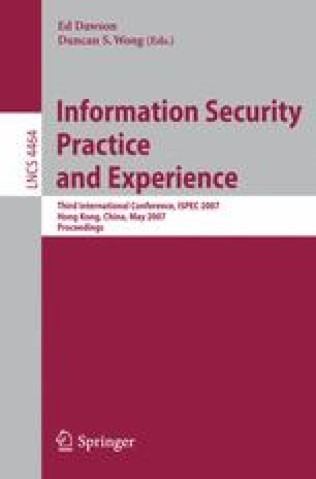
Information security, practice and experience ; 3rd International Conference, ISPEC 2007, Hong Kong, China, May 7-9, 2007, Proceedings
ISPEC is an annual conference that brings together researchers and practitioners to provide a con?uence of new information security technologies, their applications and their integration with IT systems in various vertical s- tors. In 2005 and 2006,the ?rst and second conferences were held successfully in Singapore and Hangzhou, China, respectively.

Information security applications ; 8th International Workshop, WISA 2007, Jeju Island, Korea, August 27-29, 2007, Revised Selected Papers
Complete with Springer's trademark online files and updates, this fascinating text constitutes the refereed proceedings of the 8th International Workshop on Information Security Applications, WISA 2007, held in Jeju Island, Korea, in August 2007.

Information security and cryptology ; Vol. 3822 ; 1st SKLOIS Conference, CISC 2005, Beijing, China, December 15-17, 2005, Proceedings
The first SKLOIS Conference on Information Security and Cryptography(CISC 2005) was organized by the State Key Laboratory of Information Security of the Chinese Academy of Sciences. It was held in Beijing, China, December 15-17, 2005 and was sponsored by the Institute of Software, the Chinese Academy of Sciences, the Graduate School of the Chinese Academy of Sciences and the National Science Foundation of China. The conference proceedings, represe- ing invited and contributed papers, are published in this volume of Springer’s Lecture Notes in Computer Science (LNCS) series. The area of research covered by CISC has been gaining importance in recent years, and a lot of fundamental, experimental and applied work has been done, advancing the state of the art. The program of CISC 2005 covered numerous ?elds of research within the general scope of the conference.

Error-Correction Coding and Decoding : Bounds, Codes, Decoders, Analysis and Applications
This book discusses both the theory and practical applications of self-correcting data, commonly known as error-correcting codes. The applications included demonstrate the importance of these codes in a wide range of everyday technologies, from smartphones to secure communications and transactions. Written in a readily understandable style,This book is a valuable resource for anyone interested in error-correcting codes and their applications, ranging from non-experts to professionals at the forefront of research in their field.

Error-Correcting Linear Codes : Classification by Isometry and Applications
This text offers a thorough introduction to the mathematical concepts behind the theory of error-correcting linear codes. Care is taken to introduce the necessary algebraic concepts, for instance the theory of finite fields, the polynomial rings over such fields and the ubiquitous concept of group actions that allows the classification of codes by isometry. The book provides in-depth coverage of important topics like cyclic codes and the coding theory used in compact disc players. The final four chapters cover advanced and algorithmic topics like the classification of linear codes by isometry, the enumeration of isometry classes, random generation of codes, the use of lattice basis reduction to compute minimum distances, the explicit construction of codes with given parameters, as well as the systematic evaluation of representatives of all isometry classes of codes.

Error Correction Codes for Non-Volatile Memories
In ECC for Non-Volatile Memories the authors expose the basics of coding theory needed to understand the application to memories, as well as the relevant design topics, with reference to both NOR and NAND Flash architectures. A collection of software routines is also included for better understanding.

Cryptographic hardware and embedded systems - CHES 2008 ; 10th International Workshop, Washington, D.C., USA, August 10-13, 2008. Proceedings
This book constitutes the refereed proceedings of the 10th Interntaional Workshop on Cryptographic Hardware and Embedded Systems, CHES 2008, held in Washington, D.C., USA, during August 10-13, 2008.

Cryptographic hardware and embedded systems - CHES 2005 ; 7th International Workshop, Edinburgh, UK, August 29 - September 1, 2005, Proceedings
Constitutes the refereed proceedings of the 7th International Workshop on Cryptographic Hardware and Embedded Systems, CHES 2005, held in Edinburgh, UK in August/September 2005. The papers in this book are organized in topical sections on side channels, arithmetic for cryptanalysis, special purpose hardware, hardware attacks and more.

Coding for Data and Computer Communications
In a unique, single volume, this highly versatile text/reference introduces readers to the importance of channel coding (error-correcting codes), secure coding (cryptography), and source coding (data compression). It is organized in three main parts and uses clear, nonmathematical explanations to develop the concepts, principles, and techniques in each area of coding. Requiring only a general familiarity with computer methods, the book deals with all aspects of coding and its relevance to fast, secure, and reliable data transmission and storage. Features & Benefits: Presents comprehensive coverage of areas of coding often found in separate books, and stresses data coding’s relevance in today’s world / Provides a wealth of examples and exercises (with solutions) to help readers easily grasp the material / Incorporates an extensive chapter on data hiding, a sparsely documented topic of increasing importance in the community / Includes an author-supplied website with supplementary material / Possesses a detailed bibliography and helpful glossary, index, and appendixes (including projects for self-study).

Coding and Cryptography ; International Workshop, WCC 2005, Bergen, Norway, March 14-18, 2005, Revised Selected Papers
This volume contains refereed papers devotedtocodingandcrypto graphy.These papers arethe full versionsof a selectionof the best extended abstractsaccepted for presentation at the International Workshop on Coding and Cryptography (WCC 2005) held in Bergen, Norway, March 14–18, 2005. Each of the 118 - tended abstracts originallysubmitted to the workshop were reviewed by at least two members of the Program Committee. As a result of this screening process, 58 papers were selected for presentation, of which 52 were eventually presented at the workshop together with four invited talks.
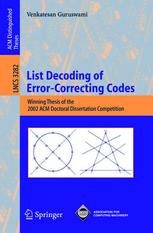
List decoding of error-correcting codes : Winning thesis of the 2002 ACM doctoral dissertation competition
Presents some spectacular new results in the area of decoding algorithms for error-correcting codes. Specifically, it shows how the notion of “list-decoding” can be applied to recover from far more errors, for a wide variety of err- correcting codes, than achievable before. A brief bit of background : error-correcting codes are combinatorial str- tures that show how to represent (or “encode”) information so that it is - silient to a moderate number of errors. Speci?cally, an error-correcting code takes a short binary string, called the message, and shows how to transform it into a longer binary string, called the codeword, so that if a small number of bits of the codewordare ?ipped, the resulting string does not look like any other codeword. The maximum number of errorsthat the code is guaranteed to detect, denoted d, is a central parameter in its design. A basic property of such a code is that if the number of errors that occur is known to be smaller than d/2, the message is determined uniquely. This poses a computational problem, called the decoding problem : compute the message from a corrupted codeword, when the number of errors is less than d/2.

Arithmetic of finite fields ; 1st International Workshop, WAIFI 2007, Madrid, Spain, June 21-22, 2007, Proceedings
This book presented structures in finite fields, efficient implementation and architectures, efficient finite field arithmetic, classification and construction of mappings over finite fields, curve algebra, cryptography, codes, and discrete structures.
Applied algebra, algebraic algorithms and error-correcting codes ; 17th International Symposium, AAECC-17, Bangalore, India, December 16-20, 2007, Proceedings
Among the subjects addressed are block codes, including list-decoding algorithms; algebra and codes: rings, fields, algebraic geometry codes; algebra: rings and fields, polynomials, permutations, lattices; cryptography: cryptanalysis and complexity; computational algebra: algebraic algorithms and transforms; sequences and boolean functions.
Applied algebra, algebraic algorithms and error-correcting codes ; 16th International Symposium, AAECC-16, Las Vegas, NV, USA, February 20-24, 2006, Proceedings
This book constitutes the refereed proceedings of the 16th International Symposium on Applied Algebra, Algebraic Algorithms and Error-Correcting Codes, AAECC-16, held in Las Vegas, NV, USA in February 2006. The 25 revised full papers presented together with 7 invited papers were carefully reviewed and selected from 32 submissions. Among the subjects addressed are block codes; algebra and codes: rings, fields, and AG codes; cryptography; sequences; decoding algorithms; and algebra: constructions in algebra, Galois groups, differential algebra, and polynomials.

Algebraic and Proof-theoretic Aspects of Non-classical Logics : Papers in Honor of Daniele Mundici on the Occasion of His 60th Birthday
It profound connections between logic and such diverse fields of research as functional analysis, probability and measure theory, the geometry of toric varieties, piecewise linear geometry, and error-correcting codes. Several prominent logicians, mathematicians, and computer scientists
