



الصفحة 1
الصفحة 1

Vector Semantics
Links the formal theory of word vectors to the cognitive theory of linguistics. The computational linguists and deep learning researchers who developed word vectors have relied primarily on the ever-increasing availability of large corpora and of computers with highly parallel GPU and TPU compute engines, and their focus is with endowing computers with natural language capabilities for practical applications such as machine translation or question answering. Cognitive linguists investigate natural language from the perspective of human cognition, the relation between language and thought, and questions about conceptual universals, relying primarily on in-depth investigation of language in use.

Topics in Discrete Mathematics : Dedicated to Jarik Nešetril on the Occasion of his 60th birthday
Leading experts have contributed survey and research papers in the areas of Algebraic Combinatorics, Combinatorial Number Theory, Game theory, Ramsey Theory, Graphs and Hypergraphs, Homomorphisms, Graph Colorings and Graph Embeddings.

Representation learning for natural language processing
Provides an overview of the recent advances in representation learning theory, algorithms, and applications for natural language processing (NLP), ranging from word embeddings to pre-trained language models. It is divided into four parts. Part I presents the representation learning techniques for multiple language entries, including words, sentences and documents, as well as pre-training techniques. Part II then introduces the related representation techniques to NLP, including graphs, cross-modal entries, and robustness. Part III then introduces the representation techniques for the knowledge that are closely related to NLP, including entity-based world knowledge, sememe-based linguistic knowledge, legal domain knowledge and biomedical domain knowledge. Lastly, Part IV discusses the remaining challenges and future research directions..

Representation Learning : Propositionalization and Embeddings
This monograph addresses advances in representation learning, a cutting-edge research area of machine learning. Representation learning refers to modern data transformation techniques that convert data of different modalities and complexity, including texts, graphs, and relations, into compact tabular representations, which effectively capture their semantic properties and relations. The monograph focuses on (i) propositionalization approaches, established in relational learning and inductive logic programming, and (ii) embedding approaches, which have gained popularity with recent advances in deep learning. The authors establish a unifying perspective on representation learning techniques developed in these various areas of modern data science, enabling the reader to understand the common underlying principles and to gain insight using selected examples and sample Python code. The monograph should be of interest to a wide audience, ranging from data scientists, machine learning researchers and students to developers, software engineers and industrial researchers interested in hands-on AI solutions.

Hands-on question answering systems with BERT : Applications in neural networks and natural language processing
Begins with an overview of the technology landscape behind BERT. It takes you through the basics of NLP, including natural language understanding with tokenization, stemming, and lemmatization, and bag of words. Next, you’ll look at neural networks for NLP starting with its variants such as recurrent neural networks, encoders and decoders, bi-directional encoders and decoders, and transformer models. Along the way, you’ll cover word embedding and their types along with the basics of BERT. After this solid foundation, you’ll be ready to take a deep dive into BERT algorithms such as masked language models and next sentence prediction. You’ll see different BERT variations followed by a hands-on example of a question answering system. You will: Examine the fundamentals of word embeddings / Apply neural networks and BERT for various NLP tasks / Develop a question-answering system from scratch / Train question-answering systems for your own data

Compactifying Moduli Spaces for Abelian Varieties
This volume presents the construction of canonical modular compactifications of moduli spaces for polarized Abelian varieties (possibly with level structure), building on the earlier work of Alexeev, Nakamura, and Namikawa. This provides a different approach to compactifying these spaces than the more classical approach using toroical embeddings, which are not canonical. There are two main new contributions in this monograph: (1) The introduction of logarithmic geometry as understood by Fontaine, Illusie, and Kato to the study of degenerating Abelian varieties; and (2) the construction of canonical compactifications for moduli spaces with higher degree polarizations based on stack-theoretic techniques and a study of the theta group.
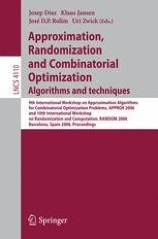
Approximation, randomization, and combinatorial optimization algorithms and techniques ; 9th International Workshop on approximation algorithms for combinatorial optimization problems, APPROX 2006 and 10th International Workshop on Randomization and Computation, RANDOM 2006, Barcelona, Spain, August 28-30, 2006, Proceedings
This is the joint refereed proceedings of the 9th International Workshop on Approximation Algorithms for Combinatorial Optimization Problems, APPROX 2006 and the 10th International Workshop on Randomization and Computation, RANDOM 2006. The book presents 44 carefully reviewed and revised full papers. Among the topics covered are design and analysis of approximation algorithms, hardness of approximation problems, small spaces and data streaming algorithms, embeddings and metric space methods, and more.
