



الصفحة 1
الصفحة 1

Nishina Memorial Lectures : Creators of Modern Physics
This volume is a collection of Nishina Memorial Lectures delivered by distinguished physicists during the past 50 years at the invitation of the Nishina Memorial Foundation.

Ionospheric multi-spacecraft analysis tools : Approaches for deriving ionospheric parameters
This book provides a comprehensive toolbox of analysis techniques for ionospheric multi-satellite missions. The immediate need for this volume was motivated by the ongoing ESA Swarm satellite mission, but the tools that are described are general and can be used for any future ionospheric multi-satellite mission with comparable instrumentation.

Introduction to Relativistic Continuum Mechanics
This mathematically-oriented introduction takes the point of view that students should become familiar, at an early stage, with the physics of relativistic continua and thermodynamics within the framework of special relativity. Therefore, in addition to standard textbook topics such as relativistic kinematics and vacuum electrodynamics, the reader will be thoroughly introduced to relativistic continuum and fluid mechanics. Emphasis in the presentation is on the 3+1 splitting technique, widely used in general relativity for introducing the relative observers point of view.

General Relativity
This book offers an alternative to other textbooks on the subject, providing a more specific discussion of numerous general relativistic effects for readers who have knowledge of classical mechanics and electrodynamics, including special relativity. Coverage includes gravitational lensing, signal retardation in the gravitational field of the Sun, the Reissner-Nordström solution, selected spin effects, the resonance transformation of an electromagnetic wave into a gravitational one, and the entropy and temperature of black holes. The book includes numerous problems at various levels of difficulty, making it ideal also for independent study by a broad readership of advanced students and researchers.

Fundamentals of quantum optics and quantum information
This book is an introduction to the two closely related subjects of quantum optics and quantum information. Essentially, the physical aspects of quantum information processing have now become an integral part of quantum optics.

Frontiers in Quantum Systems in Chemistry and Physics
The basic theory of matter on the nanoscale is quantum mechanics and the application of quantum mechanics to the study of the many-body problem in molecules and materials is a rapidly developing field of research. Frontiers in Quantum Systems in Chemistry and Physics defines the leading edge; hence it describes the new theoretical developments available to a wider audience and presents theories which provide, for example, new insights into the structure of increasing complex molecular systems or molecules in a variety of environments. New computational techniques and practices are accessed, exploiting the wide range of equipment available to the researcher from “leadership” class supercomputers to distributed workstations and the internet.

Fluctuations, Information, Gravity and the Quantum Potential
A main theme of the book outlines the role of the quantum potential in quantum mechanics and general relativity and one of its origins via fluctuations formulated in terms of Fisher information. Another theme is the description of various approaches to Bohmian mechanics and their role in quantum mechanics and general relativity. Along the way various approaches to, for instance, the Dirac equation, the Einstein equations, the Klein-Gordon equation, the Maxwell equations and the Schr?dinger equations are described. Statistics and geometry are intertwined in various ways and, among other matters, the aether, cosmology, entropy, fractals, quantum Kaehler geometry, the vacuum and the zero point field are discussed. There is also some speculative material and some original work along with material extracted from over 1000 references and the work is current up to April 2005.

Fisica solare = Solar physics
An introduction to Solar Physics, intended to illustrate to those who intend to approach this discipline (students, PhDs, researchers) the physical mechanisms underlying the complex phenomena observed on our closest star. It does not claim to be exhaustive (suffice it to say that solar physics spans a wide range of disciplines, such as nuclear physics, thermodynamics, electrodynamics, atomic and molecular physics, spectroscopy across all bands of the electromagnetic spectrum, magnetohydrodynamics, plasma physics, the development of new instrumentation, optics, etc.). Rather, a number of topics of fundamental relevance to the current study of the Sun have been selected (especially with regard to ground-based observations with large telescopes), and an attempt has been made to provide a general overview of these topics, including their historical evolution, without going into excessive detail. Since Solar Physics can rightfully be considered the "Rosetta Stone" of all Astrophysics, the volume can also be considered a valid introduction to this subject.

Explorations in Mathematical Physics : The Concepts Behind an Elegant Language
This book takes you on a tour of the main ideas forming the language of modern mathematical physics. Here you will meet novel approaches to concepts such as determinants and geometry, wave function evolution, statistics, signal processing, and three-dimensional rotations. You'll see how the accelerated frames of special relativity tell us about gravity. On the journey, you'll discover how tensor notation relates to vector calculus, how differential geometry is built on intuitive concepts, and how variational calculus leads to field theory. You will meet quantum measurement theory, along with Green functions and the art of complex integration, and finally general relativity and cosmology.
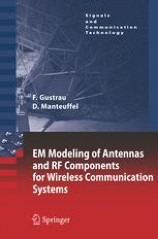
EM Modeling of Antennas and RF Components for Wireless Communication Systems
The book focuses on the practical aspects of computational electrodynamics. A short review of electromagnetic field theory and an illustrative introduction to basic concepts of numerical methods provide the mathematical and physical background. The main part the book guides the reader step-by-step through the modelling process: from the initial "what question shall the model answer?", through the setting up of a computer model by creating geometry, boundary conditions, sources, …, to post processing, validation, and optimization. A number of antenna and filter examples demonstrate the advantages and disadvantages of different numerical methods. So the book provides a realistic view on the capabilities and limits of state-of-the-art 3D-field simulators and on how to apply this knowledge efficiently to EM analysis and designing of RF applications in modern communication systems.

Elements of Quantum Optics
Elements of Quantum Optics gives a self-contained and broad coverage of the basic elements necessary to understand and carry out research in laser physics and quantum optics, including a review of basic quantum mechanics and pedagogical introductions to system-reservoir interactions and to second quantization.

Electronic Imaging in Astronomy : Detectors and Instrumentation
The second edition of Electronic Imaging in Astronomy: Detectors and Instrumentation describes the remarkable developments that have taken place in astronomical detectors and instrumentation in recent years – from the invention of the charge-coupled device (CCD) in 1970 to the current era of very large telescopes, such as the Keck 10-meter telescopes in Hawaii with their laser guide-star adaptive optics which rival the image quality of the Hubble Space Telescope. Authored by one of the world’s foremost experts on the design and development of electronic imaging systems for astronomy, this book has been written on several levels to appeal to a broad readership. Mathematical expositions are designed to encourage a wider audience, especially among the growing community of amateur astronomers with small telescopes with CCD cameras.

Electromagnetic Theory for Microwaves and Optoelectronics
This book is a first year graduate text on electromagnetic fields and waves. At the same time it serves as a useful reference for researchers and engineers in the areas of microwaves and optoelectronics. Following the presentation of the physical and mathematical foundations of electromagnetic theory, the book discusses the field analysis of electromagnetic waves confined in material boundaries, or so-called guided waves, electromagnetic waves in the dispersive media and anisotropic media, Gaussian beams and scalar diffraction theory. The theories and methods presented in the book are foundations of wireless engineering, microwave and millimeter wave techniques, optoelectronics and optical fiber communication.

Electromagnetic Field Theory for Engineers and Physicists
This established, didactically excellent textbook unifies intuitiveness with extraordinary precision of its terminology and the derivation of concepts. It was developed as manuscript to teach students in electrical engineering, and has served to do so for thousands of students over two decades.

Differential Optical Absorption Spectroscopy : Principles and Applications
This book reviews the basics of atmospheric chemistry, radiation transport, and optical spectroscopy before detailing the principles underlying DOAS. The second part of the book describes the design and application of DOAS instruments as well as the evaluation and interpretation of spectra. The recent expansion of DOAS application to the imaging of trace gas distributions by ground, aircraft, and satellite-based instruments is also covered.

Cours doptique : Simulations et exercices résolus avec Maple, Matlab, Mathematica, Mathcad = Optics course: Simulations and exercises solved with Maple, Matlab, Mathematica, Mathcad
Intended for students at the L and M levels of the university as well as for engineers wishing to study certain subjects in greater depth. It covers all the themes of a traditional optics course, from geometric optics to holography, interference, diffraction, coherence and the use of the Fourier transform for spectroscopy. The presentation is developed from mathematical models deriving from typical situations and fundamental examples which are presented in the form of computer programs ready to be implemented. These programs are also available on the CD accompanying the book, for each of the following scientific programming environments: Matlab, Maple, Mathematica and Mathcad. Thus, the reader will be able to modify the parameters of the examples proposed to adapt them to new situations.
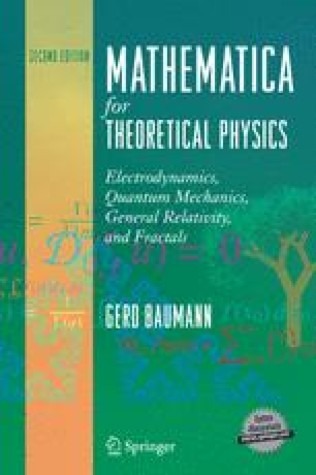
Mathematica for Theoretical Physics : Electrodynamics, Quantum Mechanics, General Relativity, and Fractals
Mathematica for Theoretical Physics: Electrodynamics, Quantum Mechanics, General Relativity, and Fractals This second edition of Baumann's Mathematica® in Theoretical Physics shows readers how to solve physical problems and deal with their underlying theoretical concepts while using Mathematica® to derive numeric and symbolic solutions. Each example and calculation can be evaluated by the reader, and the reader can change the example calculations and adopt the given code to related or similar problems. The second edition has been completely revised and expanded into two volumes: The first volume covers classical mechanics and nonlinear dynamics. Both topics are the basis of a regular mechanics course. The second volume covers electrodynamics, quantum mechanics, relativity, and fractals and fractional calculus. New examples have been added and the representation has been reworked to provide a more interactive problem-solving presentation. This book can be used as a textbook or as a reference work, by students and researchers alike. A brief glossary of terms and functions is contained in the appendices.
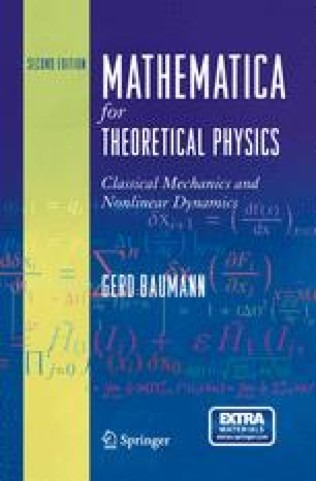
Mathematica for Theoretical Physics : Classical Mechanics and Nonlinear Dynamics
Mathematica for Theoretical Physics: Classical Mechanics and Nonlinear Dynamics This second edition of Baumann's Mathematica® in Theoretical Physics shows readers how to solve physical problems and deal with their underlying theoretical concepts while using Mathematica® to derive numeric and symbolic solutions. Each example and calculation can be evaluated by the reader, and the reader can change the example calculations and adopt the given code to related or similar problems. The second edition has been completely revised and expanded into two volumes: The first volume covers classical mechanics and nonlinear dynamics. Both topics are the basis of a regular mechanics course. The second volume covers electrodynamics, quantum mechanics, relativity, and fractals and fractional calculus. New examples have been added and the representation has been reworked to provide a more interactive problem-solving presentation. This book can be used as a textbook or as a reference work, by students and researchers alike. A brief glossary of terms and functions is contained in the appendices.

Magnetic Monopoles
This monograph addresses the field theoretical aspects of magnetic monopoles. Written for graduate students as well as researchers, the author demonstrates the interplay between mathematics and physics. He delves into details as necessary and develops many techniques that find applications in modern theoretical physics. This introduction to the basic ideas used for the description and construction of monopoles is also the first coherent presentation of the concept of magnetic monopoles. It arises in many different contexts in modern theoretical physics, from classical mechanics and electrodynamics to multidimensional branes. The book summarizes the present status of the theory and gives an extensive but carefully selected bibliography on the subject. The first part deals with the Dirac monopole, followed in part two by the monopole in non-abelian gauge theories. The third part is devoted to monopoles in supersymmetric Yang-Mills theories.
Large Coulomb Systems: Lecture Notes on Mathematical Aspects of QED
A mathematically consistent formulation of relativistic quantum electrodynamics (QED) has still to be found. Nevertheless, there are several simplified effective models that successfully describe many body quantum systems and the interaction of radiation with matter. Large Coulomb Systems explores a selection of mathematical topics inspired by QED. It comprises selected, expanded and edited lectures given by international experts at a topical summer school and is intended as a high-level introduction for graduate students, postdocs and nonspecialists from related fields.
