



الصفحة 1
الصفحة 1

Handbook on Quality and Standardisation in E-Learning
The handbook provides a cross-national perspective on these issues and draws a clear picture of the situation in quality development and standardisation. It covers topics of a rather foundational nature in quality and standardisation research as well as descriptions of quality approaches, instruments, standards, experiences and best practices. The Handbook is directed to learners, professionals, researchers and policy makers – people creating the next generation of learning.

Handbook on Information Technologies for Education and Training
The handbook's goal is to enable the reader to gain a deep understanding of past, current and future research and applications in the field of educational technology. The reader will gain an in-depth understanding of complex theories, strategies, concepts, and methods relating to the design, development, implementation, and evaluation of educational technologies. Because it combines both the present experience in the field and the vision of its emerging directions, the handbook will be a comprehensive guide for researchers and practitioners working with educational technologies. All the chapters of the second edition are newly written, the handbook therefore presents the latest developments in the field.

Educational Research : Networks and Technologies
In this book distinguished philosophers and historians of education focus on the way ‘networks’ and ‘technologies’ characterize education and educational research nowadays. Attention is paid for instance to online networks as ‘spaces’ and ‘places’ that are changing research practices and relations, to the involvement of the researcher in the moral debate, but also to particular educational technologies such as the use of experts’ advice concerning Internet use, the American True Love Waits movement and the practice of punishment in schools.

Creative applications of artificial intelligence in education
Explores the synergy between AI and education, highlighting its potential impact on pedagogical practices. It navigates the evolving landscape of AI-powered educational technologies and suggests practical ways to personalise instruction, nurture human-AI co-creativity, and transform the learning experience. Spanning from primary to higher education, this short and engaging volume proposes concrete examples of how educational stakeholders can be empowered in their AI literacy to foster creativity, inspire critical thinking, and promote problem-solving by embracing AI as a tool for expansive learning. Structured in three parts, the book starts developing the creative engagement perspective for learning and teaching to then present practical applications of AI in K-12 and higher education, covering different fields (teacher education, professional education, business education) as well as different types of AI supported tools (games, chatbots, and AI assisted assessment).
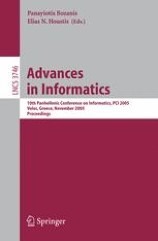
Advances in informatics ; 10th Panhellenic Conference on informatics, PCI 2005, Volas, Greece, November 11-13, 2005, Proceedings
This volume contains a subset of the papers presented at the 10th Panhellenic Conference in Informatics (PCI 2005), which took place at the , Greece, Of the submitted papers, 81 were accepted for inclusion in this volume, papers are classi?ed into 17 thematic sections as follows: – data bases and data mining – algorithms and theoretical foundations – cultural and museum information systems – Internet-scale software/information systems – wearable and mobile computing – computer graphics, virtual reality and visualization – AI, machine learning and knowledge bases – languages, text and speech processing – bioinformatics – software engineering – educational technologies – e-business – computer and sensor hardware and architecture – computer security – image and video processing – signal processing and telecommunications – computer and sensor networks
