



الصفحة 1
الصفحة 1

Topics in Applied Macrodynamic Theory
This book presents topics in applied dynamic macrotheory for closed and open economies. The authors give an advanced treatment of macroeconomic topics such as the Phillips curve, forward and backward looking behavior, open economy macrodynamics, structural macroeconometric model building as well as the empirics of Keynesian oriented macro models. They start from the closed economy and consider open economies for fixed and flexible exchange rate systems with free international capital flows later on. The dynamics of open economies in the context of interacting two country models are treated as well. The macrofounded approach extends and integrates non-market-clearing traditions in macrodynamics. It is compared to New Keynesian approaches which are generally rigorously microfounded, but often neglect to study macroeconomic feedback mechanisms (that may be stabilizing or destabilizing).

Time and Space in Economics
In August 2005, a small but important conference took place at Chuo University in Tokyo, Japan. This international conference, the Chuo Meeting on Economics of Time and Space 2005 (Chuo METS 05), aimed to enrich the respective disciplines of the economics of time (dynamic economics) and the economics of space (spatial economics) and to expand their applicability in the real world. The chapters contained herein are based on the papers presented at that conference. Part I of the book deals with Keynesian macrodynamics, which allows for the existence of involuntary unemployment; Part II focuses on nonlinear dynamics, with an emphasis on the complexity that is generated as a result of the nonlinearity of the system; Part III consists of an empirical analysis of spatial economics through geographical relationships with economic activity; and Part IV analyzes the effects of spatial competition between economic organizations or agents on economic performance in a region.

The EU and the Economies of the Eastern European Enlargement
The enlargement of the European Union towards the East from May 2004 has generated an increase of about 100 million inhabitants in the EU population, and has especially brought along major challenges and important opportunities both for the "new" countries and for the "old" member states. That is the main focus of this volume, which is divided into three sections. The first analyses the effects of the enlargement on the functioning of Community institutions, on the relations with the other Eastern European countries, and finally on regional and global economic dynamics; the second section analyses in detail the role of the monetary politics of the European Central Bank and the activities of the European Bank for Reconstruction and Development; and the third deals with the importance of the entrepreneurial class in ensuring the success of the transition process of the Eastern European economies.

The Coupling of Climate and Economic Dynamics : Essays on Integrated Assessment
Deals with various aspects of the building of integrated assessment models, either by coupling economic growth and climate change modules, or using mathematical models of viability or dynamic game theory to represent the interactions between the world regions concerned. This book is the result of several years of joint research in an interdisciplinary project on the human dimension of climate change. It proposes innovative ways to include climate simulation modules in optimal economic growth models; it explores the possible use of computable general economic equilibrium models coupled with paradigms of game theory to assess the dividends of cooperation in climate policies; it reports on the building of multi-region dynamic energy-technology-environment models to assess the possible response of the world energy system to a global cap on GHG emissions, and it shows how to model the impacts of climate change at a regional level.

Sustainable Resource Use and Economic Dynamics
Pollution of the environment increased while the stock of worldwide natural resources declined. Consequently, the concern that environmental restrictions, especially the bounded supply of natural resources end energies, will limit economic development in the long run is widespread. Most prominently, it has been expressed in the prediction of ‘limits to growth’ by the Club of Rome in the 1970s. Today, the notion of ‘sustainable growth’ is widely accepted as a main principle in the theoretical and political discussion. But a general consensus on the consequences for the use of natural capital has still to be established. This holds true not only for economics, but also for interdisciplinary research programs and the public debate.

Structural Change and Exchange Rate Dynamics : The Economics of EU Eastern Enlargement
Structural change, economic growth and adequate exchange rate adjustment are key challenges in the context of EU eastern enlargement as are consistent macroeconomic policies. The authors focus on sectoral adjustment across industries in catching-up countries and explain changes in the composition of output – this includes new aspects of the Chenery model. They describe and analyze the spatial pattern of specialization and adjustment in many countries. Theoretical and empirical analysis of foreign direct investment, innovation and structural change shed new light on economic dynamics in Old Europe and New Europe. As regards exchange rate dynamics both traditional aspects (such as the Balassa-Samuelson effect) and new approaches to understanding exchange rate developments are presented. Links between exchange rate changes and innovation are particularly emphasized.

Nonlinear Dynamics and Heterogeneous Interacting Agents
Economic application of nonlinear dynamics, microscopic agent-based modelling, and the use of artificial intelligence techniques as learning devices of boundedly rational actors are among the most exciting interdisciplinary ventures of economic theory over the past decade. This volume provides us with a most fascinating series of examples on "complexity in action" exemplifying the scope and explanatory power of these innovative approaches.
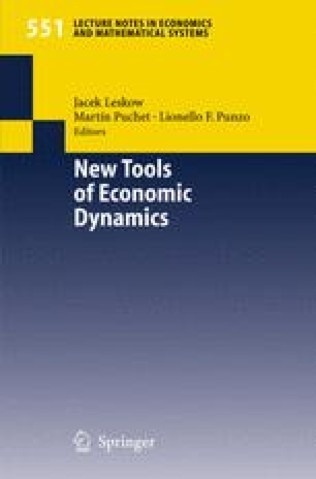
New Tools of Economic Dynamics
New Tools of Economic Dynamics gives an introduction and overview of recently developed methods and tools, most of them developed outside economics, to deal with the qualitative analysis of economic dynamics. It reports the results of a three-year research project by a European and Latin American network on the intersection of economics with mathematical, statistical, and computational methods and techniques. Focusing upon the evolution and manifold structure of complex dynamic phenomena, the book reviews and shows applications of a variety of tools, such as symbolic and coded dynamics, interacting agents models, microsimulation in econometrics, large-scale system analysis, and dynamical systems theory. It shows the potential of a comprehensive analysis of growth, fluctuations, and structural change along the lines indicated by pioneers like Harrod, Haavelmo, Hicks, Goodwin, Morishima, and it highlights the explanatory power of the qualitative approach they initiated.

Emerging States and Economies : Their Origins, Drivers, and Challenges Ahead
This book asks why and how some of the developing countries have “emerged” under a set of similar global conditions, what led individual countries to choose the particular paths that led to their “emergence,” and what challenges confront them. If we are to understand the nature of major risks and uncertainties in the world, we must look squarely at the political and economic dynamics of emerging states. Their rapid economic development has changed the distribution of wealth and power in the world. Yet many of them have middle income status. To global governance issues, they tend to adopt approaches that differ from those of advanced industrialized democracies. At home, rapid economic growth and social changes put pressure on their institutions to change. This volume traces the historical trajectories of two major emerging states. It also analyzes cross-country data to find the general patterns of economic development and sociopolitical change in relation to globalization and to the middle income trap.

Emergent Macroeconomics : An Agent-Based Approach to Business Fluctuations
This book contributes substantively to the current state-of-the-art of macroeconomics by providing a method for building models in which business cycles and economic growth emerge from the interactions of a large number of heterogeneous agents. Drawing from recent advances in agent-based computational modeling, the authors show how insights from dispersed fields like the microeconomics of capital market imperfections, industrial dynamics and the theory of stochastic processes can be fruitfully combined to improve our understanding of macroeconomic dynamics. This book should be a valuable resource for all researchers interested in analyzing macroeconomic issues without recurring to a fictitious representative agent.

Economics: Complex Windows
This volume contains papers that provide an analysis of topics in the following areas: Agent Based Models, Non-linear Time Series Analysis, Financial Market Dynamics, Econo-physics, Deterministic Chaos, Macroeconomic Dynamics. Economics: Complex Windows, does not present contributions to the sterile debate as to the merits of the different grand, or potentially grand paradigms of economics. Rather it offers a balanced collection of methodological advances which can be applied to concrete economic problems. Starting with a presentation of the "complexity approach" to economics, it goes on to provide a collection of applications to areas such as the analysis of market imperfections, risk assessment, non-linear dynamics, forecasting and highly irregular fluctuations. The tools used help to provide a clearer understanding and a more accurate analysis of these areas of economics. They also highlight the gulf which exists between current economic theory and real economic practice. The basic idea is to encourage economic researchers to embrace a more open and pragmatic approach to economics rather than to reluctantly move in this direction as if it were somehow a betrayal of established dogma. We hope, in this way, to open up avenues which will lead to progress beyond the "holy trinity", (rationality, equilibrium and greed) of modern economics.

Economic dynamics and information
This book analyzes the existence of equilibria in economies having a measured space of agents and a continuum of agents and commodities. Excessive homogeneity with respect to agent productivity leads to instability and non-uniqueness of a given stationary state and the indeterminacy of the corresponding stationary state equilibrium. Sufficient heterogeneity leads to global saddle-path stability, uniqueness of a given stationary state and the global uniqueness of the corresponding equilibrium.

Digital Excellence ; University Meets Economy
Digital economic modernization is a crucial element of progress in both OECD countries and newly industrialized countries. The contributions to this book explore the technological and economic dynamics of information and communication technology (ICT) and focus on several innovative software applications which aim at solving standard and new problems more efficiently. They particularly emphasize the point that innovation within an economic context does not solely concern companies and their customers; integrating research institutions and universities enhances the scope of creativity to not only produce concrete innovative ideas and projects, but also to develop procedures and techniques for putting them into practice. This book provides companies with both insights into new approaches and immediate access to innovative concepts.

Digital Economic Dynamics : Innovations, Networks and Regulations
This book analyzes the dynamics and impacts of software development and discusses new institutional and economic changes in the context of digital market economies.The book furthermore examines telecommunications regulation of fixed line networks, cable TV and mobile communications.
Complex systems approach to economic dynamics
This monograph introduces new concepts of unstable periodic orbits and chaotic saddles which are unstable structures embedded in a chaotic attractor, responsible for economic intermittency.
Business cycle dynamics : Models and tools
Business cycle theory has been one of the fastest growing fields in modern nonlinear economic dynamics. The book is centered around models of multiplier-accelerator type, emerging from Samuelson's seminal work, later developed into nonlinear formats by Hicks and Goodwin. These models left open ends, as the tools then available did not permit more systematic analysis.
50 Years of EU Economic Dynamics : Integration, Financial Markets and Innovations
On the occasion of the 50th anniversary of the European Union experts present their analyses of historical developments and new economic challenges for the EU. After a reflection on historical dynamics, the contributors point out the dramatic economic shifts between Europe, Asia and the US. Representatives from major central banks (including the ECB), other leading banks, and academia analyze the dynamics of the Eurozone and financial market integration in the context of globalization and economic growth. Furthermore, the authors discuss the challenges of information and communication technologies by means of various country analyses. Moreover, the Schumpeterian prospects for Europe and the Lisbon Agenda, the long-term challenges of EU pension reforms, emission trading systems in the EU, and options for a new EU constitution are highlighted. At the bottom line of this EU analysis are major implications for investors, managers, policy-makers and the public at large in both the EU and the global economy.
