



الصفحة 1
الصفحة 1
Nuclear Science and Safety in Europe
Recent results on the nature of low-, intermediate- and high-energy nuclear forces as well as on the internal structure of nucleons and atomic nuclei are presented. This book Prospects to find a new state of the nuclear matter at extreme conditions that existed in the early Universe and the utilisation of the nuclear energy are discussed.

Inflationary Cosmology
Some 25 years after the birth of inflationary cosmology this volume sets out to provide a both authoritative and pedagogical introduction and review of the state of the field. Cosmic inflation corresponds to an episode of accelerated expansion of the very early universe and solves nicely a collection of puzzles that had plagued standard cosmology so far.

Gravity, Black Holes, and the Very Early Universe : An Introduction to General Relativity and Cosmology
In the early 1900s, Albert Einstein formulated two theories that would forever change the landscape of physics: the Special Theory of Relativity and the General Theory of Relativity. By 1925, quantum mechanics had been born out of the dissection of these two theories, and shortly after that, relativistic quantum field theory. We now had in place some important ties between the laws of physics and the types of particle interactions the new physics was uncovering. Gravity is one of the four types of forces that are found throughout the universe. In fact, although it is a relatively weak force, it operates at huge distances, and so must be accounted for in any cosmological system. Unfortunately, gravity continues to defy our neat categorization of how all the forces in nature work together.

Galaxy Formation
This second edition of Galaxy Formation is an up-to-date text on astrophysical cosmology, expounding the structure of the classical cosmological models from a contemporary viewpoint. This forms the background to a detailed study of the origin of structure and galaxies in the Universe. The derivations of many of the most important results are derived by simple physical arguments which illuminate the results of more advanced treatments. A very wide range of observational data is brought to bear upon these problems, including the most recent results from WMAP, the Hubble Space Telescope, galaxy surveys like the Sloan Digital Sky Survey and the 2dF Galaxy Redshift Survey, studies of Type 1a supernovae, and many other observations.
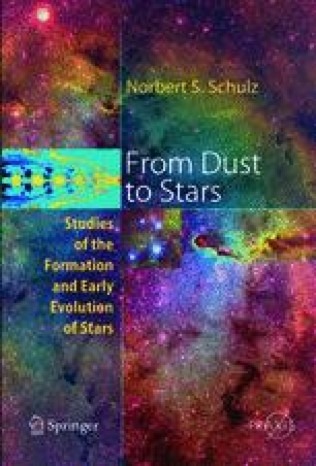
From Dust To Stars : Studies of the Formation and Early Evolution of Stars
Studies of stellar formation in galaxies have a profound impact on our understanding of the present and the early universe. The book describes complex physical processes involved in the creation of stars and during their young lives. It illustrates how these processes reveal themselves from radio wavelengths to high energy X-rays and gamma -rays, with special reference towards high energy signatures. Several sections devoted to key analysis techniques demonstrate how modern research in this field is pursued.

Extragalactic Astronomy and Cosmology : An Introduction
This textbook introduces the astronomy of galaxies, their structure, their active galactic nuclei, their evolution and their large scale distribution. Starting with a detailed description of our Milky Way, the book examines the formation of structures and astronomical objects in the early universe.

Cosmic Magnetic Fields
While magnetic fields permeate the universe on all scales, the present book is dedicated to their investigation on the largest scales and affords a balanced account of both theoretical and observational aspects. Written as a set of advanced lectures and tutorial reviews, which lead up to the forefront of research, this book offers both a modern source of reference for the experienced researchers as well as a high-level introductory text for postgraduate students and nonspecialist researchers working in related areas.
La musica del Big Bang : Come la radiazione cosmica di fondo ci ha svelato i segreti dell’Universo = The music of the Big Bang : How the cosmic background radiation revealed the secrets of the Universe to us
Cosmic microwave background radiation is the residue of the great heat following the Big Bang. A tenuous sign, over 13 billion years old, in which the answers to many of the questions about the nature of our Universe are hidden. Discovered by chance in 1964, in the last forty years this fossil trace of the origins of the Cosmos has been explored with every available means. Two Nobel Prizes in physics have already been awarded for research involving it, the last in 2006 for the results of the COBE satellite. Much of the information encoded in the cosmic background radiation was impressed by the superimposition of acoustic waves present in the early Universe: a "music" of the Big Bang, which cosmologists have tried for years to reconstruct, using techniques similar to those that allow to distinguish the sound of different musical instruments. Only recently have the first notes of this extraordinary cosmic symphony finally been revealed, but the investigation is not over yet. This book illustrates, with a language suitable even for non-specialists, the theories, observations and discoveries that have brought cosmology into a new era.
La correspondance entre Henri Poincaré et les physiciens, chimistes et ingénieurs = The correspondence between Henri Poincaré and physicists, chemists and engineers
Cosmic microwave background radiation is the residue of the great heat following the Big Bang. A tenuous sign, over 13 billion years old, in which the answers to many of the questions about the nature of our Universe are hidden. Discovered by chance in 1964, in the last forty years this fossil trace of the origins of the Cosmos has been explored with every available means. Two Nobel Prizes in physics have already been awarded for research involving it, the last in 2006 for the results of the COBE satellite. Much of the information encoded in the cosmic background radiation was impressed by the superimposition of acoustic waves present in the early Universe: a "music" of the Big Bang, which cosmologists have tried for years to reconstruct, using techniques similar to those that allow to distinguish the sound of different musical instruments. Only recently have the first notes of this extraordinary cosmic symphony finally been revealed, but the investigation is not over yet. This book illustrates, with a language suitable even for non-specialists, the theories, observations and discoveries that have brought cosmology into a new era.
Astrophysics Update 2
"Astrophysics Updates" is intended to serve the information needs of professional astronomers and postgraduate students about areas of astronomy, astrophysics and cosmology that are rich and active research spheres. Observational methods and the latest results of astronomical research are presented as well as their theoretical foundations and interrelations. The contributed commissioned articles are written by leading exponents in a format that will appeal to professional astronomers and astrophysicists who are interested in topics outside their own specific areas of research. This collection of timely reviews may also attract the interest of advanced amateur astronomers seeking scientifically rigorous coverage.
