



الصفحة 1
الصفحة 1

Modern Multivariate Statistical Techniques : Regression, Classification, and Manifold Learning
Remarkable advances in computation and data storage and the ready availability of huge data sets have been the keys to the growth of the new disciplines of data mining and machine learning, while the enormous success of the Human Genome Project has opened up the field of bioinformatics. These exciting developments, which led to the introduction of many innovative statistical tools for high-dimensional data analysis, are described here in detail. The author takes a broad perspective; for the first time in a book on multivariate analysis, nonlinear methods are discussed in detail as well as linear methods.

Introduction to Machine Learning with Applications in Information Security
Provides a classroom-tested introduction to a wide variety of machine learning and deep learning algorithms and techniques, reinforced via realistic applications. The book is accessible and doesn't prove theorems, or dwell on mathematical theory. The goal is to present topics at an intuitive level, with just enough detail to clarify the underlying concepts. The book covers core classic machine learning topics in depth, including Hidden Markov Models (HMM), Support Vector Machines (SVM), and clustering. Additional machine learning topics include k-Nearest Neighbor (k-NN), boosting, Random Forests, and Linear Discriminant Analysis (LDA). The fundamental deep learning topics of backpropagation, Convolutional Neural Networks (CNN), Multilayer Perceptrons (MLP), and Recurrent Neural Networks (RNN) are covered in depth. A broad range of advanced deep learning architectures are also presented, including Long Short-Term Memory (LSTM), Generative Adversarial Networks (GAN), Extreme Learning Machines (ELM), Residual Networks (ResNet), Deep Belief Networks (DBN), Bidirectional Encoder Representations from Transformers (BERT), and Word2Vec.

Fundamentals of pattern recognition and machine learning
Fundamentals of Pattern Recognition and Machine Learning is designed for a one or two-semester introductory course in Pattern Recognition or Machine Learning at the graduate or advanced undergraduate level. The book combines theory and practice and is suitable to the classroom and self-study.

COMPSTAT 2006 - Proceedings in Computational Statistics ; 17th Symposium Held in Rome, Italy, 2006
International Association for Statistical Computing The International Association for Statistical Computing (IASC) is a Section of the International Statistical Institute.The objectives of the Association are to foster world-wide interest in effective statistical computing and to - change technical knowledge through international contacts and meetings - tween statisticians, computing professionals, organizations, institutions, g- ernments and the general public.
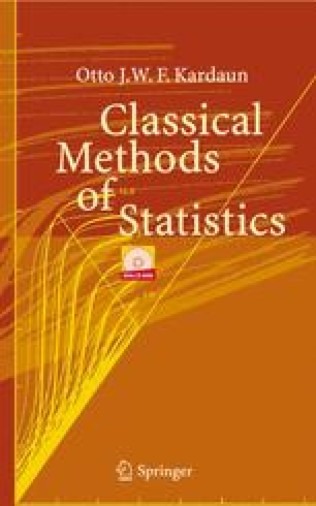
Classical Methods of Statistics : With Applications in Fusion-Oriented Plasma Physics
Classical Methods of Statistics is a blend of theory and practical statistical methods written for graduate students and researchers interested in applications to plasma physics and its experimental aspects. It can also fruitfully be used by students majoring in probability theory and statistics. In the first part, the mathematical framework and some of the history of the subject are described. Many exercises help readers to understand the underlying concepts. In the second part, two case studies are presented exemplifying discriminant analysis and multivariate profile analysis. The introductions of these case studies outline contextual magnetic plasma fusion research. In the third part, an overview of statistical software is given and, in particular, SAS and S-PLUS are discussed. In the last chapter, several datasets with guided exercises, predominantly from the ASDEX Upgrade tokamak, are included and their physical background is concisely described. The book concludes with a list of essential keyword translations.

Cancer drug safety and public health policy : A changing landscape
Description and analysis of recent developments and current trends in health policy with regard to cancer drug safety. Opens with an overview of pharmacovigilance for cancer blockbuster drugs, covering both general considerations and efforts to develop a structured framework for the identification and reporting of adverse drug reactions (ADRs). A number of important examples of serious ADRs to hematology and oncology drugs are then reviewed, with evaluation of the lessons learned and the policy implications of the ensuing legal cases and their settlements. Further, the difficulty of reporting such blockbuster side effects in the medical literature is explored in an empirical study. Significant advances have been achieved in analytic methods for the identification of ADRs, and here there is a particular focus on the value of optimal discriminant analysis. Finally, the impacts on pharmacovigilance and drug safety of the huge fines paid under the U.S. False Claims Act relating to the defrauding of governmental programs also receive careful attention – these fines are playing an important role in changing the landscape for pharmaceutical safety.

Advances in biometric person authentication ; Vol. 3781 ; International workshop on biometric recognition systems, IWBRS 2005, Beijing, China, October 22 – 23, 2005, Proceedings
Constitutes the refereed proceedings of the 5th Chinese Conference on Biometric Recognition, SINOBIOMETRICS 2004, held in Guanzhou, China in December 2004. The 60 revised full papers presented together with 14 invited papers by internationally leading researchers were carefully reviewed and selected from 140 submissions. The papers are organized in topical sections on biometrics, best performing biometric engines, face localization, pose estimation, face recognition, 3D based methods, subspace and discriminant analysis, systems and applications, fingerprint preprocessing and minutiae extraction, fingerprint recognition and matching, fingerprint classificaiton, iris recognition, speaker recognition, and other biometric primitives.
Adaptive Machine Learning Algorithms with Python : Solve Data Analytics and Machine Learing Problems on Edge Devices
Learn to use adaptive algorithms to solve real-world streaming data problems. This book covers a multitude of data processing challenges, ranging from the simple to the complex. At each step, you will gain insight into real-world use cases, find solutions, explore code used to solve these problems, and create new algorithms for your own use. You will: Apply adaptive algorithms to practical applications and examples / Understand the relevant data representation features and computational models for time-varying multi-dimensional data / Derive adaptive algorithms for mean, median, covariance, eigenvectors (PCA) and generalized eigenvectors with experiments on real data / Speed up your algorithms and put them to use on real-world stationary and non-stationary data / Master the applications of adaptive algorithms on critical edge device computation applications
