



الصفحة 1
الصفحة 1
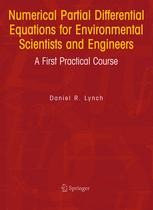
Numerical partial differential equations for environmental scientists and engineers : A first practical course
This book concerns the practical solution of Partial Differential Equations (PDEs). It reflects an interdisciplinary approach to problems occurring in natural environmental media: the hydrosphere, atmosphere, cryosphere, lithosphere, biosphere and ionosphere. It assumes the reader has gained some intuitive knowledge of PDE solution properties and now wants to solve some for real, in the context of practical problems arising in real situations. The practical aspect of this book is the infused focus on computation. It presents two major discretization methods - Finite Difference and Finite Element. The blend of theory, analysis, and implementation practicality supports solving and understanding complicated problems. It is divided into three parts. Part I is an overview of Finite Difference Methods. Part II focuses on Finite Element Methods, including an FEM tutorial. Part III deals with Inverse Methods, introducing formal approaches to practical problems which are ill-posed.

Numerical Mathematics and Advanced Applications ENUMATH 2019 ; European Conference, Egmond aan Zee, The Netherlands, September 30 - October 4
It contians basic aspects and new trends in numerical mathematics and scientific and industrial applications, all examined at the highest level of international expertise.
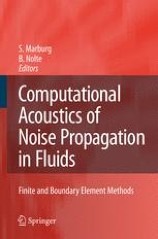
Computational Acoustics of Noise Propagation in Fluids - Finite and Boundary Element Methods
Among numerical methods applied in acoustics, the Finite Element Method (FEM) is normally favored for interior problems whereas the Boundary Element Method (BEM) is quite popular for exterior ones. That is why this valuable reference provides a complete survey of methods for computational acoustics, namely FEM and BEM. It demonstrates that both methods can be effectively used in the complementary cases. The chapters by well-known authors are evenly balanced: 10 chapters on FEM and 10 on BEM. An initial conceptual chapter describes the derivation of the wave equation and supplies a unified approach to FEM and BEM for the harmonic case. A categorization of the remaining chapters and a personal outlook complete this introduction. In what follows, both FEM and BEM are discussed in the context of very different problems.
