



الصفحة 1
الصفحة 1

Immigration Policy and the Labor Market : The German Experience and Lessons for Europe
German and European immigration policies have only recently begun to cope with the inevitable: growing labor demand in the face of high unemployment and a shrinking labor force due to demographic change. Despite the implementation of Germany's first immigration act and several European initiatives towards legal harmonization at the EU level, an actively controlling immigration policy, which would be needed to master the challenges ahead, is not yet in sight. Against this background, the book draws conclusions from the German history of immigration policy. It analyzes the country's future demand for immigration and develops an economic model for the effective selection and integration of labor migrants that could provide the foundation for a joint European immigration strategy.

Healthy Longevity in China : Demographic, Socioeconomic, and Psychological Dimensions
China is aging at an extraordinary speed and has the largest quantity of elderly persons in the world. Scholars utilize this unprecedented living experience of human being and the unique Chinese Longitudinal Healthy Longevity Survey (CLHLS) datasets with the aim to answer in this volume the following questions critical to the aging population world wide. Is the period of disability compressing or expanding with increasing life expectancy and what factors are associated with these trends in the recent decades? Is it possible to realize morbidity compression with a prolongation of the life span in the future?The first section of the book presents the CLHLS project’s study design, sample distribution, contents of data collected, and assessments of age reporting and data quality. The remaining chapters are grouped into sections dealing with the demographic, social, economic, familial and psychological dimensions of healthy longevity.

Dynamic Population Models
The book is well organized and clearly written so that it is accessible to those with only a minimal knowledge of calculus. It begins with a review of fixed rate population models, from the basic life table to multistate stable populations. The process of convergence to stability is described, and the regularities underlying change in the size and composition of any population are explored. Techniques for estimating rates from multistate population distributions are presented, and new multi-age, multistate dynamic models are developed.

Demographic Change in Germany : The Economic and Fiscal Consequences
Just as one might be inclined to thinkthat every thing about demographic change has been already said and heard, a new dimension opens up. In fact, this is what makes the topic so fascinating. There is nothing trivial any longer about children, families, age, and care. Europe is undergoing profound demo graphic change. Each generation of children is quantitatively smaller than that of their parents; the propor tion of children and adolescents among the population is becoming smaller and smaller, while that of the elde rlyi s growing inexorably. Fewer and fewer people are marrying; more and more marriages are failing. Manyar eas of our society are affected by this; just think about the challenges faced by the social security systems as a result of demographic ageing. Politi cians and society are forced to adju st todem ographic change. Many people in Europe are concerned about these changes and are looking to politicians and researchers for solutions. Predictions are never easy, especially not about the future.

Demographic Change and Intergenerational Justice : The Implementation of Long-Term Thinking in the Political Decision Making Process
The book deals with the complex relationship between intergenerational justice and demographic change and is characterized by its interdisciplinary approach. The authors come from a multitude of professional backgrounds and from several countries. This illustrates the implications of the demographic shift from many different perspectives. The book deals not only with the aspects of economic policy but also with environmental, societal and philosophical issues. The comprehensive volume is composed of five sections that pinpoint demographic trends, examine the impact of demographic changes on key indicators, investigate the relationship between key indicators and intergenerational justice, scrutinize population policies, and finally propose ways to implement long-term thinking on these issues.

Allocating public and private resources across generations : Riding the age waves ; Vol .2
The chapters in this volume greatly develop our understanding of the nature and measurement of transfers, their motives and mechanisms, and their macro-level dimensions, especially in the context of demographic transitions.
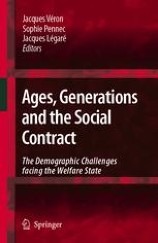
Ages, generations and the social contract : The demographic challenges facing the welfare state
Our societies are ageing. The Family is changing. Labour force behaviour is evolving. How is the organisation of family and collective solidarity adapting in this context of longer life spans, low fertility, and work that is simultaneously scarce and abundant? The welfare states are currently facing three main challenges: ensure satisfactory living conditions for the elderly without increasing the cost burden on the active population, reduce social inequality, and maintain equity between successive generations. In this book, researchers from different countries compare their experiences and offer contrasting views on the future of social protection. They consider the theoretical aspects of the intergenerational debate, relations between generations within the family, the living standards of elderly people, and the question of social time.
