



الصفحة 1
الصفحة 1

Corporate Sustainability Management in the Energy Sector : An Empirical Contigency Approach
Corporate social responsibility, sustainability, and citizenship are terms that often evoke considerable scepticism and cynicism, particularly in civil society. Much needed sector-specific and comparative research, which could facilitate a more fact-oriented debate, is still missing from the literature. The present study aims to fill this gap by presenting data collected from two groups of managers, namely sustainability experts and non-sustainability experts, from two different industry sectors (integrated oil and gas vs. electric utilities) and several geographical regions. Oliver Salzmann provides a comprehensive view on corporate sustainability management in companies such as Shell and RWE and investigates the key social and environmental issues driving the energy sector. The author analyses the influence which stakeholder pressure exercises on energy companies and their efforts to become more responsive. Moreover, he develops a model for strategic, thus profit-oriented, corporate sustainability management.

Corporate Sustainability in Practice : A guide for Strategy Development and Implementation
Building better organisations, with a clear sense of purpose, is a common challenge faced by many entrepreneurs and executives in industry. A fully integrated corporate sustainability strategy can help organisations to better manage risks, to win business opportunities and to ultimately strengthen reputation. Building on the experience of renowned strategists, sustainability, finance and academic experts, this book offers practical tools and approaches that can be used to develop and implement fully integrated corporate sustainability strategies.

Corporate Sustainability as a Challenge for Comprehensive Management
Sustainability has become a topic of global relevance: Corporations and other economically acting organizations increasingly need to realize economic, environmental and social objectives in order to survive. Supplementary to "classical" environmental management, realizing corporate sustainability requires comprehensive approaches which allow the integration of social and economic aspects. Such concepts can be found e.g. in international excellence models mainly based on a TQM thinking but also in the field of human factors in organizational design and management. Understood as systems approaches, they include the interests of all relevant stakeholders with a mid- or long-term time perspective and are thus highly linked with the principles of sustainable development. In this book internationally leading scientists discuss the issue of sustainability from their perspective, resulting in an innovative view on different management approaches under the umbrella of corporate sustainability.
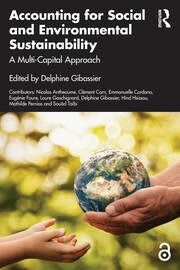
Accounting for social and environmental sustainability : A multi-capital approach
Offers an in‑depth examination of multi‑capital accounting, which has already been integrated within the corporate sustainability reporting directive and will follow on from sustainability reporting. the LIFTS model (limits and foundations towards sustainability accounting model) used in this book combines various scientific and practical contributions to develop budgets for environmental impacts and social obligations on an organisational scale. it proposes an accounting mechanism that enables an organization to manage each of its budgets and measure variances between forecast and actual. it provides an introduction to the principles of this model and its conditions of application and describes its implementation in numerous companies.
