



الصفحة 1
الصفحة 1
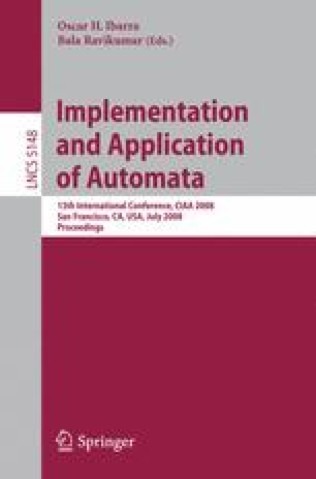
Implementation and Applications of Automata ; 13th International Conference, CIAA 2008, San Francisco, California, USA, July 21-24, 2008. Proceedings
This book constitutes the thoroughly refereed post-proceedings of the 13th International Conference on Implementation and Application of Automata, CIAA 2008, held in San Francisco, USA, in July 2008.The 26 revised full papers togehter with 4 invited papers were carefully reviewed and selected from 40 submissions and have gone through two rounds of reviewing and improvement. The papers cover various topics in the theory, implementation, and applications of automata and related structures.

Generalized Curvatures
The central object of this book is the measure of geometric quantities describing N a subset of the Euclidean space (E ,), endowed with its standard scalar product. Let us state precisely what we mean by a geometric quantity. Consider a subset N S of points of the N-dimensional Euclidean space E , endowed with its standard N scalar product. LetG be the group of rigid motions of E . We say that a 0 quantity Q(S) associated toS is geometric with respect toG if the corresponding 0 quantity Q[g(S)] associated to g(S) equals Q(S), for all g?G . For instance, the 0 diameter ofS and the area of the convex hull ofS are quantities geometric with respect toG . But the distance from the origin O to the closest point ofS is not, 0 since it is not invariant under translations ofS. It is important to point out that the property of being geometric depends on the chosen group. For instance, ifG is the 1 N group of projective transformations of E , then the property ofS being a circle is geometric forG but not forG , while the property of being a conic or a straight 0 1 line is geometric for bothG andG . This point of view may be generalized to any 0 1 subsetS of any vector space E endowed with a groupG acting on it.

Effective Computational Geometry for Curves and Surfaces
Computational geometry emerged as a discipline in the seventies and has had considerable success in improving the asymptotic complexity of the solutions to basic geometric problems including constructions of data structures,convex hulls, triangulations, Voronoi diagrams and geometric arrangements as well as geometric optimisation. The goal of this book is to take into consideration the multidisciplinary nature of the problem and to provide solid mathematical and algorithmic foundations for effiective computational geometry fo rcurves and surfaces. This book covers two main approaches. In a first part, we discuss exact geometric algorithms for curves and s- faces. We revisit two prominent data structures of computational geometry, namely arrangements (Chap. 1) and Voronoi diagrams (Chap. 2) in order to understand how these structures, which are well-known for linear objects, behave when de?ned on curved objects.

Algorithms – ESA 2005 ; 13th Annual European Symposium, Palma de Mallorca, Spain, October 3-6, 2005, Proceedings
This volume contains the 75 contributed papers and the abstracts of the threeinvited lectures presented at the 13th Annual European Symposium on Algo-rithms (ESA 2005), held in Spain, 2005. respectively.Papers were solicited in all areas of algorithmic research, including but notlimited to algorithmic aspects of networks, approximation and on-line algo-rithms, computational biology, computational geometry, computational financeand algorithmic game theory, data structures, database and information re-trieval, external memory algorithms, graph algorithms, graph drawing, machinelearning, mobile computing, pattern matching and data compression, quantumcomputing, and randomized algorithms. The algorithms could be sequential,distributed, or parallel. Submissions were especially encouraged in the area ofmathematical programming and operations research, including combinatorialoptimization, integer programming, polyhedral combinatorics, and semidefiniteprogramming.Each extended abstract was submitted to one of the two tracks.
