



الصفحة 1
الصفحة 1

Medical and healthcare interactions
Presenting a series of empirical studies by scholars working with approaches from ethnomethodology and conversation analysis, Medical and Healthcare Interactions studies real-life work and training encounters among medical and healthcare professionals and trainees or between professionals and patients. Using video analysis and detailed description, it considers the methods and procedures through which professionals, trainees, and patients produce actions and interpret those of others, exploring questions of member competence and socialization within situated courses of interaction. Offers fruitful contributions for training and education in the field of healthcare and will appeal to scholars in the human and social sciences with interests in interaction, ethnomethodology, and conversation analysis.

Meaning-Making for Living : The Emergence of the Presentational Self in Children’s Everyday Dialogues
This Brief analyzes the dynamics in which children’s selves emerge through their everyday activities of meaning construction, both in their relationships with family and within school education. It begins with a discussion of new psychological inquiries into children's selves and builds upon the innovative theoretical notion of the Presentational Self, developed by the author over the last decade. The book illustrates how the observation of children’s meaning construction in their everyday lives becomes a starting point for theoretical and empirical inquiries into child development and gives a framework that promotes new inquiries in this area. The book describes the Presentational Self Theory as a sense of how the notion of the Self is being worked upon in everyday life encounters. Chapters feature in-depth analyses of exchanges between adults and children in the Japanese cultural context.
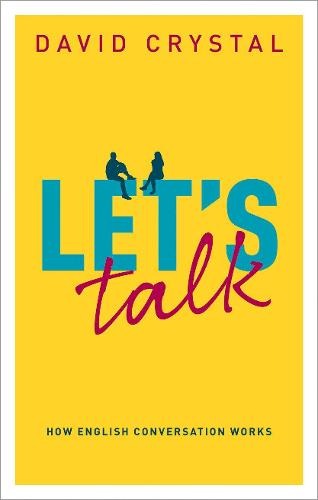
Let's talk : How English conversation works
Banter, chit-chat, gossip, natter, tete-a-tete: these are just a few of the terms for the varied ways in which we interact with one another through conversation. David Crystal explores the factors that motivate so many different kinds of talk and reveals the rules we use unconsciously, even in the most routine exchanges of everyday conversation. We tend to think of conversation as something spontaneous, instinctive, habitual.
