



الصفحة 1
الصفحة 1

Model-based Process Supervision : A Bond Graph Approach
Model-based fault detection and isolation requires a mathematical model of the system behaviour. Modelling is important and can be difficult because of the complexity of the monitored system and its control architecture. The authors use bond-graph modelling, a unified multi-energy domain modelling method, to build dynamic models of process engineering systems by composing hierarchically arranged sub-models of various commonly encountered process engineering devices. The structural and causal properties of bond-graph models are exploited for supervisory systems design.

Model-based Fault Diagnosis Techniques : Design Schemes, Algorithms, and Tools
The objective of this book is to introduce basic model-based FDI schemes, advanced analysis and design algorithms and the needed mathematical and control theory tools at a level for graduate students and researchers as well as for engineers.

Informatics in Control Automation and Robotics : Selected Papers from the International Conference on Informatics in Control Automation and Robotics 2006
The present book includes a set of selected papers from the 3rd “International Conference on Informatics in Control Automation and Robotics” (ICINCO 2006), held in Setúbal, Portugal, 1-5 August 2006.

Dynamic Modeling, Predictive Control and Performance Monitoring : A Data-driven Subspace Approach
A typical design procedure for model predictive control or control performance monitoring consists of: identification of a parametric or nonparametric model, derivation of the output predictor from the model and design of the control law or calculation of performance indices according to the predictor.

Distributed Embedded Control Systems : Improving Dependability with Coherent Design
Distributed Embedded Control Systems handles the domains encountered when designing a distributed embedded computer control system as an integrated whole. First to be discussed are some basic issues about real-time systems and their properties, specifically safety. Then, system and hardware architectures are dealt.

Distributed Consensus in Multi-vehicle Cooperative Control : Theory and Applications
Distributed Consensus in Multi-vehicle Cooperative Control develops distributed consensus strategies designed to ensure that the information states of all vehicles in a network converge to a common value. This approach strengthens the team, minimizing power consumption and the deleterious effects of range and other restrictions.
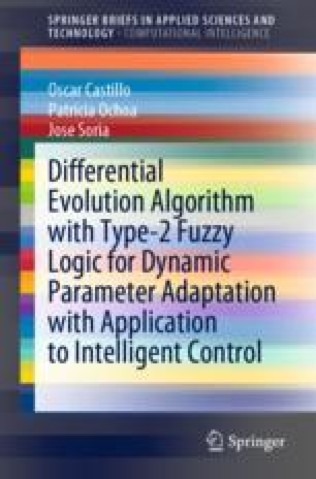
Differential Evolution Algorithm with Type-2 Fuzzy Logic for Dynamic Parameter Adaptation with Application to Intelligent Control
This book focuses on the fields of fuzzy logic, bio-inspired algorithm, especially the differential evolution algorithm and also considering the fuzzy control area. The main idea is that these two areas together can help solve various control problems and to find better results. In this book, the authors test the proposed method using five benchmark control problems. First, the water tank, temperature, mobile robot, and inverted pendulum controllers are considered. For these 4 problems, experimentation was carried out using a Type-1 fuzzy system and an Interval Type-2 system. The last control problem was the D.C. motor, for which the experiments were performed with Type-1, Interval Type-2, and Generalized Type-2 fuzzy systems. When we use fuzzy systems combined with the differential evolution algorithm, we can notice that the results obtained in each of the controllers are better and with increasing uncertainty, the results are even better. For this reason, the authors consider in this book the proposed method using fuzzy systems and the differential evolution algorithm to improve the fuzzy controllers’ behavior in complex control problems.

Diagnosis of Process Nonlinearities and Valve Stiction : Data Driven Approaches
In this book, Higher Order Statistical (HOS) theory is used to develop indices for detecting and quantifying signal non-Gaussianity and nonlinearity. These indices, together with specific patterns in the mapping of process output and controller output are used to diagnose the causes of poor control loop performance.
Control of Nonlinear Dynamical Systems : Methods and Applications
This book is devoted to new methods of control for complex dynamical systems and deals with nonlinear control systems having several degrees of freedom, subjected to unknown disturbances, and containing uncertain parameters. Various constraints are imposed on control inputs and state variables or their combinations. The book contains an introduction to the theory of optimal control and the theory of stability of motion, and also a description of some known methods based on these theories.

Control and Scheduling Codesign : Flexible Resource Management in Real-Time Control Systems
Recent evolutionary advances in information and communication technologies give rise to a new environment for Real Time Control Systems. This book is a monograph that covers our recent and original results in this direction.
Analysis and Design of Nonlinear Control Systems : In Honor of Alberto Isidori
The chapters in this book cover a significant number of control and systems theory topics and describe a mix of new methodological results, advanced applications, emerging control areas and tutorial works.

AI based Robot Safe Learning and Control
This book mainly focuses on the safe control of robot manipulators. The control schemes are mainly developed based on dynamic neural network, which is an important theoretical branch of deep reinforcement learning.
Adaptive-robust control with limited knowledge on systems dynamics : An artificial input delay approach and beyond
investigates the role of artificial input delay in approximating unknown system dynamics, referred to as time-delayed control (TDC), and provides novel solutions to current design issues in TDC. Its central focus is on designing adaptive-switching gain-based robust control (ARC) for a class of Euler–Lagrange (EL) systems with minimal or no knowledge of the system dynamics parameters. The newly proposed TDC-based ARC tackles the commonly observed over- and under-estimation issues in switching gain. The consideration of EL systems lends a practical perspective on the proposed methods, and each chapter is supplemented by relevant experimental data
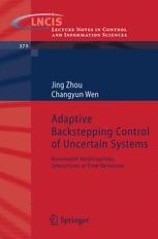
Adaptive Backstepping Control of Uncertain Systems : Nonsmooth Nonlinearities, Interactions or Time-Variations
This book employs the powerful and popular adaptive backstepping control technology to design controllers for dynamic uncertain systems with non-smooth nonlinearities.
